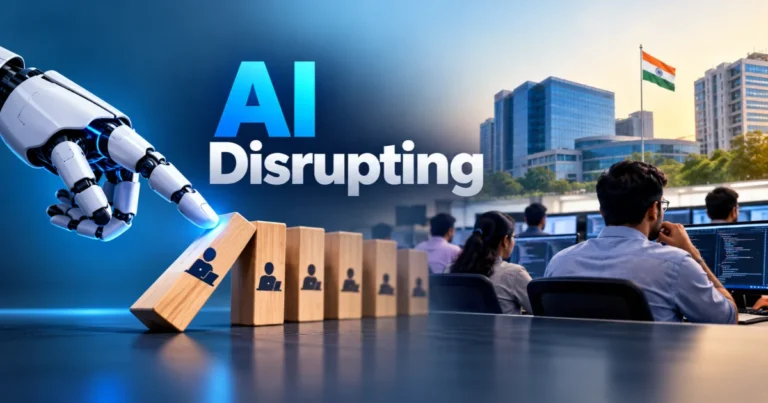

It promises to get worse before getting better. Boardroom conversations across Bengaluru, Hyderabad, and Pune reveal palpable anxiety today. Many leaders fear the rapid pace of Artificial Intelligence (AI) adoption.
They worry it will accelerate job cuts across the IT sector and ripple into the broader economy. Today, industry experts hotly debate the timeline for this disruption. Veteran predictions range anywhere from 12 to 36 months.
Yet, immense optimism runs alongside this panic. AI is more than just a grim reaper of code; it is a powerful catalyst for productivity. It promises to create high-paying, AI-centric roles.
Furthermore, it offers traditional IT service firms a golden opportunity to transform their core business models.
The stakes, however, remain mathematically daunting. Think tank NITI Aayog projects significant workforce shifts ahead. Tech sector jobs could drop from 8 million in 2023 to 6 million by 2031.
Customer experience roles face a similar decline, potentially falling to 1.8 million. Overall, automation threatens nearly 60 percent of formal sector jobs. To survive, Indian tech giants must aggressively invest in employee reskilling.
Tactical Restructuring of the Talent Pool
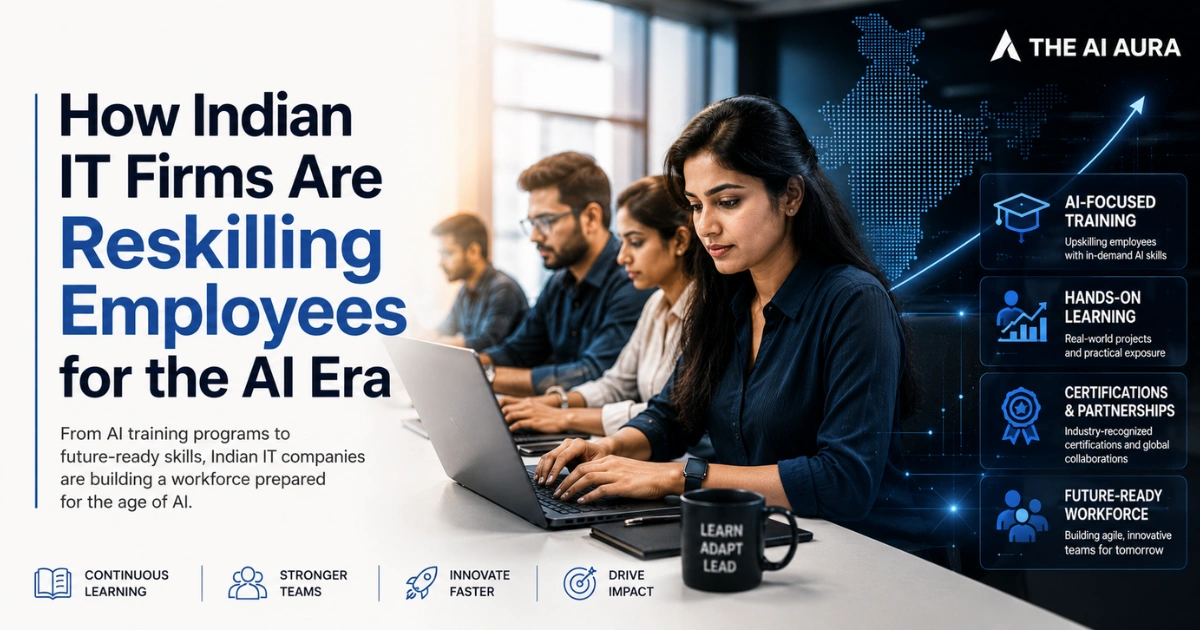
How are Indian IT giants pivoting their massive workforces toward an AI-first reality? Recent industry data shows a clear shift. Companies have abandoned generic weekend workshops in favor of rigorous, hyper-specialized certification pipelines.
IT firms understand that superficial training cannot counter a foundational tech shift. Today, companies partner directly with major hyperscalers like Microsoft, AWS, and Google.
Mid-level engineers face the highest risk of routine task automation. Therefore, tech giants now mandate high-tier certifications in cloud-native AI deployment, prompt engineering, and LLM fine-tuning.
This is no longer positioned as an optional career boost; it is tied directly to project deployment readiness and appraisal cycles. We are seeing the creation of internal “AI-first” academies where gamified, micro-learning modules are pushed to employees daily.
The operational goal is to transition a legacy Java or Python developer into someone who can leverage AI copilots to write that same code in a fraction of the time. The Indian IT worker is being pushed to evolve from a manual writer of syntax into an orchestrator of intelligent tools.
Shifting from Execution to Advisory
The second, and perhaps more challenging, phase of this reskilling effort has surprisingly little to do with learning new programming frameworks. If an AI application can write flawless code, debug a legacy system, or generate a testing script in seconds, the human edge shifts entirely toward context, empathy, and domain expertise.
IT firms now actively train engineers in consultative business skills. For example, retail banking developers must look beyond database maintenance.
They must understand banking workflows so they can advise clients on predictive AI churn models. Modern curricula heavily emphasize design thinking, complex problem-solving, and cross-domain expertise.
We are witnessing a structural shift where the offshore Indian engineer is expected to act more like a strategic partner. The reskilling modules now routinely include navigating data privacy laws, understanding AI ethics, and managing client expectations around algorithmic bias.
By wrapping technical AI proficiency with deep industry knowledge and critical thinking, Indian IT firms are attempting to build an impermeable moat around their workforce, ensuring that even as the bottom layer of execution gets automated, their human capital remains indispensable to global clients.
Source: Official Business Standard, "How to Embrace AI: Indian IT Firms Gear Up for the Reskilling Challenge"