
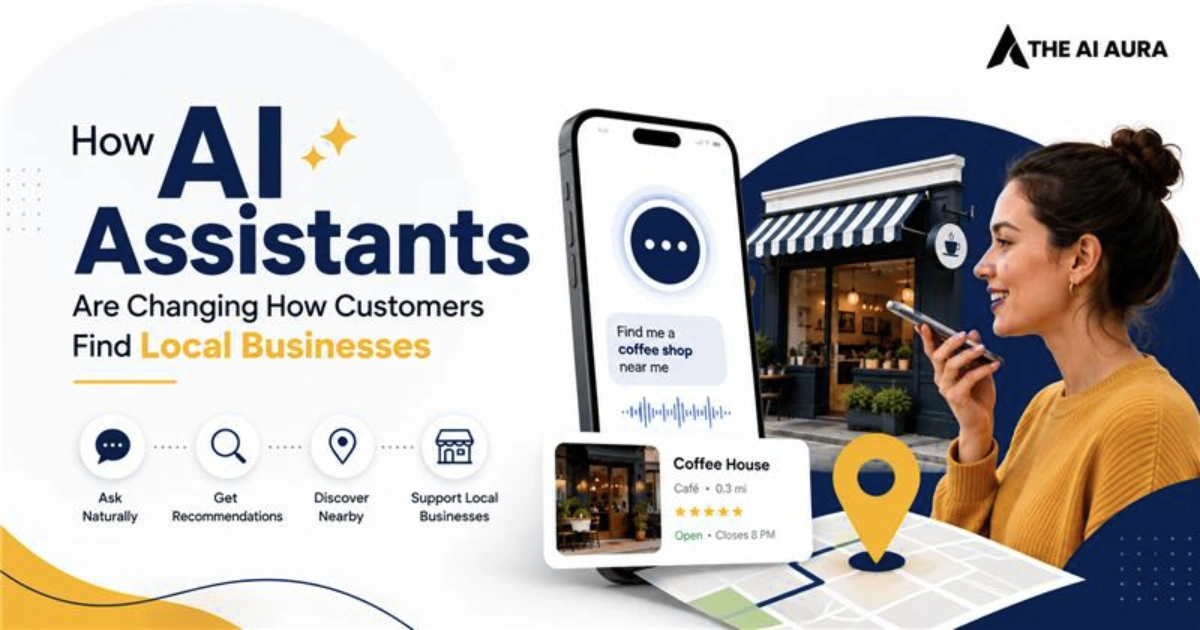

Local search has fundamentally fractured. For decades, the transaction between a prospective customer and a search engine was completely predictable. Users entered a search query and browsed the local map pack.
Then, they opened several browser tabs to evaluate each option manually. Today, AI assistants are actively intercepting that comparison phase.
People now ask AI engines for suggestions directly. They might want a quiet dining spot or a reputable local attorney. The engine skips the traditional blue links entirely. Instead, it processes the request and delivers a highly curated shortlist. The system pre-vets and selects these options in advance.
Traditional page ranking no longer measures success solely. You must secure a spot within a synthesized, localized answer instead. This shift requires a complete recalibration. Local businesses must change how they approach their digital presence.
The Anatomy of an AI Local Recommendation
To understand how to surface in these new environments, you have to understand the mechanics behind the output. Google’s generative AI heavily relies on a process called Retrieval-Augmented Generation (RAG).
RAG bridges standard search indexes with generative models. It extracts key web pages to construct real-time conversational responses.
The model leverages “query fan-out” to aggregate comprehensive context. This technique executes several related sub-queries in parallel behind the scenes. It completes this background work before formulating an output.
The reality of this technology is highly restrictive. Industry testing reveals a stark limitation. AI engines usually whittle down choices to a concise list.
They feature just three to five businesses per query. Local visibility used to rely entirely on directory listings and a decent review profile. Today, those basic signals are merely the entry fee.
If an assistant cannot find explicitly clear, crawlable information about your business, it will simply skip you.
Google’s AI often pulls multiple sources with conflicting data. It rarely guesses when operating hours or specific services mismatch. Instead, it moves on to a competitor with a clearer digital footprint.
Modern algorithms do more than crawl your primary website. They evaluate overall review sentiment and niche directory listings. They also check third-party roundups. This helps them synthesize an accurate profile of your reputation.
Adapting Your Digital Footprint for AI Systems
Tracking your success in this new landscape is frustratingly opaque. Google Search Console is gradually rolling out a Generative AI performance report. However, this tool only provides basic impression data.
It does not reveal the specific queries that triggered your appearance. Furthermore, it ignores recommendations inside ChatGPT, Perplexity, or Claude.
Because granular analytics are currently missing, local businesses must rely on foundational, defensive optimization.
The most critical step involves giving the assistant something literal to quote. Publish your core business details in absolute plain text. Include your operating hours, service capabilities, and geographic boundaries. Google notes that complex JavaScript frameworks can complicate rendering.
Do not hide your contact number within graphic banners. Avoid burying key service offerings behind multi-step interactive menus. These actions prevent search bots from properly indexing your core details.
Beyond basic recommendations, we are rapidly approaching an era of AI booking agents.
These are systems designed to execute tasks, like making a reservation or comparing local quotes, without human intervention. Automated browser agents do not view visual layouts.
They navigate the Document Object Model (DOM) instead. They also parse accessibility structures designed for assistive tech. An unlabeled button or an improperly tagged form field will cause an automated agent to fail.
Future-proofing your local visibility demands a clean, structurally accessible site. Machines must parse and act upon your platform effortlessly.
Source: Official Search Engine Journal, "AI Assistants Are Choosing Local Businesses For Your Customers"