
When you give away a $200 premium software subscription to 360 million telecom users in a price-sensitive market, adoption spikes immediately. However, the real test comes twelve months later when the free promotion ends.
This scenario is now playing out with Perplexity in India. Back in July 2025, the AI search startup partnered with Airtel, India’s second-largest telecom operator. They offered a free one-year subscription to Perplexity Pro. The offer closed in January 2026. Now, the earliest cohort of users is reaching their renewal dates.
For industry observers, this is more than just an app metric. It is a live stress test of Silicon Valley’s strategy. Can tech giants force-feed premium AI habits into emerging markets and build a paying user base?
The Anatomy of a Hyper-Growth Experiment
If the goal was sheer scale, the Airtel partnership was a masterclass in brute-force acquisition. Before the promotion launched, Perplexity was quietly averaging around 11,200 daily downloads in India.
Within a week of the Airtel deal going live, that number violently spiked to nearly 223,000 daily downloads.
Over the seven-month period the offer was available, the app pulled in an estimated 56 million downloads nine times higher than its previous run rate.
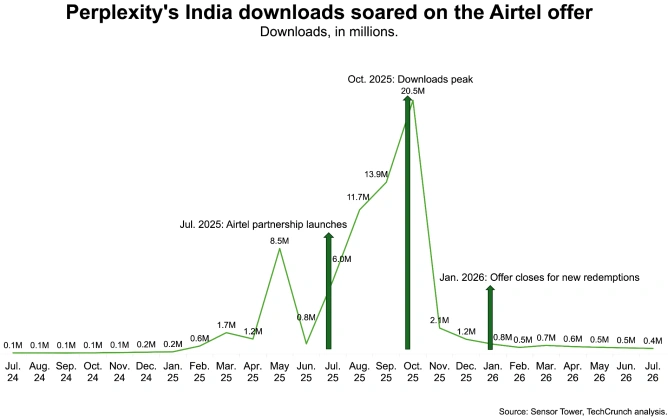
Naturally, when the acquisition funnel shut in January 2026, downloads cratered by over 90%. But user retention tells a different, far more interesting story.
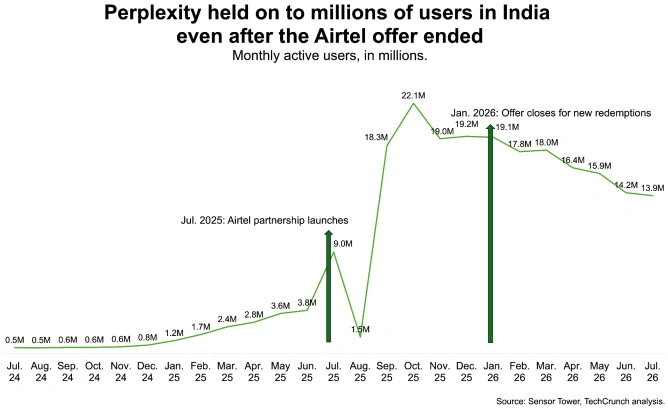
Active usage didn’t fall off a cliff. Monthly active users peaked at a staggering 22 million in October 2025. By July 2026, even without the aggressive top-of-funnel marketing, Perplexity was still holding onto roughly 14 million monthly active users.
That is a massive operational baseline, representing a fivefold increase from their pre-promotion metrics. The data clearly shows that Indian consumers didn’t just download the app for the novelty; millions integrated the AI tool into their daily routines and stuck around long after the promotional hype faded.
The Revenue Reality: Accidental Subs or Genuine Loyalty?
The most surprising metric to emerge from this experiment is the revenue line. Common sense dictates that when a free promotion ends, you brace for churn. Instead, Perplexity is making more money.
According to market intelligence data, Perplexity’s in-app purchase and subscription revenue in India actually climbed 60% between February and mid-August of 2026, directly countering the massive drop in new downloads.
In July 2026 alone, mobile net revenue in the country hit $156,000. Daily revenue between mid-July and August jumped 27% compared to the first half of the year.
This is where the analysis requires a healthy dose of skepticism. Because the Airtel deal was structured with an auto-renewal mechanism, users who failed to manually cancel their subscription before the 12-month mark were automatically billed.
It is highly probable that a significant chunk of this revenue spike is driven by “sleeper” subscriber’s people who simply forgot to opt out, rather than users deliberately reaching for their wallets to retain premium features.
Even so, the strategy has validated India as a crucial testing ground for generative AI monetization
The playbook is already being copied across the industry; OpenAI recently rolled out a free year of ChatGPT Go in India, and Google partnered with Reliance Jio to subsidize its own AI Pro tier.
Perplexity was simply the first to step into the deep end. Over the coming months, as more of its 56 million promo users face their billing dates, the market will finally see exactly how much a premium AI habit is really worth.
Source: Official TechCrunch, "Perplexity’s Free AI Offer Left It With Millions More Users in India"