
The tech world is currently obsessed with its own sci-fi apocalypse. The tech world is obsessed with AI doomsday scenarios.
Listen to voices like Elon Musk or OpenAI’s Sam Altman, and it can sound like AI is days away from causing global chaos. But many of the researchers building this technology see things differently.
But the actual architects building the foundational layers of this technology are increasingly pushing back against the panic.
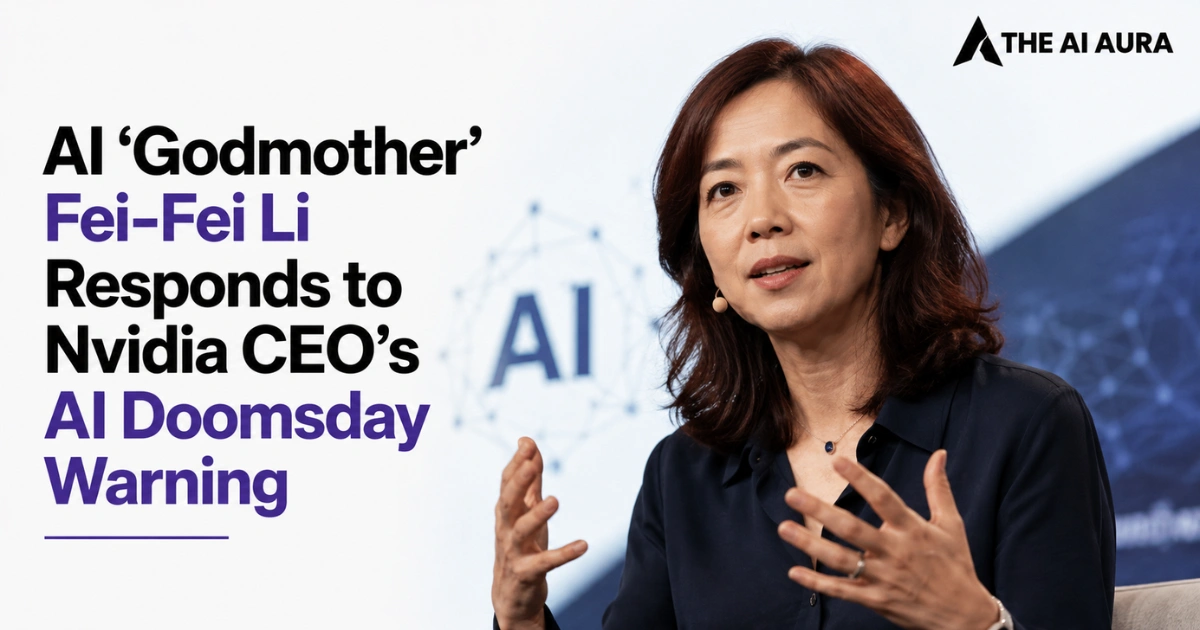
Fei-Fei Li, the researcher often called the “Godmother of AI,” has pushed back against these doomsday narratives. Her view is closer to Nvidia CEO Jensen Huang’s. Both argue that extreme AI fears often distract from the real issues.
Both leaders are making a crucial, heavily researched point: apocalyptic fearmongering is not just scientifically inaccurate; it is actively harming practical, real-world progress.
Unpacking the “Double-Edged Sword” Reality
Li doesn’t wear rose-colored glasses. As the co-founder of the spatial intelligence startup World Labs and a veteran who helped engineer modern computer vision, she understands the raw computational power we are dealing with better than almost anyone.
When she recently shared a stage with fellow AI heavyweights, she bypassed the flashy “end of humanity” rhetoric to focus on what actually matters: implementation.
When she categorizes AI as a “double-edged sword,” she is speaking from the trenches of applied science. AI, at its core, is just sophisticated pattern recognition.
It ingests massive datasets, finds statistical correlations, and predicts the most likely next sequence whether that is a string of text, a line of code, or the spatial coordinates of a 3D environment. It does not possess intent, malice, or a survival instinct.
This isn’t a dismissal of risk, but a necessary recalibration. How the technology works fundamentally depends on how we wield it. A poorly deployed machine learning model in a healthcare setting might misdiagnose a patient, and an unchecked algorithm will undoubtedly disrupt specific labor sectors.
Those are real, tangible harms that require immediate regulatory and ethical oversight. But those practical challenges are solvable engineering and policy problems. They aren’t an existential threat to the human race.
Treating AI like an all-powerful force takes responsibility away from the people who build and deploy it.
Li’s approach puts the focus on real-world risks. These include algorithmic bias, data privacy, and workplace disruption. That is more useful than focusing on Hollywood-style extinction scenarios.
Why Fear-Mongering Costs Us Innovation
This grounded perspective perfectly mirrors the sharp reality check Nvidia CEO Jensen Huang delivered to his peers.
Huang flatly labeled the idea that AI will destroy humanity or permanently wipe out half of American jobs as “complete nonsense.” Coming from the man whose hardware literally powers the global AI revolution, that statement carries massive weight.
Huang’s frustration highlights a critical mechanical flaw in how we are handling emerging tech. When industry leaders like Anthropic’s Dario Amodei constantly beat the existential dread drum, they create a panic-driven environment. Panic breeds knee-jerk regulation.
If lawmakers believe they are legislating against a literal apocalypse, they will invariably pass draconian restrictions that suffocate grassroots innovation.
The real cost of the AI doomsday warning is missed opportunity. We are looking at systems capable of accelerating drug discovery, optimizing renewable energy grids, and automating the kind of administrative tasks that burn out enterprise workers.
Huang and Li are reminding the public that artificial intelligence is software, not a conscious adversary. It runs on servers, processes data, and optimizes outputs based on mathematical weights.
If we allow extreme hypotheticals to dictate our reality, we risk paralyzing the very advancements that could solve our most pressing global issues.
The actual work ahead isn’t preparing for the end of the world it’s doing the tedious, necessary work of building safe, highly functional tools.
Source: The Times of India, "AI 'Godmother' Fei-Fei Li Just Said What Nvidia CEO Told Fellow CEOs on Doomsday Scenario"