
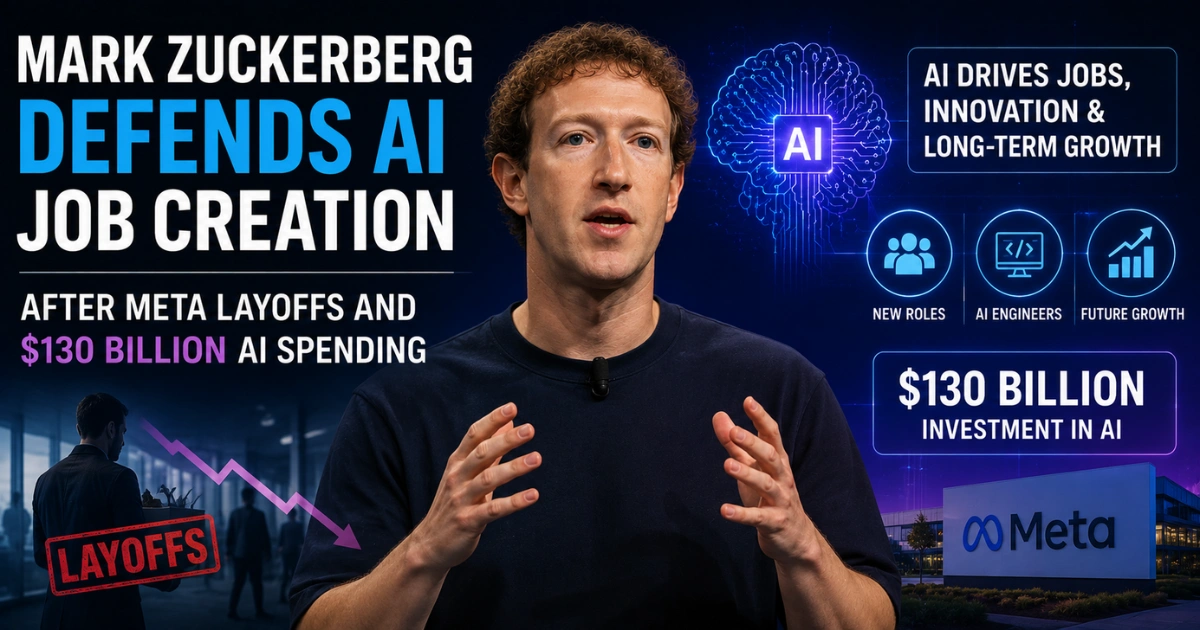

Mark Zuckerberg is pushing a surprisingly optimistic view of artificial intelligence and employment. Just hours before Meta’s latest earnings call, he spoke with the Wall Street Journal. He made a bold claim: AI is a massive net job creator.
According to the Meta chief, generative AI requires enormous infrastructure. Because of this, the mass-unemployment scenarios predicted by some critics have not materialized.
It is a fascinating perspective. It comes from a CEO who recently spent much of the year overseeing major workforce changes.
Let’s look at the numbers.
In May, Meta cut 8,000 employees. That represented roughly 10% of the company’s workforce. The move was part of a clear shift toward artificial intelligence.
Another 7,000 workers were forcibly reassigned. So, when Zuckerberg talks about job creation, we need to look at both sides of the equation. Who is getting hired? And who is losing their jobs?
The Blue-Collar Shift: Where the AI Jobs Actually Live
The jobs Zuckerberg is pointing to aren’t software engineering roles in Menlo Park. They are on active construction sites. His defense relies entirely on the physical, concrete reality of the AI boom.
Meta is currently operating or actively building 32 massive data centers around the globe. They are pushing to double their computing capacity to 7 gigawatts this year, targeting a staggering 14 gigawatts by 2027.
You do not build that kind of power grid with coders. Facilities of this magnitude require heavy machinery operators, electricians, structural engineers, and advanced cooling specialists. Those jobs exist strictly because AI has an insatiable appetite for compute.
Inside Meta’s own walls, however, the transition feels less like an economic boom and more like an eviction. The recent layoffs were handled with clinical detachment predawn emails waking up staff across global time zones, abruptly locking them out of corporate systems.
Morale took a massive hit, compounded by internal mandates forcing staff onto new Applied AI teams without the option to decline.
Add in the highly controversial deployment of keystroke and screen-tracking software on corporate laptops to train Meta’s own models, and the reality of the AI pivot looks incredibly grim for the tech workers caught in the crossfire.
A $130 Billion Gamble with Wall Street’s Money
This aggressive restructuring is not cheap, and Wall Street is starting to sweat. Meta is on track to burn through a staggering $130 billion to $145 billion on AI infrastructure in 2026 alone, roughly doubling its previous outlay.
Investors are getting deeply anxious about what this capital is actually buying. While Meta’s second-quarter revenue looked phenomenal climbing 28 percent to $60.8 billion its free cash flow utterly collapsed, plummeting 91 percent down to a multi-year low of $784 million.
When analysts pushed back, Zuckerberg vehemently defended the capital expenditure. The compute power itself is becoming the commodity. Meta is already fielding lucrative offers to lease out this capacity at a premium, even reportedly holding talks with rivals like Anthropic.
Yet Zuckerberg insists it would be a strategic failure to cash out for short-term profit. He is personally betting the house on developing proprietary AI agents, demanding long-term patience from his shareholders.
Ultimately, Zuckerberg’s arithmetic is factually accurate but intentionally evasive. Artificial intelligence is generating work. The massive concrete pours and gigawatt substations are undeniably real.
But his sunny outlook conveniently ignores exactly who is funding this transition: the 8,000 displaced tech workers whose salaries were sacrificed to buy the servers.
Source: The Times of India, "Mark Zuckerberg Lays Off 8,000, Spends $130 Billion on AI, Then Says AI Has Created a Lot of Jobs"