
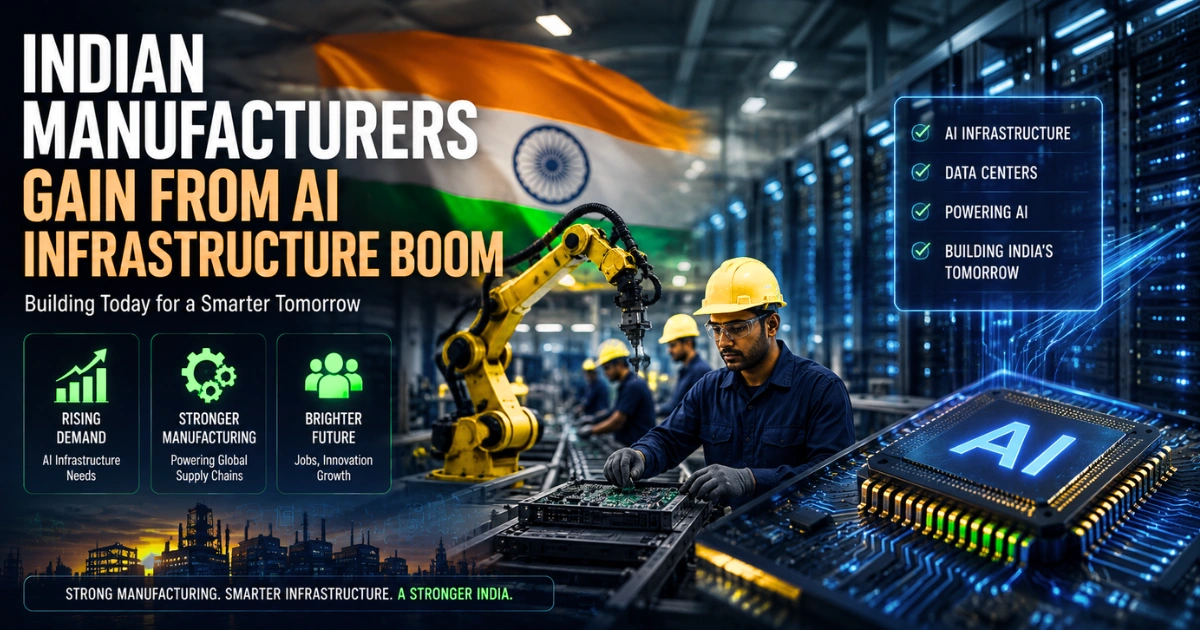

The global race for artificial intelligence dominance is largely framed around who possesses the most advanced semiconductors and the most sophisticated foundational models.
Yet, beneath the high-profile battles over silicon capabilities and algorithmic supremacy, a different economic reality is unfolding. India, despite lagging in proprietary chip manufacturing and advanced generative AI models, is capturing massive value from the physical backbone of the AI revolution.
Industrial enterprises across the subcontinent are experiencing windfall gains by supplying the essential, unglamorous hardware required to keep hyper-scale data centers operational.
This dynamic mirrors the classic “picks and shovels” trade of the 19th-century gold rushes. While software giants and chip designers shoulder the extreme risk and immense capital expenditure required to train next-generation models, Indian manufacturers are quietly securing guaranteed revenue streams.
Every new data center, regardless of which company’s silicon sits inside the server racks, demands an exhaustive list of supporting infrastructure.
The market requires miles of hair-thin fiber-optic cabling, heavy-duty switchgear, specialized transformers, robust grid connectivity hardware, and industrial-scale cooling solutions.
Indian firms have already entrenched themselves within this specific supply chain, turning domestic production lines into critical nodes for the global AI buildout.
The demand profile has shifted so drastically that factories previously accustomed to incremental capacity upgrades over three to five years are now operating continuously to meet both offshore and domestic orders.
The “Picks and Shovels” Strategy of AI
The pivot from traditional telecommunications supply to AI-centric infrastructure has restructured the order books for several legacy manufacturers.
Companies historically dependent on routine domestic telecom upgrades are now securing billion-dollar, multi-year contracts directly from US-based hyper-scalers.
Fiber-optic manufacturers are scaling production of high-density cables necessary to manage the extreme bandwidth requirements connecting massive server clusters.
Telecom equipment makers are reporting record-breaking quarters, with revenue figures directly correlated to the rapid expansion of global data networks.
Beyond cabling, power management has become a severe chokepoint for AI facilities.
Training large language models is exceptionally energy-intensive, forcing data center operators to source highly specialized electrical equipment. Indian engineering firms producing switchgears, transformers, and power units for fuel-cell systems are seeing their equity valuations surge as a result.
The sheer volume of electricity required by these facilities means that uninterrupted power supply hardware is no longer a localized commodity but a global necessity.
Manufacturers providing closed-loop water cooling technologies are also securing premium contracts.
These cooling systems are vital for maintaining operational efficiency without depleting local resources, a critical factor considering the growing environmental scrutiny facing data center operators globally.
Capital Inflows and Greenfield Expansion
The macro environment heavily favors this sustained industrial expansion. India currently generates and hosts nearly a fifth of the world’s data, yet it commands less than five percent of global data center capacity.
This extreme asymmetry guarantees a long-term domestic runway for infrastructure development, acting as a hedge against any potential softening in international demand.
Global hyper-scalers have committed tens of billions of dollars toward new Indian capacity over the past twelve months, moving aggressively to capture digital real estate.
Concurrently, domestic conglomerates are deploying equivalent sums into greenfield digital infrastructure projects, ensuring a steady pipeline of capital expenditure that flows directly to local manufacturers.
Unlike the regulatory gridlock and community opposition stalling energy-guzzling data center construction in parts of the United States and Europe, the development environment in India remains highly permissive.
Zoning approvals and grid connection requests for gigawatt-scale facilities are advancing rapidly. This regulatory ease allows capital to be deployed at an accelerated rate, translating into immediate demand for physical materials.
For the manufacturers supplying this ecosystem, the necessity of scaling up operations is immediate.
The transition requires significant capital outlays to upgrade manufacturing capacity, but the sheer visibility of future earnings provides the necessary confidence.
The physical infrastructure of artificial intelligence is proving to be just as lucrative as the code itself, cementing India’s role in the global supply chain.
Source: The Economic Times, "No Chips, No Models, No Problem: Indian Manufacturers Strike Gold in AI's Infrastructure Gold Rush"