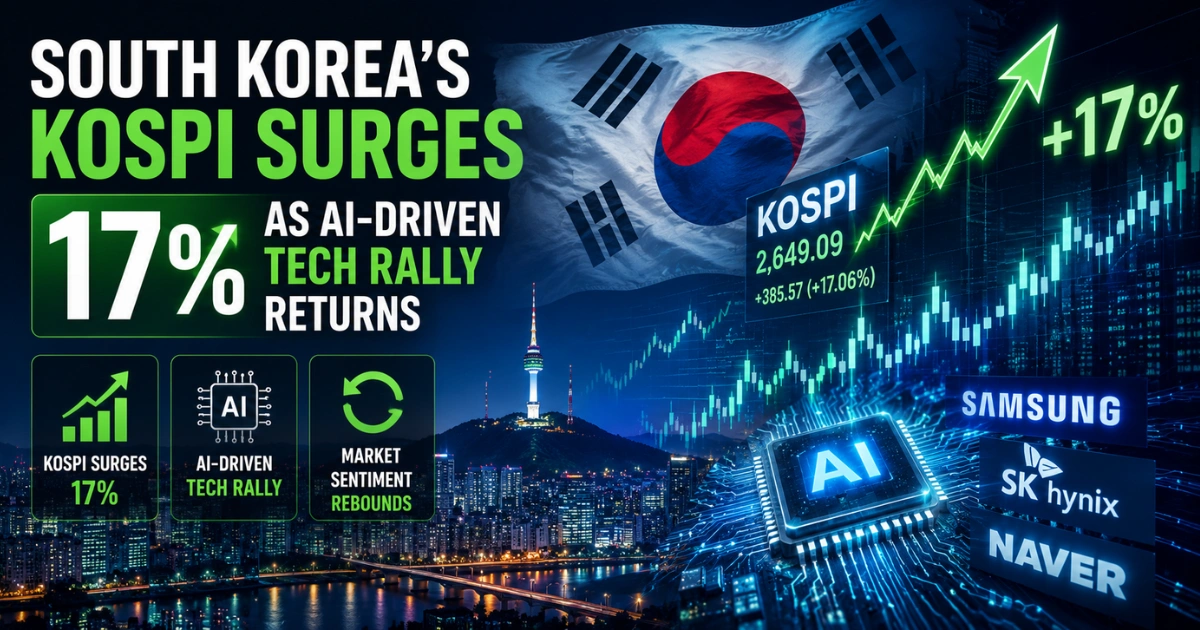

Financial markets rarely deliver whiplash quite like the recent price action in Seoul. After a sharp three-day selloff, South Korea’s Kospi surged 17% as the AI-driven technology rally returned.
On July 31, 2026, the benchmark index jumped more than 1,000 points and closed near the 6,600 level. The rally erased much of the losses from the previous sessions and added hundreds of trillions of won to the market’s value in a single day.
The reversal came after growing concerns about an AI bubble and stronger competition from Chinese memory-chip makers triggered heavy selling. Retail investors and leveraged funds were also caught in the downturn.
The mood changed quickly as strong earnings from major US technology companies encouraged investors to buy the dip. The rebound showed that global funds still see Korean semiconductor companies as key beneficiaries of the AI infrastructure boom.
Foreign Capital Inflow and Semiconductor Dominance
The internal mechanics of this historic recovery were dominated by an absolute avalanche of overseas capital.
Foreign investors orchestrated a record-breaking net purchase of over 7.5 trillion won ($5.3 billion) in KOSPI shares, easily overpowering the massive profit-taking and portfolio rebalancing from domestic retail and institutional participants.
Instead of broad-based, index-wide accumulation, this offshore capital deployment was highly surgical, targeting the foundational pillars of the global technology infrastructure.
Memory chip titans Samsung Electronics and SK Hynix served as the primary conduits for this sudden burst of liquidity, with both megacap equities recording intraday spikes exceeding 20%. SK Hynix alone absorbed more than 3.6 trillion won in foreign purchasing power within a few hours.
International asset managers recognized that while the short-term price action had deteriorated, the fundamental supply-demand dynamics for high-bandwidth memory (HBM) and conventional DRAM remained entirely intact.
By aggressively accumulating shares of these semiconductor behemoths, institutional capital reaffirmed Seoul’s status as a critical proxy for global technology expansion.
This aggressive capital rotation illustrates a deep-seated conviction that the hardware constraints dictating the pace of data center construction will continue to generate immense pricing power for the few companies capable of manufacturing advanced computing components.
Wall Street Earnings Reignite the Supercycle
While the physical execution of these massive block trades happened during Asian market hours, the direct catalyst for this monumental resurgence originated on Wall Street.
The recent bout of skepticism regarding capital expenditure returns on generative AI vanished the moment global cloud computing giants, notably Microsoft and Amazon, released their quarterly financial disclosures.
Their unwavering commitment to spending tens of billions on next-generation computing infrastructure provided the exact counter-narrative required to stabilize jittery international markets.
These earnings reports unequivocally confirmed that the hyperscaler investment cycle remains in a rapid acceleration phase rather than approaching near-term saturation.
Consequently, the direct correlation between the tech-heavy Nasdaq and the Kospi intensified, as Korean equities essentially traded as a derivative of American infrastructure ambitions.
The realization that heavy capex deployments will directly translate into sustained, multi-year order flow for advanced packaging, fabrication equipment, and precision electronic materials electrified the entire Korean supply chain.
Rather than abandoning the tech sector at the first sign of macroeconomic stress, market participants aggressively repriced the region’s growth trajectory, proving that the overarching enthusiasm for artificial intelligence retains more than enough fundamental momentum to override transient market corrections.
Source: Official Moneycontrol, "South Korea's Kospi Surges Record 17% as AI-Driven Tech Rally Returns"