

I’ve spent years analyzing fintech platforms. One problem keeps appearing: personal budgeting is still far more complicated than it should be. For most of us, digital payments have remained a strictly transactional affair.
You open an app, scan a merchant code, enter a PIN, and put your phone away. Tracking where that money goes isn’t as simple. Many people export bank statements, rely on budgeting apps, or maintain spreadsheets to stay organized.
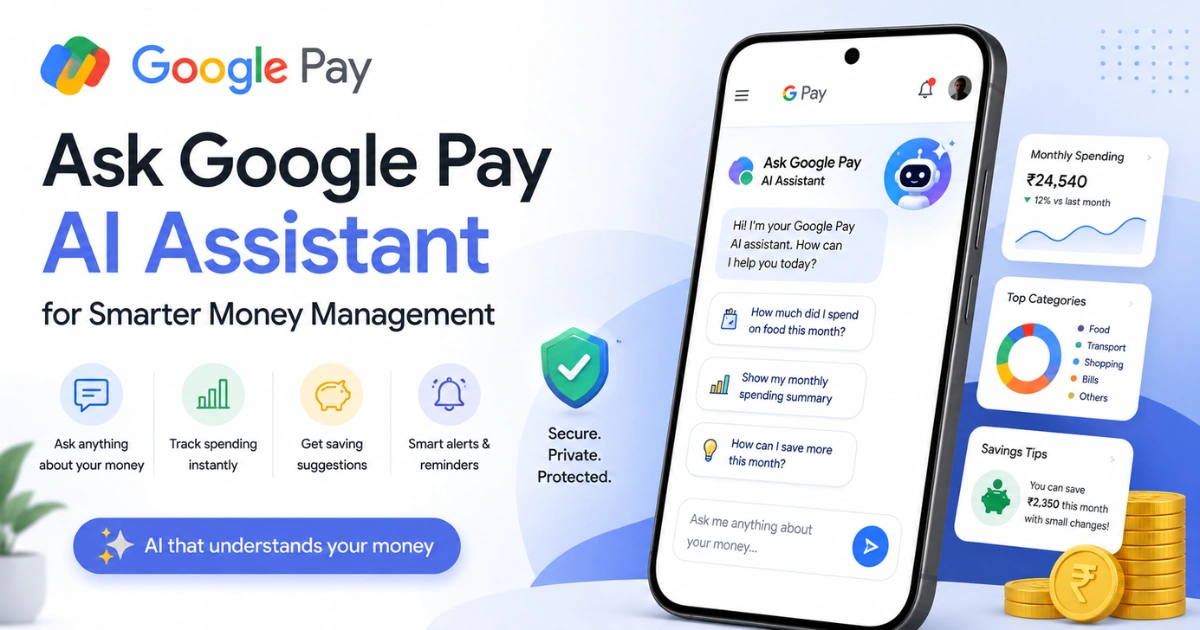
Google is now attempting to eliminate that friction entirely with the rollout of “Ask Google Pay.” Powered by their proprietary Gemini AI model, this new feature is far more than a generic customer service chatbot bolted onto a payment interface.
It is a highly contextual, personalized financial assistant built directly into the app you already use to spend money. It analyzes your transaction history using natural language processing. This moves Google Pay beyond money transfers and toward smarter financial management.
Unpacking the Mechanics of Ask Google Pay
The feature understands natural-language questions about your past transactions. It searches your financial history and returns relevant answers instantly.
Previously, finding out your monthly food delivery expenses meant endlessly scrolling through transaction logs and doing the mental math yourself.
Ask Google Pay changes the architecture of how we retrieve data. You can simply ask the assistant, “How much money did I spend on groceries last month?” or “Show me my recent transactions at fuel stations.”
Gemini does the heavy lifting instantly, aggregating those specific merchant transactions into a single, digestible figure.
But the mechanics go much deeper than simple addition. Because the Gemini model understands context and nuance, the assistant is engineered to generate proactive, personalized insights based on your unique footprint. It doesn’t just spit out numbers; it identifies trends.
If your discretionary spending spikes abnormally in a given week, the AI can flag this behavior. You converse with it just as you would a human advisor, without needing to memorize specific commands or rigid syntax.
Beyond tracking, Google has integrated a strong layer of educational utility. Users can ask the assistant to explain complex financial concepts right within the chat interface.
Whether you are trying to understand the nuances of compound interest or the difference between liquid funds and fixed deposits, the AI breaks it down in simple terms. This effectively democratizes financial literacy, making it accessible at the exact moment you are thinking about your money.
Proactive Financial Utility and Credit Expansion
What makes Ask Google Pay a serious disruptor is how it transitions the app from a passive ledger to an active participant in your financial health. Identifying spending leaks is only the first step.
The system is designed to suggest actionable ways to save money, tailored specifically to the spending patterns it identifies. It might point out recurring subscriptions you are paying for but barely using or suggest optimizing your spending categories. It acts like a wealth manager living directly in your pocket.
This push toward deeper financial utility is heavily supported by Google’s concurrent expansion of its Flex credit program.
By officially partnering with SBI Card, Google isn’t just showing you where your money goes; they are actively expanding how you access and manage credit. The Flex program allows eligible users to tap into pre-approved credit lines seamlessly within the app.
When you combine friction-free credit access with a Gemini-powered assistant capable of advising you on repayment structures, the entire financial lifecycle is handled under one roof.
You aren’t just borrowing money; you have an AI companion capable of explaining the exact interest implications of a transaction before you make it. It is a serious maturation of the Google Pay ecosystem, proving that the future of fintech isn’t just about moving money faster, but managing it smarter.
Source: Moneycontrol, "Google Launches Ask Google Pay AI Assistant to Help Users Track Spending and Save Money"