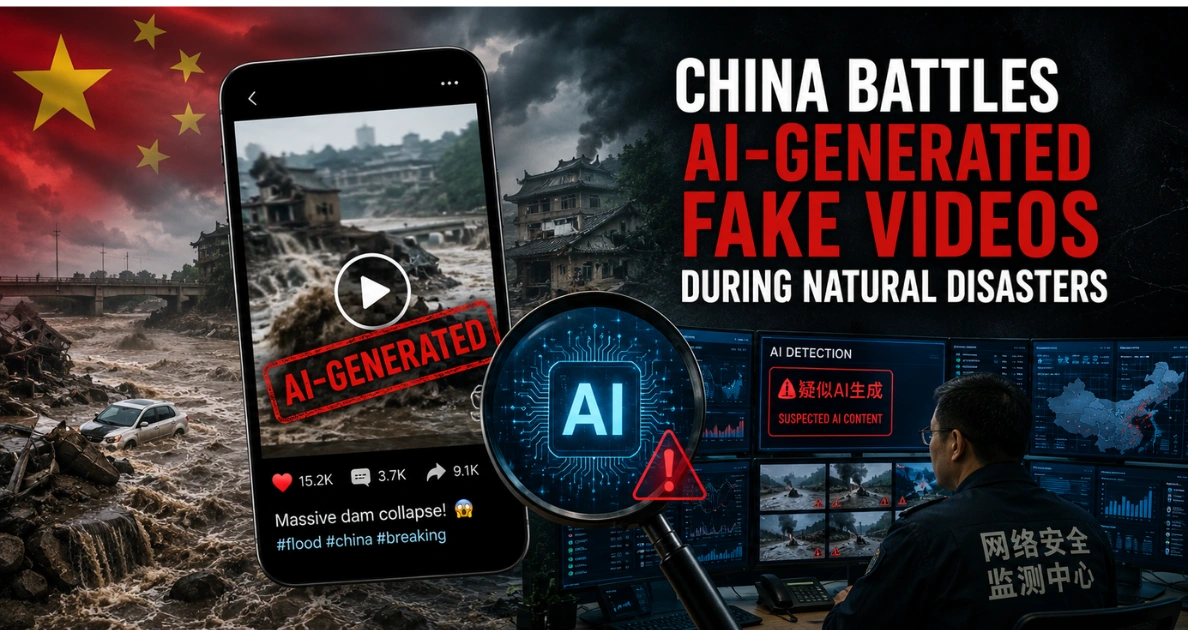

As Typhoon Noul battered the coast, emergency responders managed mass evacuations and severe flooding. At the same time, authorities faced another challenge. Hyper-realistic AI-generated fake videos spread rapidly across social media and complicated emergency efforts.
Across Chinese social media, manipulated videos spread quickly. Some falsely showed widespread power outages, while others depicted fake crocodiles swimming through flooded streets.
As a result, the misinformation fueled panic and distracted emergency responders. Consequently, rescue operations became more difficult and public confusion increased.
The Anatomy of Crisis Misinformation
The barrier to entry for large-scale digital deception has effectively vanished. Prompt-based artificial intelligence tools have eliminated the need for technical expertise, allowing opportunists to mass-produce convincing, wholly fabricated media in a matter of seconds.
The driving force behind this digital storm is rarely ideological. Instead, it is fueled by raw, algorithmic greed. Bad actors understand that in the midst of an emergency, sensationalism sells.
By plastering timelines with grim imagery of non-existent casualties in floodwaters or absurd, highly shareable scenarios—like rescue workers allegedly prioritizing livestock over human victims—these creators hijack social media algorithms for clicks, followers, and ad revenue.
We are currently locked in an unwinnable cat-and-mouse game. While experts advocate for mandatory watermarking and strict geographic timestamp verification, detection technology inherently lags behind generation software. A required AI watermark can be easily scrubbed by the next user in the chain.
This leaves tech platforms and authorities playing a reactive game of whack-a-mole during critical hours when access to real-time, accurate information is a matter of survival.
Policing the Trust Vacuum
In response, China’s Cyberspace Administration has launched an aggressive nationwide crackdown targeting malicious editing and staged disaster scenes.
Public security bureaus have mobilized specialized task forces to monitor short-video platforms, warning that creators of panic-inducing fakes face severe penalties—ranging from steep fines to seven years in prison. Yet, heavy-handed enforcement only addresses a symptom of a much deeper vulnerability.
The rapid, uncritical spread of synthetic media is drastically accelerated by a pre-existing public trust deficit.
When official channels attempt to manage panic by downplaying the severity of a disaster—such as softening the language around a fatal breach at the Liulan Dam that ultimately killed 26 people—an information vacuum opens up.
Bad actors thrive in this exact void. When the public begins to doubt sanitized official reports, they become highly susceptible to sensationalized, AI-generated alternatives that seemingly confirm their worst fears.
Ultimately, holding individual creators accountable is insufficient. The legal framework must evolve to hold the platforms themselves responsible as the primary enablers and amplifiers of this content.
If a platform’s algorithm aggressively pushes a fake video that directly results in real-world injury or mass panic, the host must share the liability.
Managing this escalating threat requires more than just reactive policing; it demands a flawlessly verifiable information infrastructure and total transparency to rebuild public trust before the next storm makes landfall.
Source: BBC News, "China Battles AI-Generated Fake Videos During Natural Disasters"