
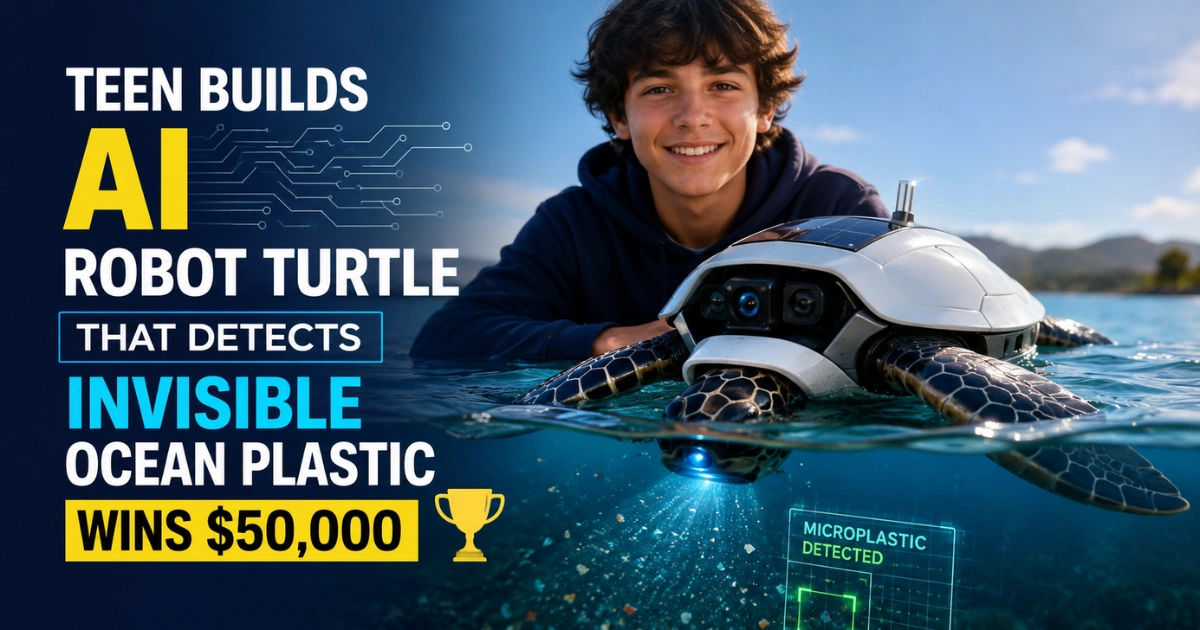

A 16-year-old student from Ontario has won the $50,000 Gordon E. Moore Award for creating an AI-powered robotic turtle that detects ocean microplastics.
The innovative system makes pollution monitoring faster and more affordable.
It detects tiny plastic particles more accurately than traditional laboratory methods, helping scientists monitor ocean pollution more effectively.
AI-Powered Robot Detects Tiny Plastic Particles
Named BURT (Bionic Underwater Robotic Turtle), the autonomous robot uses a 3D holographic imaging system and an AI model to identify microplastics as small as 10 microns.
The robot analyzes water directly in real time. Researchers no longer need to collect laboratory samples.
It gives researchers immediate results and helps them detect pollution directly in the water.
Nature-Inspired Design Improves Ocean Monitoring
BURT uses 3D-printed flippers inspired by sea turtles. It also features a variable ballast system and quiet propulsion to minimize disturbance to marine life.
Powered by rechargeable batteries and solar energy, the robot can operate for up to eight hours, making it suitable for long-term environmental monitoring.
A Scalable Solution for Marine Conservation
After nearly two years of testing, the AI system achieved an accuracy rate of around 94% in identifying microplastics.
Built with affordable, off-the-shelf components, the project demonstrates how AI and robotics could help researchers and environmental agencies monitor ocean pollution more efficiently and at a lower cost.
Source: The Times of India, "This 16-Year-Old Canadian Student Built an AI Robot Turtle That Hunts Plastic Invisible to the Eye, and Won $50,000 for It"