

Artificial intelligence is rapidly changing how software teams collaborate, but workplace communication hasn’t evolved at the same pace.
Developers often switch between Slack for conversations, GitHub for code reviews, and multiple AI assistants for coding, documentation, and automation. That constant context switching slows productivity and fragments workflows.
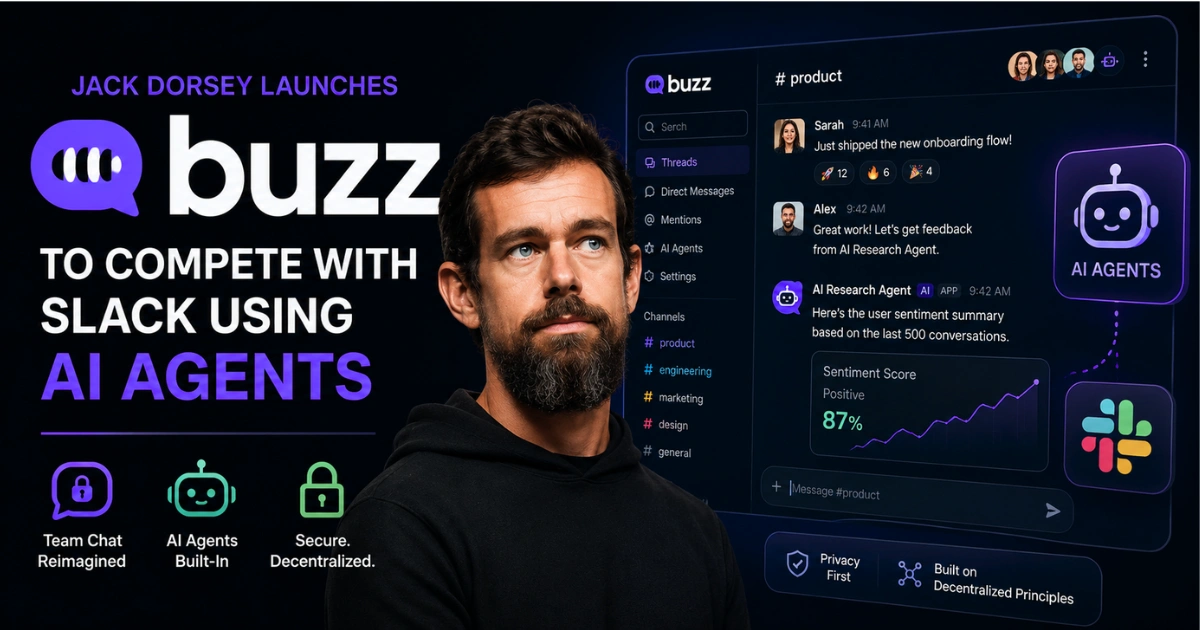
Jack Dorsey wants to change that. The Block co-founder has unveiled Buzz, a decentralized, open-source collaboration platform designed to bring human teams and AI agents into the same workspace.
Rather than treating AI as a separate chatbot or browser tab, Buzz makes AI agents active participants in team conversations, allowing them to collaborate alongside developers, designers, and project managers.
Still in its early stages, Buzz represents Dorsey’s vision for a more open and flexible alternative to traditional workplace communication platforms like Slack.
Bringing AI Agents Into Everyday Team Collaboration
Unlike conventional messaging platforms that rely on third-party AI integrations, Buzz is built around AI from the start.
According to Dorsey, the platform is model agnostic, decentralized, self-sovereign, and open source, giving organizations complete control over how they deploy and manage AI within their workflows.
Teams are not tied to a single AI provider and can integrate different language models depending on their needs.
From a user perspective, Buzz offers familiar channel-based communication similar to Slack. The major difference is that AI agents appear as first-class collaborators instead of simple chatbots.
For example, a software development team can discuss a feature request, review a GitHub pull request, assign an AI agent to write documentation or identify bugs, and continue the discussion all within the same workspace.
The AI becomes part of the conversation rather than an external tool that requires switching applications.
This unified workflow could significantly reduce the friction developers face when moving between messaging platforms, coding environments, and AI assistants throughout the workday.
The decentralized architecture also gives organizations greater ownership over their data. Companies can self-host Buzz, integrate their preferred AI models, and customize the platform without depending entirely on a single cloud vendor.
Open Source Could Be Buzz’s Biggest Advantage
Perhaps Buzz’s strongest selling point is its open-source foundation.
Unlike proprietary workplace software, developers can inspect the source code, build custom integrations, and adapt the platform to meet their own security and operational requirements.
That flexibility is particularly attractive to enterprises handling sensitive source code or confidential business data.
Organizations can deploy Buzz within their own infrastructure while maintaining full control over how AI agents access internal systems. This approach may appeal to businesses concerned about sending proprietary information to third-party cloud services.
Buzz also enters a market that is becoming increasingly competitive. Companies across the AI industry are exploring ways to integrate autonomous agents into existing workplace tools.
Some solutions focus on enhancing platforms like Slack with AI-powered assistants, while Buzz takes a different approach by rebuilding the collaboration experience around AI from the ground up.
Although the concept is promising, Buzz remains an early-stage product. It will need to prove that it can scale reliably, support enterprise-grade security, and attract a strong developer community before it can seriously challenge established collaboration platforms.
For now, the platform is available as a free desktop application for Windows, macOS, and Linux, while its complete source code has been published on GitHub for developers to explore and contribute.
As AI agents become a larger part of everyday work, collaboration software is likely to evolve beyond simple messaging.
Buzz reflects that shift by treating AI as a permanent member of the team rather than just another productivity feature, offering a glimpse of what the next generation of workplace collaboration could look like.
Source: TechCrunch, "Jack Dorsey Is Taking on Slack With Buzz, a Group Chat Platform for Teams and Their AI Agents"