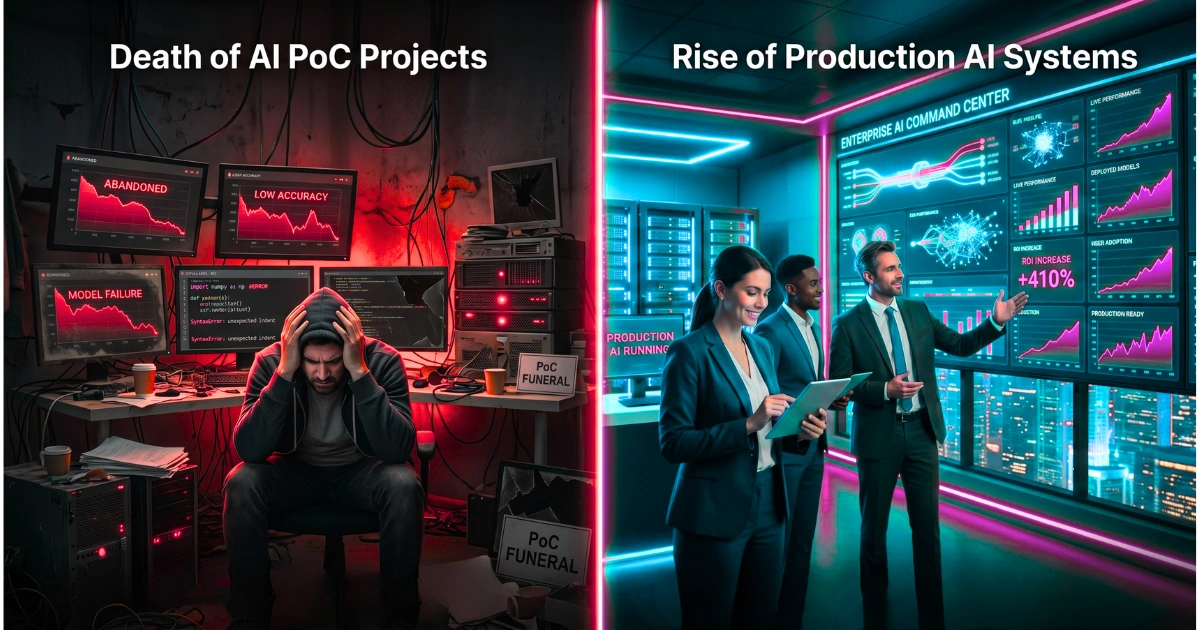

Enterprises are done funding your science projects.
For the last thirty-six months, organizations bought every wrapper, autonomous agent, and shiny API that promised an operational revolution. The result is a fractured, unmanageable ecosystem where nobody knows which underlying parameter weights are actually driving revenue.
CIOs are aggressively cutting bloated experimentation budgets to fund the only vendors that matter: those who can prove hard ROI.
Organizations are moving rapidly away from isolated point solutions toward unified systems that natively handle context window management without requiring custom middleware.
A brutal bifurcation is here.
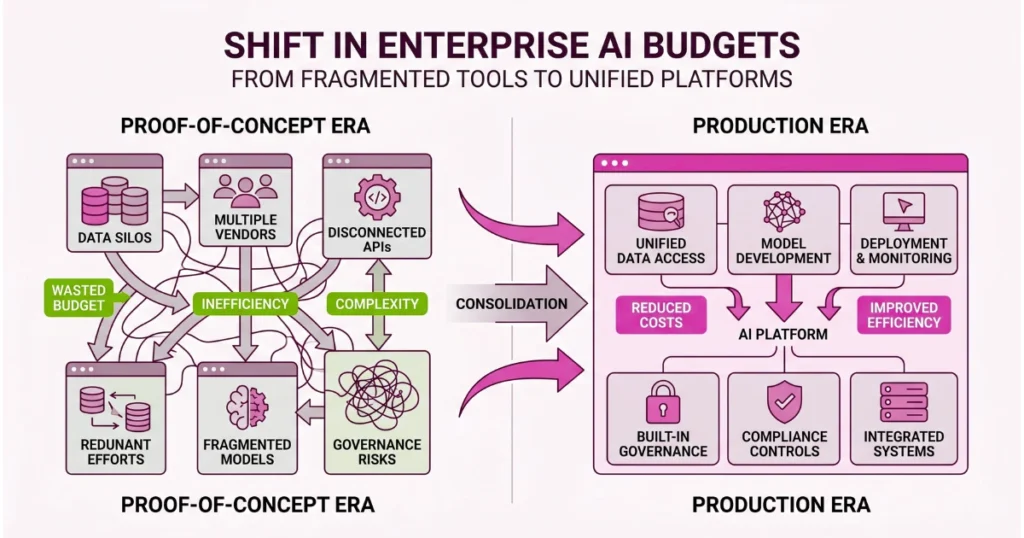
A handful of unified platforms will absorb the vast majority of enterprise spend, while the rest watch their renewal rates flatline.
The SaaS Sprawl Penalty
This consolidation is a desperate attempt to fix broken infrastructure.
Last quarter, we audited a mid-market fintech that realized they were paying three different vendors for the exact same semantic search capability. They were bleeding $18,000 a month in duplicated inference calls across overlapping LLM providers.
But the actual cost was the engineering hours. The integration layer completely collapsed because Vendor A’s embedding dimensions (1536) couldn’t map to Vendor B’s vector schema.
The operations team had to pay a premium data janitor tax, writing Python scripts at 2:00 AM to normalize conflicting JSON outputs just to keep the batch syncs from colliding.
They were paying a massive premium for API integration costs that vastly outstripped the core compute value of the actual models.
Tools that cannot immediately lower this integration overhead will not survive the procurement review.
Compliance as the Procurement Guillotine
The real money is moving strictly to the infrastructure that makes production safe.
Enterprises are refusing to scale deployments because their legal teams cannot audit the shadow IT created by a dozen disconnected prompt interfaces. Capital is flowing exclusively into the oversight layers.
This means robust role-based access controls, verifiable deterministic audit trails, and unified data governance models that restrict model outputs based on existing enterprise identity and access management policies.
If your stack requires duct tape and custom routing logic just to meet basic enterprise compliance, your 2026 budget is already defunded.