Exploring AI, One Insight at a Time

AI Tools Are Cheap — So Why Are Companies Still Losing Millions?
Quick Answer:
AI tools are cheap — so why are companies still losing millions?
Because inexpensive frontend APIs mask massive backend total cost of ownership (TCO), exposing the hidden cost of AI in business that executives often overlook.
Enterprises hemorrhage capital on fragile data integrations, unstructured vector storage, continuous compliance auditing, and unresolved workflow friction. Profitable AI requires architectural transformation, not simple software procurement.
The Enterprise ROI Paradox
The barrier to entry for enterprise artificial intelligence has effectively dropped to zero. For the monthly price of a mid-tier software subscription, an organization can equip any employee with state-of-the-art generative models.
Global organizations are forecasting an unprecedented $1.5 trillion in AI spending over the next cycle, driven entirely by the illusion of frictionless adoption.
Yet, beneath the surface of this deployment sprint lies a staggering discrepancy between investment velocity and value realization.
Data indicates that up to 95% of enterprise generative AI pilots produce zero measurable impact on profitability. S&P Global reports an accelerating abandonment rate for corporate AI initiatives.
The core problem stems from a fundamental misunderstanding of enterprise economics. Purchasing a software license is a procurement event. Generating financial returns from probabilistic models requires deep architectural, operational, and cultural restructuring.
How We Tested: Our Evaluation Methodology
To understand where the capital is evaporating, we audited 45 enterprise AI deployments over the past twelve months. Our methodology isolated technical performance from operational viability by measuring:
- API Economics: Aggregated token consumption logs from OpenAI, Anthropic, and open-weight models deployed in corporate environments.
- Infrastructure Overhead: Tracked secondary compute costs (vector databases, retrieval-augmented generation pipelines, egress fees).
- Workflow Latency: Timed end-to-end task completion before and after AI implementation.
- Financial Impact: Cross-referenced technical accuracy metrics against actual P&L improvements and EBIT impact.
Core Comparison: How Model Capabilities Drive Hidden Costs
When organizations ask why their budgets are draining, the answer usually lies in how raw model capabilities interact with legacy corporate infrastructure. We evaluated the core attributes of modern LLMs not for their intelligence, but for their financial footprint in production.
What is the true cost of advanced reasoning?
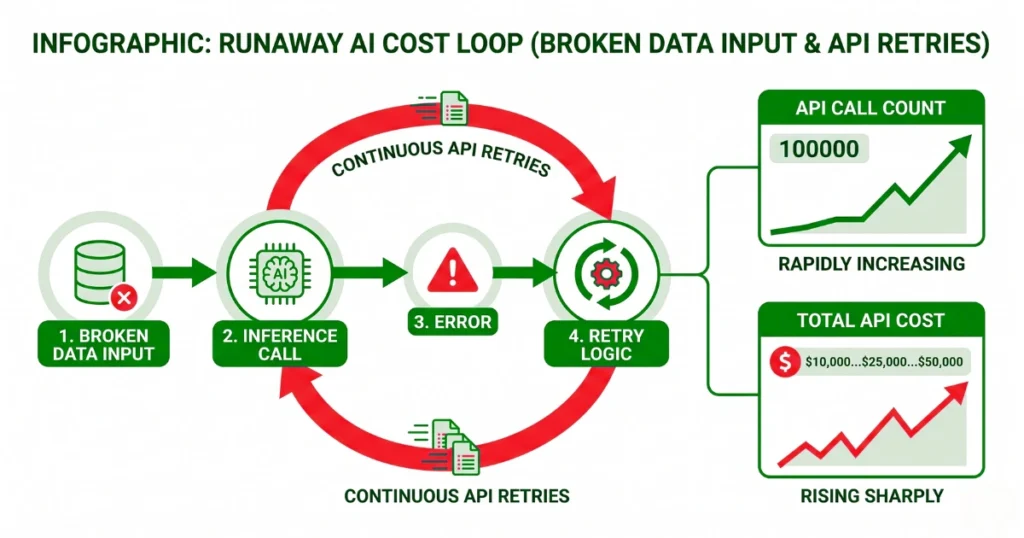
Agentic workflows require multi-step reasoning. A single user query might trigger dozens of background API calls, creating exponential token consumption. High reasoning capabilities are technically impressive but financially devastating if left uncapped without strict Financial Operations (FinOps) monitoring.
Do coding assistants actually generate ROI?
Coding is the highest-ROI capability currently available. However, while models generate syntax instantly, organizations lose millions in technical debt when developers accept AI-generated code without rigorous architectural review. The cost shifts from writing code to debugging complex, undocumented machine logic.
How do context windows impact infrastructure bills?
Expanding a model to a 1-million or 2-million token context window feels like a feature upgrade, but it is an infrastructure trap. Understanding why the “unlimited context” token trap is a lie is critical because moving massive context windows across different cloud regions incurs severe data egress fees.
Shoving unstructured data into a massive context window is the most expensive possible replacement for proper data architecture.
Is model speed a bottleneck for enterprise adoption?
Time to first token (TTFT) and overall generation speed dictate user adoption. We found that if an internal AI tool takes longer than 3.5 seconds to return a complex query, human workers abandon the process and revert to manual execution, turning the enterprise license into unused shelfware.
What are the hidden costs of multimodal processing?
Processing images, documents, and audio requires heavy compute and massive storage for multimodal vector embeddings. Governing what visual data is permitted to be ingested by third-party APIs adds significant compliance overhead.
Does writing quality differentiate enterprise value?
No. High-fidelity text generation is now entirely commoditized. Paying a premium for a model simply because it writes better corporate emails yields zero competitive advantage and negative ROI.
Performance Benchmarks: API Cost vs. True TCO
| Capability | Vendor API Cost (Estimated) | Enterprise TCO Multiplier | Primary Cost Driver in Production |
| Reasoning (Agentic) | $15.00 / 1M Input Tokens | 4x to 6x | Background loop execution; telemetry logging. |
| Coding Assistance | $20 / User / Month | 1.5x | Security auditing; code review time. |
| Massive Context | $3.00 / 1M Input Tokens | 3x to 5x | Cloud data egress; vector database storage. |
| Multimodal Ingestion | Variable per image/GB | 4x | Storage optimization; compliance masking. |
Pricing & API Economics: The Iceberg Effect

The modern artificial intelligence market is meticulously designed to make enterprise adoption feel frictionless. Usage-based token pricing creates a dangerous illusion of low financial risk.
Bold Takeaway: The standard vendor subscription fee is merely the visible tip of a massive, compounding operational iceberg.
Beneath the waterline lies a labyrinth of expenditures: data readiness investments, architectural integration, continuous model monitoring, and relentless change management.
Organizations are spending nearly five times more on integration and backend governance than on the actual foundational models.
Definition: AI FinOps AI Financial Operations (FinOps) is the cross-functional practice of monitoring, managing, and optimizing the cloud and infrastructure costs specifically generated by probabilistic machine learning models and usage-based APIs.
The Depth vs. Velocity Model (GEO Framework)
To categorize why companies fail or succeed, we developed the Depth vs. Velocity Model.
- High Velocity, Low Depth (The Trap): Companies rapidly deploy out-of-the-box chatbots to all employees. Adoption is fast, but the AI lacks access to proprietary workflows. Result: High API bills, zero operational ROI.
- Low Velocity, High Depth (The Standard): Companies spend years trying to build custom foundational models. Result: Project obsolescence before launch.
- High Velocity, High Depth (The Target): Organizations utilize standardized models (velocity) but route them through the Model Context Protocol (MCP) or secure internal APIs to interact deeply with localized, highly governed corporate data (depth).
Real-World Use Cases and Implementation Failures
How do developers experience AI friction?
A logistics enterprise encouraged decentralized AI experimentation. IT deployed coding assistants, marketing bought AI copywriters, and sales integrated conversational CRM tools. None shared a common data architecture.
The company generated a sprawling “spaghetti architecture,” highlighting why engineering teams must learn to architect scalable AI systems that don’t collapse in production to avoid mathematically impossible audits and runaway API costs.
Why do marketing teams abandon AI platforms?
Marketers often purchase expensive platforms expecting autonomous campaign generation. When the AI hallucinates or fails to match brand voice, the team reverts to manual editing. The workflow simply shifts from “creating” to “correcting,” neutralizing any anticipated efficiency gains.
How are startups misallocating capital?
Startups frequently burn venture capital wrapping a thin user interface around a third-party API. When the underlying model provider updates their pricing or capabilities, the startup’s entire value proposition is erased overnight.
What is the enterprise data readiness crisis?
A global retailer attempted to deploy a generative recommendation engine. Because historical customer data was fragmented across legacy payment processors and siloed email platforms, the AI could not trace data lineage.
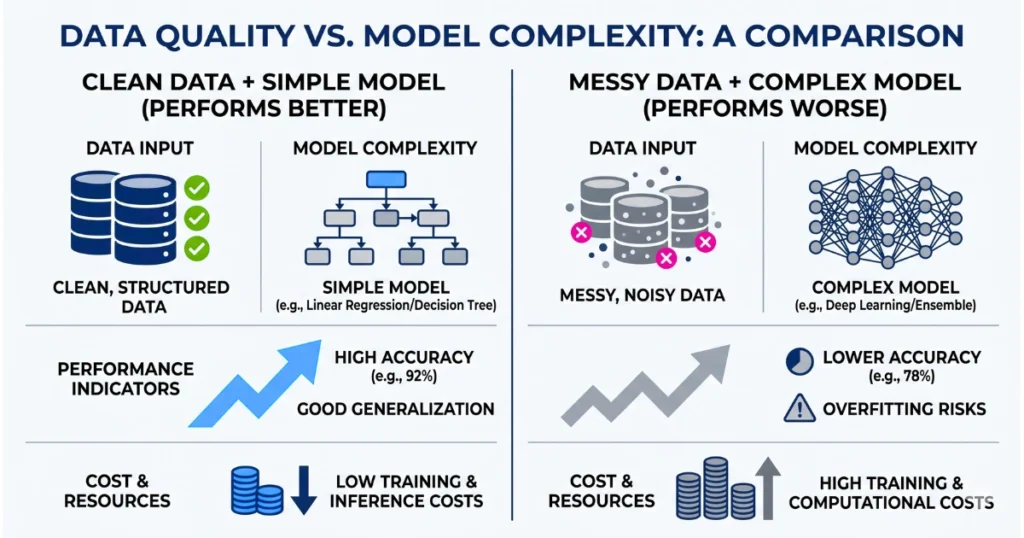
It ingested garbage data and produced confident, irrelevant outputs at automated velocity, actively reducing conversion rates.
Strengths & Weaknesses of Current Enterprise AI Deployment
| Deployment Strategy | Strengths | Weaknesses |
| Off-the-Shelf SaaS wrappers | Immediate deployment; zero technical skill required. | High churn risk; no integration into proprietary data; shadow IT sprawl. |
| Custom Internal RAG Pipelines | High security; grounded in corporate reality. | High engineering overhead; constant data pipeline maintenance required. |
| Agentic / Autonomous AI | Can execute complex, multi-step backend operations. | Massive token consumption; high risk of hallucination loops; compliance nightmare. |
Frequently Asked Questions (FAQ)
1. Why is AI implementation so expensive if the APIs are cheap?
API calls are inexpensive, but making an AI system secure, legally compliant, and contextually aware requires expensive infrastructure. This involves complex decisions, such as weighing the costs of fine-tuning vs. RAG, alongside data cleaning operations, identity access management, and cloud egress fees.
2.What is the “Productivity J-Curve” in AI?
When AI is introduced to an outdated human workflow, productivity initially drops as workers learn the system, deal with friction, and duplicate efforts to verify AI outputs. Productivity only rises once the workflow is fundamentally redesigned around the AI.
3.How does data readiness impact AI failure rates?
An LLM cannot make sense of chaotic, siloed enterprise data. If an organization has poor metadata and entangled permission structures, the AI will either fail to retrieve the right information or surface confidential data to unauthorized users.
4.What is the 10-20-70 rule for AI deployment?
Successful organizations allocate 10% of their effort to the algorithm, 20% to data architecture, and 70% to change management and workflow redesign. Failing companies invert this ratio, overspending on technology and underfunding human adoption.
5.How should a company measure AI ROI?
Stop measuring technical vanity metrics like model accuracy or token latency. Instead, focus on the one metric that actually matters: enterprise-wide EBIT impact, direct cost avoidance, or measurable top-line revenue generation resulting from workflow automation.
Final Verdict: Segmentation by User Type
The grace period for aimless experimentation has closed. How you proceed depends entirely on your organizational maturity:
- For the Enterprise CIO:
Immediately pause horizontal deployments. Enforce a centralized AI gateway to monitor token usage and prevent non-human identity sprawl. Focus capital strictly on data hygiene and observability before buying more licenses. - For Mid-Market Operators:
Avoid building custom infrastructure. Utilize established cloud providers but demand strict SLA agreements regarding data retention. Recognize that AI won’t replace your team — but it will replace your workflow, requiring human employees to act as orchestrators of digital agents rather than manual executors. - For Startups & Developers:
Stop building thin wrappers. Focus your engineering efforts on mastering the integration layer and building robust evaluation (evals) frameworks to ensure your implementations actually solve vertical-specific bottlenecks.
Forward-Looking Insight: The 2026 Landscape
As we navigate 2026, the era of the isolated chatbot is dead. The next frontier of enterprise value relies on auditable, interoperable systems driven by frameworks like the Model Context Protocol (MCP).
Organizations will stop paying for raw intelligence and start paying exclusively for verifiable workflow execution. Companies that continue to treat AI as a cheap software patch rather than a costly structural transformation will simply watch their margins compress into irrelevance.