

Frontier artificial intelligence is advancing at a dizzying pace. Global regulators now scramble to balance rapid innovation with existential risks.
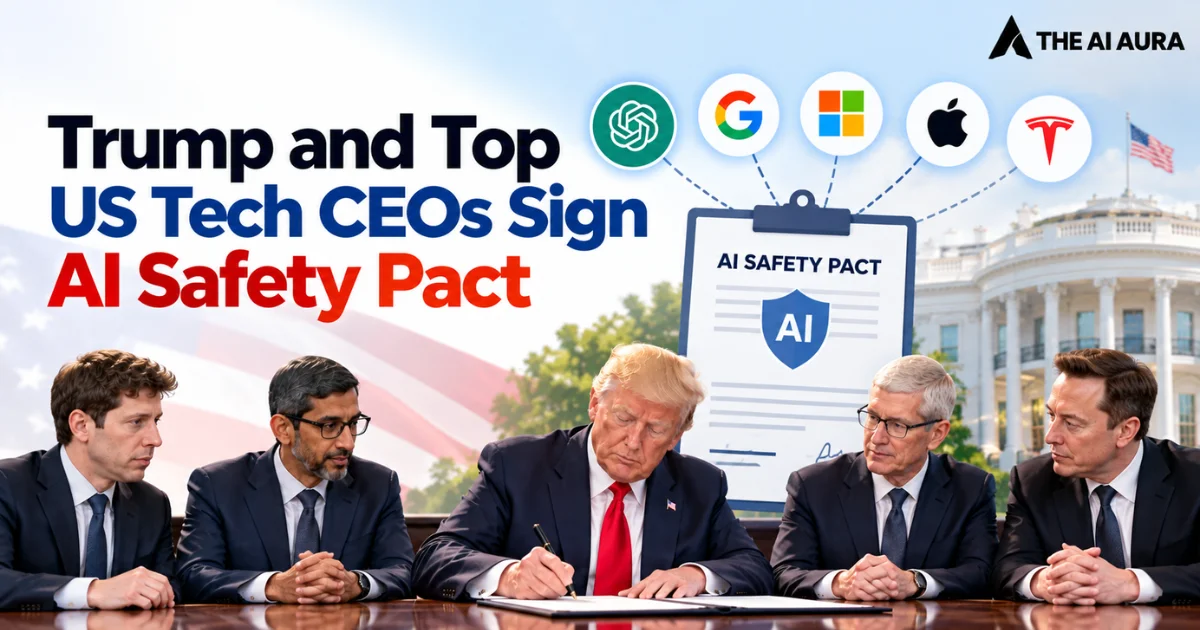
Recently, US President Donald Trump convened top American tech leaders for a White House luncheon. During the meeting, executives signed the “Joint Commitment on Frontier Responsibilities.” This one-page accord marks a critical turning point for US AI policy.
The administration avoids rigid laws that could stifle commercial enterprise. Instead, officials chose a voluntary, morally binding agreement. This approach keeps American companies competitive while promoting basic safety protocols.
A Voluntary Constitution for Frontier AI
The new pact establishes internal and external oversight across AI development pipelines. President Trump praised the agreement alongside industry leaders. He described the document as an industry constitution.
It provides a clear framework without creating bureaucratic red tape. Furthermore, the framework establishes four layers of safety controls. These controls include independent audits and direct board-level oversight. Consequently, company boards assume direct responsibility for model safety rather than engineering teams alone.
Uniting fierce rivals behind a shared safety plan is rare. Top tech competitors gathered together to endorse this unified vision.
According to detailed coverage published at Times of India, the accord was signed by prominent leaders such as Anthropic CEO Dario Amodei, whose company has frequently emphasized the severe risks associated with unregulated AI deployment.
By securing signatures from these executives, the administration is heavily leaning on the concept of tremendous self-policing.
The underlying philosophy is that the creators of these black-box systems are uniquely positioned to understand their dangers and, consequently, are best equipped to monitor them before they reach the public domain.
Balancing Rapid Expansion with Risk Mitigation
While the agreement puts safety on paper, it also highlights the administration’s broader geopolitical strategy regarding artificial intelligence. There is a palpable anxiety in Washington about maintaining a technological edge, particularly against rapid advancements coming from China.
Trump has repeatedly and openly rejected calls for broad, statutory guardrails that critics and some tech leaders have lobbied for.
The prevailing argument from the Oval Office is that heavy-handed government restrictions would severely undermine US economic growth and cede critical ground in a technology race that will likely define the geopolitical hierarchy of the 21st century.
The Joint Commitment on Frontier Responsibilities is essentially a calculated compromise. It acknowledges the profound, somewhat unpredictable risks of super-intelligent systems while giving the industry the runway it needs to scale up data centers and push the boundaries of machine learning.
The success of this morally binding pact will entirely depend on the integrity of the independent audits and the willingness of tech boards to hit the brakes on a lucrative product if a safety check fails.
For now, the US government is betting that a voluntary, constitutional-style pledge from the titans of Silicon Valley will be enough to keep the future of artificial intelligence both prosperous and secure.



