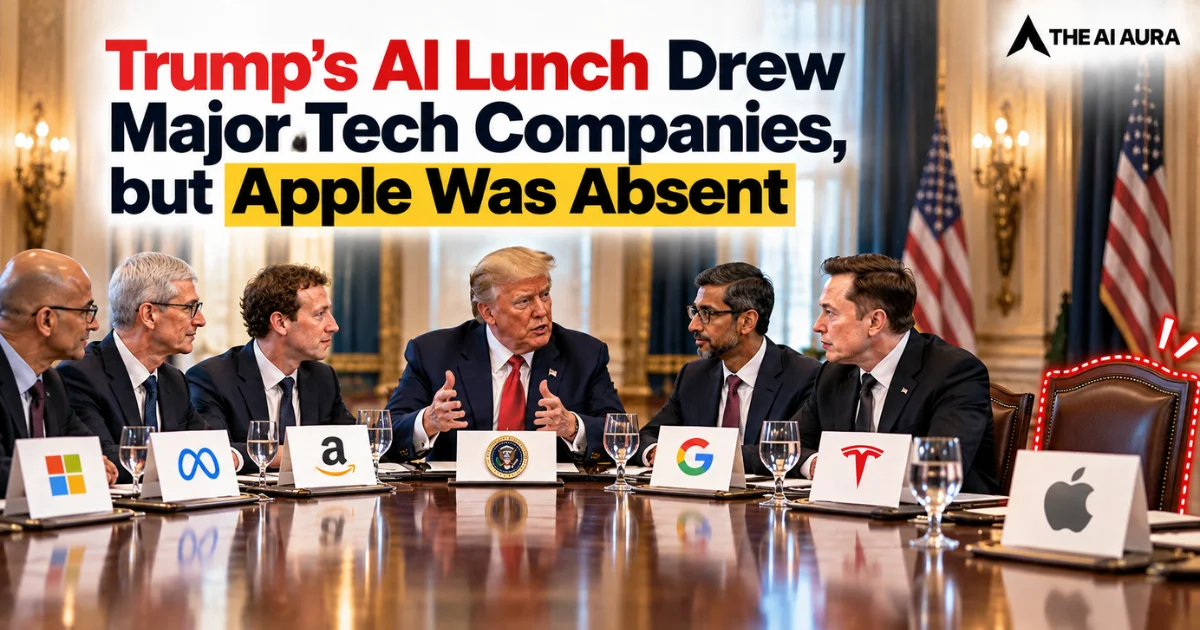

President Donald Trump recently gathered top technology executives at the White House. They met to debate the future of artificial intelligence. The guest list read like a Silicon Valley elite directory. Yet, one tech giant was conspicuously missing from the table.
Neither Executive Chairman Tim Cook nor CEO John Ternus attended. Their absence sparked intense speculation about Apple’s generative AI strategy. Competitors broke bread and signed safety accords. Meanwhile, Apple maintained its characteristic silence on the matter.
A Strategic Distance from the Frontier
Internet chatter suggested peers excluded Apple for lagging in AI. Seasoned investors view the situation differently. Altimeter Capital CEO Brad Gerstner dismissed the absence as trivial. He noted Apple understands industry developments and broader safety goals.
According to a recent report by CNBC detailing the event dynamics, the executives in attendance represented organizations that are actively pushing the boundaries of foundational model development.
Apple operates under a fundamentally different philosophy. OpenAI and Anthropic build massive, compute-heavy frontier models. These models require colossal clusters of Nvidia chips. Apple instead focuses on highly efficient local models. The company runs these models on its own silicon.
Apple remains a strictly consumer-facing entity in a landscape where the fiercest AI battles are being fought over enterprise dominance. The company’s capital expenditures are a fraction of the billions being poured into infrastructure by Microsoft, Meta, Google, and Amazon.
Instead of competing on raw scale, Apple partners with Google for certain cloud-based processing needs while keeping its proprietary Apple Foundation Models optimized for iPhones and Macs.
The market has rewarded this restraint, treating Apple stock as a safe harbor against the massive, unproven investments dragging down some of its megacap peers.
Focusing on Geopolitics and Tangible Policy
Apple’s absence from the lunch does not reflect a fractured relationship with the Trump administration. Cook has spent years carefully cultivating a pragmatic working relationship with the president, navigating complex manufacturing and trade tariffs.
Just days before the AI lunch, Cook attended Trump’s state dinner hosting Chinese President Xi Jinping, continuing his long-standing strategy of personally managing Apple’s geopolitical interests.
His policy engagements have historically centered on tangible business threats, such as the company’s recent efforts to secure licenses for Chinese-made memory chips amidst soaring global prices.
The White House gathering concluded with Nvidia, OpenAI, Meta, Google, and Anthropic signing a new accord committing to various AI safety and alignment measures.
Apple executives have routinely avoided participating in these sweeping industry manifestos. Cook has previously stated that the company prefers to engage publicly only on policies that directly intersect with their unique business model.
Because Apple is not building the type of unconstrained, frontier artificial intelligence that keeps policymakers awake at night, they have little reason to position themselves in the center of the regulatory crosshairs.