Exploring AI, One Insight at a Time

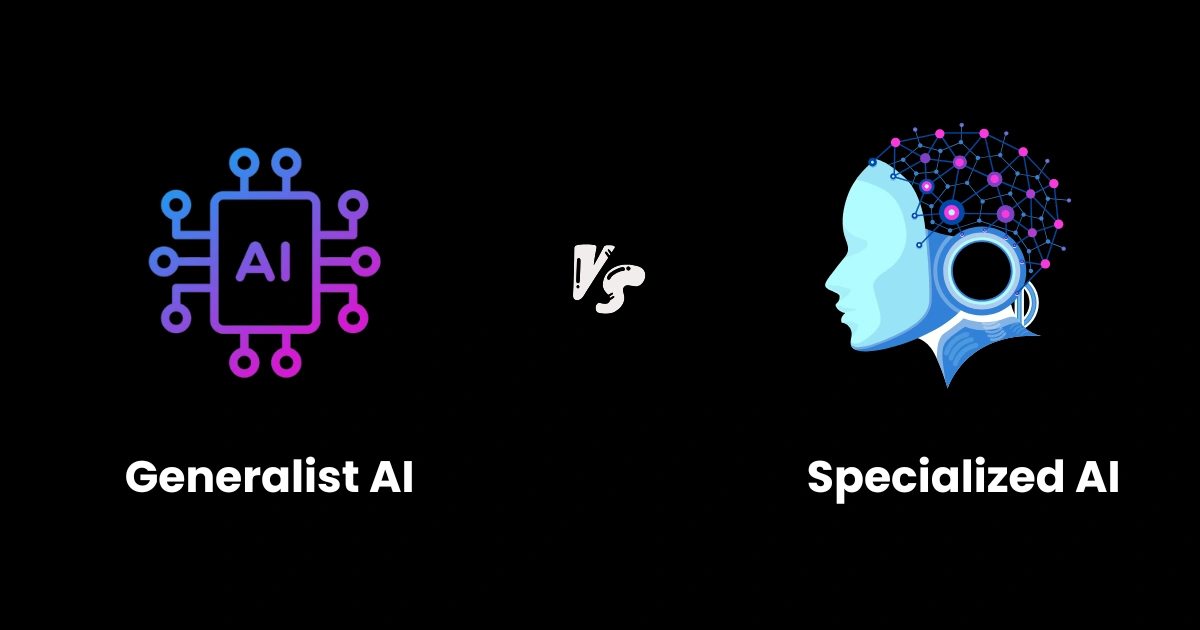
Specialized vs. Generalist AI: Which Model Wins the Generative War?

I am so tired of the “God Model” pitch.
You know the one. I’ve sat in coffee shops in SoMa for the last two years listening to founders tell me that their wrapper on top of GPT-4 is going to “revolutionize” dentistry. Or maritime law. Or dog walking.
And then I ask, “Okay, but what happens when GPT-5 comes out and just… does that better?”
Silence. usually.
This is the central tension of the last 18 months. We are watching a massive, expensive war between the Generalists (OpenAI, Google, Anthropic) and the Specialists (the vertical AI startups). And honestly? The conventional wisdom on who wins changes every three weeks.
The Swiss Army Knife Problem
Here is the thing about Generalist models like Claude or Gemini. They are incredible at being mediocre at everything.
They can write a sonnet about a toaster, debug a Python script, and tell you how to cook a risotto. That’s a miracle. I’m not downplaying it.
But try getting one to reliably cite case law for a merger in Delaware without hallucinating a precedent that doesn’t exist.
That’s where the cracks show.
I remember talking to a lawyer back in late 2023 when Harvey—that legal AI backed by the OpenAI startup fund—was just getting huge. He told me, “I don’t need a bot that can write poetry. I need a bot that doesn’t get me disbarred.”
That’s the moat. Reliability in a narrow vertical.
The Specialist Moat (Is It Real?)
The argument for Specialized AI is simple: Data.
If you are building a model for drug discovery, like Isomorphic Labs or what DeepMind did with AlphaFold, you aren’t training on Reddit comments. You’re training on protein structures. A general LLM can’t compete there because it doesn’t “know” the physics; it just knows the language of physics. Big difference.
I saw a demo recently for a construction-focused AI. It knew the building codes for specific counties in California. ChatGPT didn’t. That specific, boring, un-sexy data is the only defense these startups have against the giants.
The Contrarian Take: The Middle is Dead
Here is where I think people get it wrong, though.
Everyone thinks it’s a binary choice. Either the Giant Models win, or the Niche Models win.
I think the “middle” specialists are walking dead.
If your “specialized” AI is just a fine-tuned version of Llama 3 that writes “better marketing copy,” you are toast. The general models are getting too good, too fast. The “good enough” threshold is rising every day.
The only specialists that survive are the ones doing things the generalists can’t do because of liability or data access.
Think about Hippocratic AI. They raised $50M+ to build a safety-focused LLM for healthcare. Why? Because OpenAI literally tells you in their Terms of Service not to use them for medical diagnosis.
The “win” condition for specialized AI isn’t “being smarter.” It’s “taking the blame.”
Enterprises will pay for a specialist model not because it writes better, but because there is a contract that says, “If this screws up, we are liable, not you.”
So, Who Wins?
If you are a founder, stop building “ChatGPT for X.”
The generalists (the Omni-models) are going to eat 80% of the cognitive labor market. They will handle the emails, the basic code, the summaries, the first drafts.
The specialists will own the dangerous stuff. The biology, the high-stakes law, the autonomous driving.
If you aren’t building in the dangerous zone, you aren’t building a company. You’re building a feature that Sam Altman is going to release in an update next Tuesday.
Good luck. You’ll need it.
