
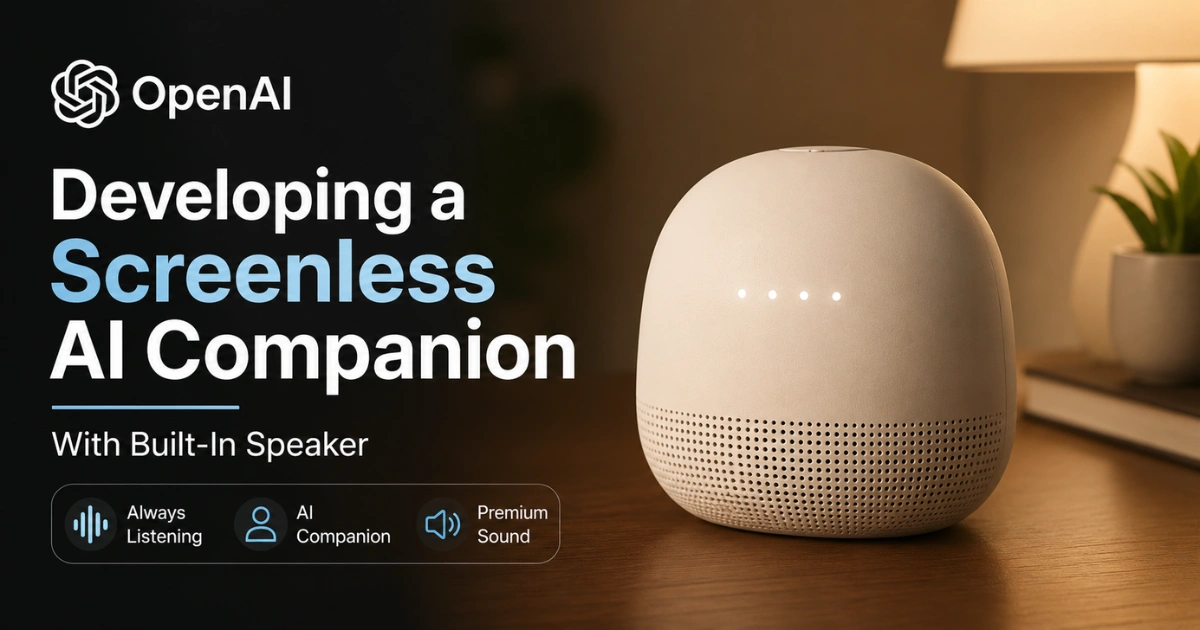

OpenAI’s long-rumored hardware debut has a shape now, according to Bloomberg’s Mark Gurman: a screen-free, portable smart speaker built to feel less like an appliance and more like something alive in the room with you.
Citing people familiar with the project, Bloomberg reports OpenAI plans to unveil the device later this year, with a commercial launch targeted for 2027, arriving just as the company prepares for a public listing that will make this launch one of the clearest tests yet of whether its AI can justify a physical product line.
What the Device is Actually Meant to Be
The speaker has no display and runs on GPT-Live, OpenAI’s low-latency conversational voice model.
A rechargeable battery lets users move it between rooms, whether they need cooking help in the kitchen or assistance in the laundry room.
Its most distinctive feature isn’t computational, it’s mechanical: built-in moving parts give the device a physical sense of personality rather than sitting still like a typical smart speaker.
A camera and additional sensors help the device understand its surroundings using multimodal AI.
Facial recognition enables personalized interactions. It can also use a user’s emails and calendar to provide proactive assistance instead of waiting for commands. This marks a shift toward truly proactive personal AI assistants.
The hardware traces back to OpenAI’s $6.5 billion acquisition of io Products, and design work runs through Jony Ive’s studio LoveFrom along with former Apple industrial design head Evans Hankey, part of more than 400 ex-Apple hires OpenAI has brought on for its hardware push.
Internally, the company describes it as a new category, an AI-native computer, rather than a rival to the Echo, Nest, or HomePod, and it’s reportedly just the first of roughly five hardware products in development, including a phone-replacement device, a wearable pendant, and home robotics.
Why Apple’s Lawsuit is Hanging Directly Over This Specific Product
The timing puts this report on a collision course with a legal fight that’s already underway.
Apple sued OpenAI last week alleging trade secret theft, and the complaint names Tang Tan, OpenAI’s chief hardware officer and the io Products co-founder now leading this exact device, as a central figure, accusing him of directing efforts to obtain confidential Apple product information.
Apple has called the allegations laid out so far only “the tip of the iceberg” and is seeking an injunction that could delay or block the hardware entirely.
OpenAI has denied wrongdoing, telling Bloomberg it has no interest in other companies’ trade secrets and arguing the speaker differs enough from anything Apple sells that infringement is unlikely.
Markets reacted to the report faster than any court will: Sonos shares fell more than 10% in late trading before paring losses, while Apple dipped under 1%. The competitive irony is sharp.
Apple is developing its own AI-focused smart-home hub, codenamed J490, a 7-inch display on a robotic arm built to showcase the next generation of Siri, meaning the two companies are now suing each other while racing to ship competing hardware into the same category.
The device itself is still a year or more from reaching anyone’s countertop, but the discovery process in Apple’s lawsuit may end up shaping its fate as much as anything OpenAI’s design team does between now and 2027.
Source: Bloomberg, "OpenAI's First Device Will Be Movable, Screenless Speaker Built as AI Companion"