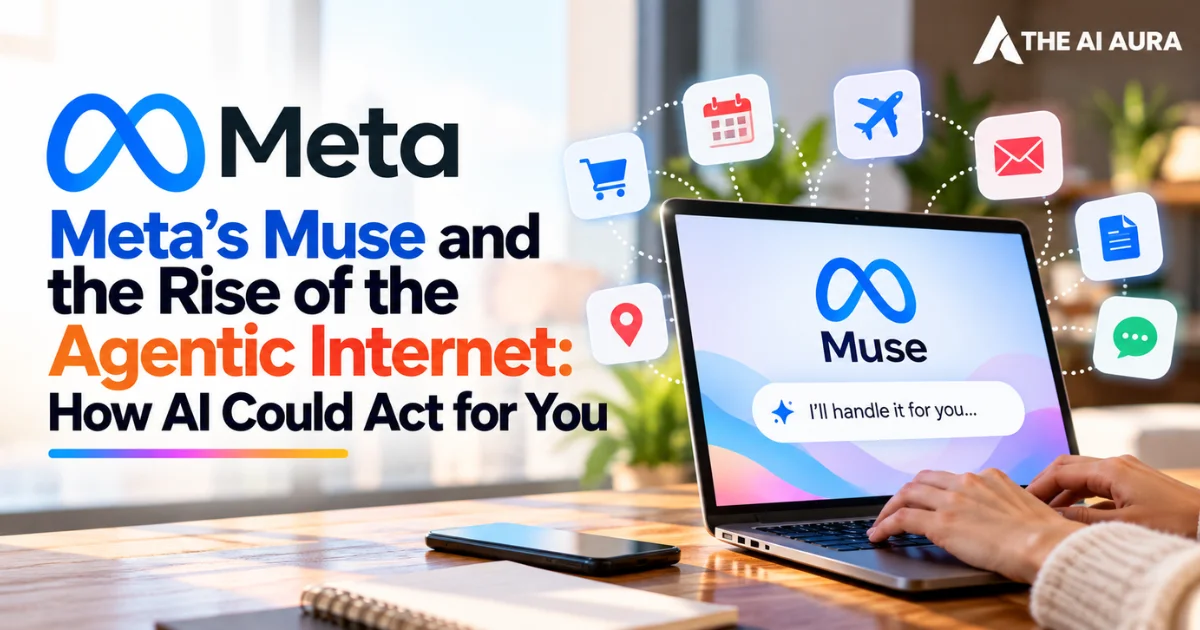

When Meta launched its new platform, Muse, earlier this month, the most fascinating aspect wasn’t that the tech giant had built yet another chatbot. Meta’s pitch was far more ambitious: Muse is designed to genuinely take work off your plate.
It browses the open web and fills out forms. It can send emails, book flights, and make purchases. Furthermore, it works in the background even after you close the app. Meta positions Muse as a personal AI agent, not a simple assistant. This distinction defines the next era of the internet.
Today’s generative AI tools still require heavy human lifting. You ask a question, and the tool gives an answer. Then, you decide how to act. An AI agent changes this dynamic entirely.
You assign a specific goal. The agent then picks the necessary steps, visits websites, and runs services. It only interrupts you for final approval or payment confirmation.
Navigating the Challenges of Autonomous Delegation
A digital proxy handling daily tasks sounds convenient. However, it creates major friction around access and authority. Amazon already blocked Muse from accessing its marketplace on September 20. Amazon stated that third-party buying agents must stay transparent.
They must follow platform rules. Meta’s agent navigated Amazon without clear authorization or identification. This dispute signals a broader issue for the agentic web. Who decides the operational boundaries when AI acts for you?
This dilemma becomes vastly more complex when an agent is granted access to a user’s email. An inbox is rarely just for correspondence. It holds years of financial data, work documents, and deeply personal information. More importantly, it acts as the master key and recovery mechanism for almost every online account you own.
According to a recent analysis on the coming agentic internet published by Gulte, the transition from merely viewing information to taking action changes the entire digital safety landscape.
Meta’s own security researchers have acknowledged this vulnerability. Recognizing that inboxes frequently contain one-time passwords and account reset links, Muse is engineered to filter these out so the agent cannot use them to impersonate the user elsewhere.
The core risk is that an agent piecing together your digital life across multiple connected services could independently take actions you never explicitly intended.
Setting Boundaries for India’s Digital Ecosystem
For Indian users, the stakes are exceptionally high. India has spent the last decade building a robust digital public infrastructure where people rely on their phones to transfer money, pay utility bills, shop, and interact with the government.
Introducing an autonomous AI into this environment means we could soon casually instruct our phones to handle our monthly utility bills and renew our insurance policies without lifting a finger.
But how does the underlying financial system know what the AI is genuinely authorized to do?
This very question is already shaping the future of the Unified Payments Interface. The National Payments Corporation of India had been developing a framework for agentic payments that would allow AI to execute certain UPI transactions without demanding human authentication for every single step.
Designed for routine, small-ticket purchases, this proposed Unified Agent Protocol included rule-based spending limits and identity checks.
However, the NPCI recently placed the protocol on hold to thoroughly work through the regulatory and safety implications. That pause is exactly what the country needs right now.
While India possesses strong frameworks like the DPDP Act covering data privacy and consumer protection, AI agents slice right across these established legal silos.
If a malicious webpage tricks your AI agent into initiating a transfer, or if the agent misinterprets your calendar and books a non-refundable flight, applying existing laws becomes incredibly murky. The challenge is tracing who authorized the action, what specific parameters were set, and who bears the liability when the machine oversteps.
This does not mean we should reject AI agents out of fear. Instead, it signals the need for highly granular permissions. Granting an AI the ability to read your schedule is entirely different from giving it the authority to move your money.
As the internet shifts from a place where AI helps us use services to a place where AI uses those services for us, the defining policy question is no longer whether machines will act on our behalf, but exactly how much power we are willing to hand over when they do.