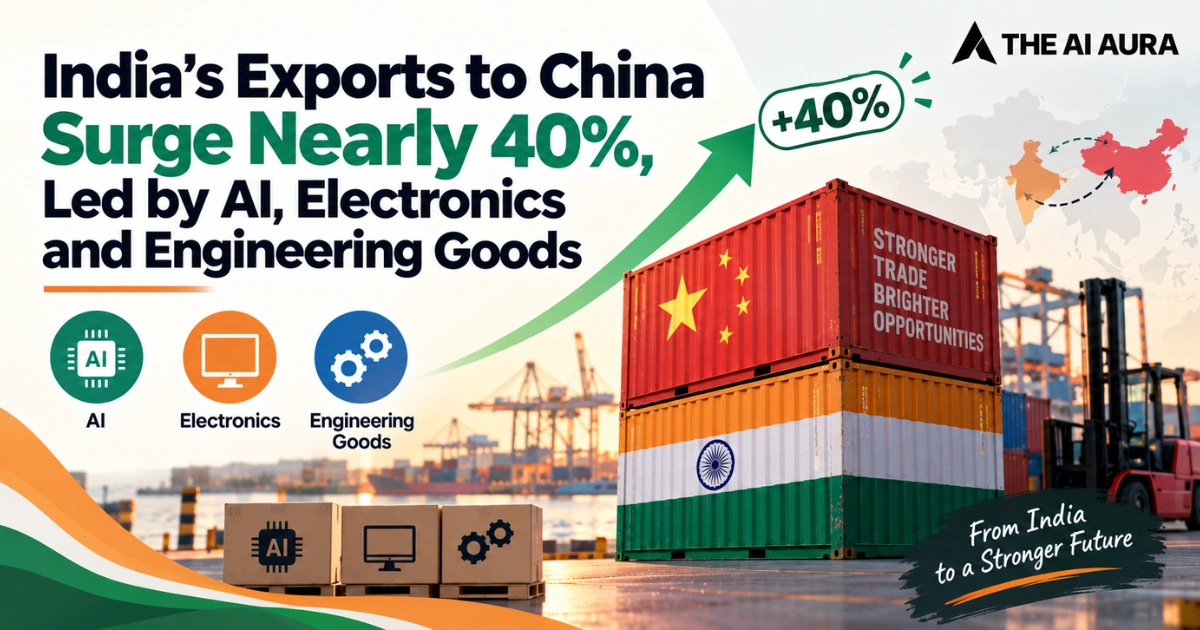

For years, a flood of Chinese industrial goods dominated trade between New Delhi and Beijing. Recent trade returns, however, show an unexpected plot twist. India’s exports to China surged nearly 40% across the five months through August.
They reached $9.61 billion, up from $6.93 billion during the same period last year. Higher-value segments now drive this quiet export rally. Electronics, telecom gear, and precision engineering parts lead the charge over traditional commodities like iron ore.
Both capitals are currently exploring a diplomatic thaw after years of border tensions. Meanwhile, these numbers suggest commercial currents are shifting faster than politics.
The AI Infrastructure Push and Value-Chain Integration
The primary catalyst behind this sudden uptick sits at the crossroads of artificial intelligence infrastructure and global supply-chain realignments. Indian shipments of electronics to China climbed by more than 15% during the April to August window, building on a previous fiscal year where outbound shipments of electronics tripled to $3.18 billion.
Much of this appetite stems from the international rush to build out enterprise data centers and compute capacity.
According to a report by The Times of India, industry groups point out that relentless global demand for high-end equipment used in AI deployment has pushed suppliers to diversify sourcing, driving direct orders for Indian printed circuit board assemblies, display modules, and telecom hardware into Chinese production ecosystems.
Engineering goods told a similar story, posting a 21% jump on the back of industrial machinery parts, precision tools, and automotive components. Together with electronics, these sectors accounted for more than a third of the overall export expansion.
While some of the movement reflects tactical purchasing by Chinese firms adapting to shifting US tariff policies, domestic trade leaders see it as early proof that Indian facilities are earning credibility within one of the world’s most demanding manufacturing corridors.
Sourcing intermediate sub-assemblies from Indian plants provides Chinese assemblers with practical supply flexibility, while giving Indian manufacturers a rare foothold in high-spec production networks that were previously considered impenetrable.
Structural Trade Realities and the Road Ahead
Despite the impressive percentage jump, the headline numbers need to be weighed against the broader scale of bilateral trade. China remains a relatively modest export market for India, absorbing roughly 4.4% of total outbound shipments, compared to the United States, which commands nearly a fifth.
On the other side of the ledger, Chinese imports into India totaled $131.6 billion in the fiscal year ended March, leaving a staggering trade deficit that independent think tanks estimate at over $112 billion.
India remains heavily reliant on Chinese components across dozens of critical product categories, including active pharmaceutical ingredients, solar wafers, and electronic components.
There are also operational wrinkles to sort through, such as differences in how Indian and Chinese customs agencies record inbound shipments. While Indian data shows a sharp run-up in circuit board assemblies, Chinese clearance logs often classify those same shipments as completed smartphones or telecom modules.
Such classification gaps highlight just how tangled cross-border assembly chains have become as parts move back and forth before reaching their final destination.
As commerce officials from both sides reopen talks to address tariff barriers and non-tariff bottlenecks, this export surge will not magically erase the massive bilateral deficit.
What it does prove, however, is that India’s manufacturing ecosystem is gradually graduating from being an exclusive importer of Chinese tech to a functioning component supplier within the wider Asian hardware network.