

The global artificial intelligence narrative is currently obsessed with silicon and massive server farms. Major economies are spending billions on advanced chips and large language models (LLMs).
But emerging economies may not need to compete with Western tech giants on infrastructure.
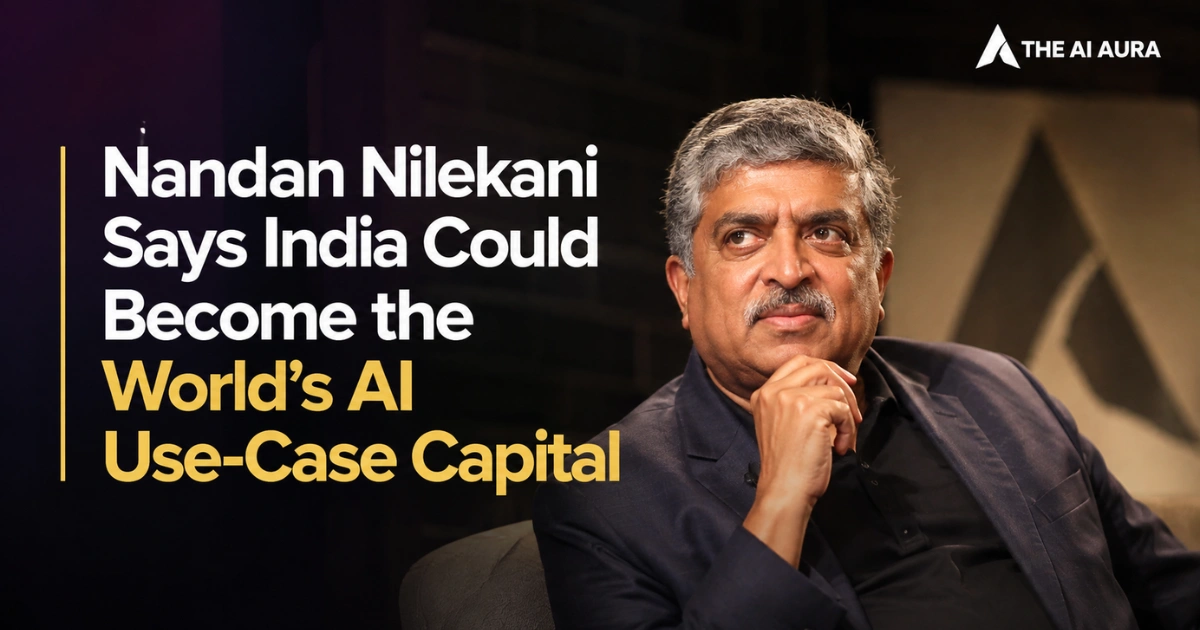
Infosys co-founder Nandan Nilekani suggests a different approach. India should focus on becoming the world’s AI use-case capital, not its hardware hub.
At the NCAER India Policy Forum 2026, Nilekani explained why the next phase of AI could look very different.
The future may depend less on who builds the biggest AI models. It may depend more on who uses AI to solve real-world problems at scale.
Skipping the Silicon Race for Real-World Applications
Nilekani’s argument hinges on a deep understanding of India’s unique structural advantages and past successes.
India has already shown that it can build digital infrastructure at massive scale. UPI transformed everyday payments, while Aadhaar made digital identity possible for more than a billion people.
Trying to match global chip factories and massive AI computing networks would require huge amounts of capital. It could also put pressure on India’s limited resources.
The real economic value for India lies one step higher in the tech stack: the application layer.
By acting as the world’s premier laboratory for applied technology, India can deploy intelligent systems at absolute population scale. The mechanics of this approach are straightforward but incredibly powerful.
AI could deliver local, weather-based crop advice to millions of farmers through voice bots. These bots could speak in regional languages.
Generative AI could also support overloaded healthcare systems. It could help sort patient data before people meet a doctor in rural areas.
In education, these models can act as personalized tutors for students sitting in resource-strapped government schools.
Nilekani sees a future where India uses AI to close major socio-economic gaps. The goal is to solve real problems, not just power enterprise software.
Demographic Dividends and Core Economic Imperatives
However, Nilekani’s vision is grounded in stark realism. Treating any software as a silver bullet completely ignores the physical realities of a rapidly developing nation.
He was quick to emphasize during the forum that technology alone cannot shoulder the immense burden of India’s future.
To genuinely capitalize on its demographic dividend a shrinking, critical window where the working-age population outnumbers dependents the country must sustain aggressive, broad-based economic growth.
The actual execution of this vision extends far beyond coding and API integration. India is staring down a massive wave of urbanization that requires sustainable, resilient infrastructure to handle millions migrating to cities.
Climate risks are actively intensifying, directly threatening the very agricultural sectors that these new AI tools aim to optimize.
If the underlying physical systems regarding basic healthcare access, foundational education quality, and overall labor productivity aren’t simultaneously overhauled, deploying sophisticated software will only yield marginal, isolated gains.
Artificial intelligence is an incredible accelerator pedal, but the actual economic engine job creation, urban planning, and climate adaptation requires relentless attention and capital.
If India manages to balance these physical fundamentals with its aggressive digital ambitions, becoming the undisputed global capital for AI use-cases will trigger a historic socio-economic transformation that the rest of the developing world will inevitably look to replicate.
Source: Moneycontrol, "India to Become AI Use-Case Capital of the World, Not Chip Capital: Nandan Nilekani"