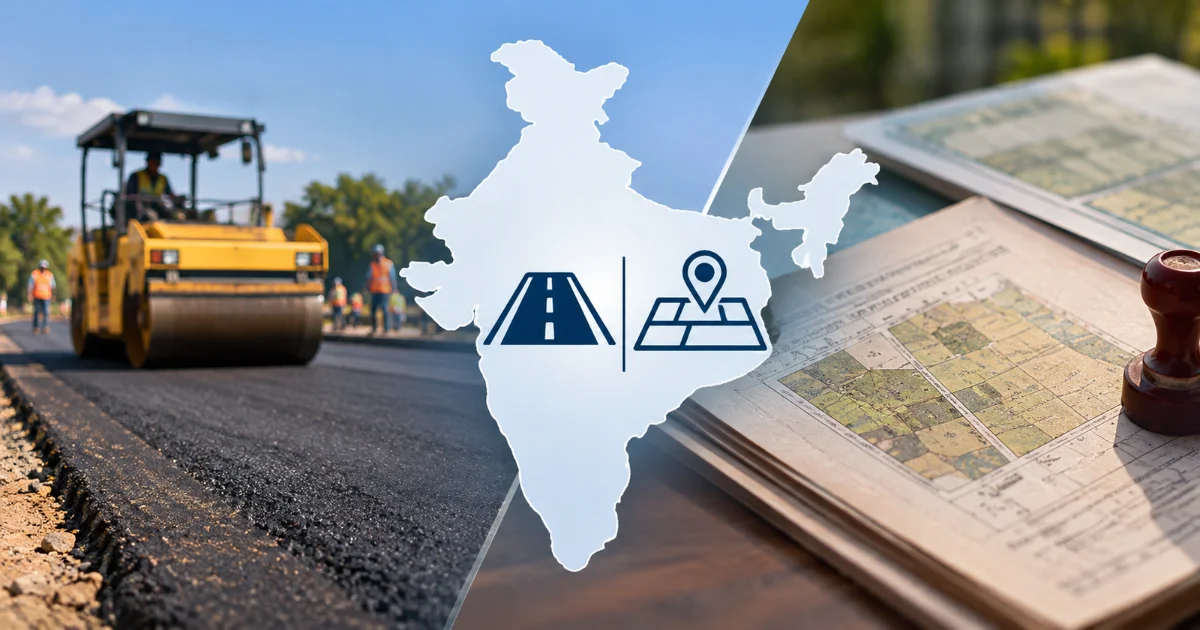
India presents a distinct landscape for artificial intelligence. While global superpowers compete in a high-stakes arms race to develop frontier language models, the Indian startup ecosystem is quietly revolutionizing practical, downstream applications.
The focus here is deeply local, tackling massive infrastructural and bureaucratic bottlenecks that have frustrated citizens and stifled economic efficiency for decades. Instead of chasing theoretical artificial general intelligence, Indian founders are building tangible solutions for highly fragmented, multilingual datasets in notoriously cost-sensitive sectors.
Two of the most pressing challenges holding back urban and economic development archaic land records and crumbling road infrastructure are currently experiencing a massive technological overhaul driven entirely by domestic AI innovation.
Untangling the Web of Property Ownership
Indian real estate administration involves enormous complexity, especially considering that property accounts for roughly eighty percent of household wealth in the country. In nations like the United States and the United Kingdom, buyers can purchase homes through a relatively straightforward process.
There, the government actively verifies ownership. India, by contrast, operates on a system of presumptive titling. This places the entire burden of establishing legal ownership squarely on the buyer.
A basic sale deed is rarely enough to prove anything definitively. Authorities routinely demand a historical labyrinth of documents. These include property tax receipts, building certificates, and heritage survey maps.
This immense bureaucratic friction sparked the creation of Landeed, an AI-driven platform born out of founder Sanjay Mandava’s personal frustration. After flying from Chicago to Chennai in 2020 to resolve a family land dispute, Mandava realized the system was fundamentally broken.
Rather than forcing citizens to manually hunt down records across disjointed government offices, his platform aggregates fragmented data and verifies titles almost instantly.
According to BBC, Landeed has mapped vast swathes of the country using geospatial technology, directly linking registered properties to their official identification numbers.
The platform utilizes an advanced AI layer to read these complex titles and spot legal inconsistencies within minutes, effectively replacing days of tedious legal work for brokers and buyers.
With a repository of nearly two billion documents, this technology is addressing a critical pain point in a country where property disputes dominate the notoriously backlogged civil courts.
Mapping Civic Decay and the Resource Crunch
Beyond legal and administrative hurdles, physical infrastructure remains a persistent everyday challenge for Indian municipalities. Pothole-ridden urban roads are a notorious issue.
This has prompted independent developers to find automated ways to hold civic bodies accountable. A recent innovation by Bengaluru-based developer Gaurav Sen utilizes standard dash-cameras, satellite navigation, and an AI vision model. It detects road damage in real-time.
The system automatically identifies the municipal officials responsible for the damaged stretch and forwards precise location data to them. This creates a scalable tool that could eventually support continuous urban monitoring across public transport networks.
This wave of civic-tech extends into public health as well. Companies like Fractal Analytics are deploying AI tools in municipal hospitals. They generate multilingual summaries of lab reports and track emerging disease trends.
Yet, despite a massive surge in venture capital funding with Indian AI startups raising over a billion dollars recently these founders face severe operational headwinds. Developing complex machine learning solutions requires immense computing power, but the cost of building in India frequently eclipses what local consumers or government bodies are willing to pay.
This difference also extends to the economics of AI development. As industry leaders have noted, running an AI model costs the same in Mumbai as it does in Silicon Valley, but local purchasing power differs vastly. At the same time, developers face significant constraints due to a severe shortage of advanced graphics processing units.
While the government has pledged tens of thousands of GPUs under state-led initiatives, the demand drastically outweighs the supply.
To avoid creating shallow, easily replicated tools that tech giants could effortlessly copy, the next generation of Indian founders must navigate these hardware deficits and bureaucratic red tape to turn successful pilots into sustainable public utility solutions.