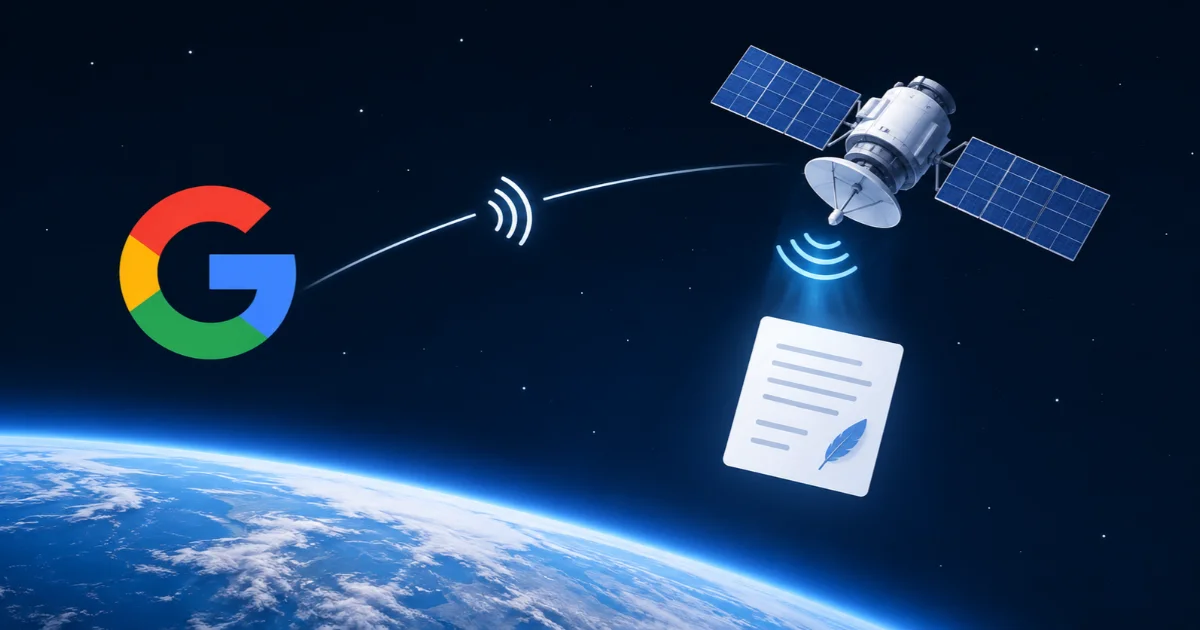

Pushing AI boundaries usually means building massive data centers on land. These facilities rely heavily on huge cooling systems and regular power grids. However, a recent milestone shifted machine learning to low Earth orbit. Google successfully ran its first AI model on a prototype satellite.
This ambitious initiative is called Project Sun Catcher. The company launched this experimental platform to test space-based data centers. Google wanted to see if its hardware could handle complex tasks in space.
Space is entirely hostile to standard electronics. The orbital test did not just return dry diagnostic data. Instead, it produced the first AI-generated poem written entirely in space.
Expanding Computing Beyond Earth
The engineering requirements for running advanced neural networks in orbit present massive physical hurdles. Traditional computer chips and memory systems are highly vulnerable to cosmic radiation, which can easily trigger hardware faults and corrupt data processing.
Furthermore, outer space lacks an atmosphere to absorb thermal output, making heat dissipation a critical engineering problem for energy-intensive artificial intelligence processors.
To circumvent these issues, the Project Sun Catcher prototype satellite was equipped with specialized heat sinks and heat pipe systems designed to keep the processing units within operational temperatures.
According to comprehensive coverage published at Times of India, this mission marks the very first time an artificial intelligence prompt was actively processed and answered by an orbital TPU rather than relying on a continuous data tether to Earth-bound servers.
By running a version of the Gemini 4 model directly on the satellite, the engineering team effectively eliminated the latency that typically plagues space communications.
Instead of beaming raw data down to a ground station for analysis and waiting for a response to be transmitted back, the satellite processed the cognitive request locally.
This development opens up the potential for future orbital systems to independently analyze satellite imagery, manage space traffic, or conduct complex astronomical research in real-time without constantly relying on Earth for computational heavy lifting.
While industry leaders acknowledge that deploying space data centers on a commercial scale may not happen until the end of the decade, overcoming the thermal and radiation constraints proves that decentralized extraterrestrial computing is physically viable.
The Poetic Proof of Concept
Researchers chose a surprisingly artistic method to verify the hardware. They did not ask the system to run complex math or diagnostics. Instead, they prompted the satellite to compose a traditional three-line haiku. The satellite wrote a thoughtfully constructed poem about its surroundings.
This poem served as a sophisticated benchmark for linguistic processing under extreme conditions. Composing poetry requires far more than raw processing power.
It demands contextual understanding, precise vocabulary selection, and strict structural rules. These abilities confirmed the neural network functioned flawlessly despite cosmic radiation.
Following the haiku, the ground team sent longer prompts to the model. They asked it to write a five-line poem about the cosmos. They also requested real-time status updates on the onboard equipment.
This mix of creative generation and practical reporting proved highly effective. It showed an isolated AI can handle multiple cognitive loads at once. Using poetry as a diagnostic tool highlights a fascinating engineering intersection.
It blends advanced aerospace engineering with human-like creativity. The same silicon infrastructure can track climate patterns and articulate quiet isolation. This turns a cold technical achievement into a profound machine learning milestone.