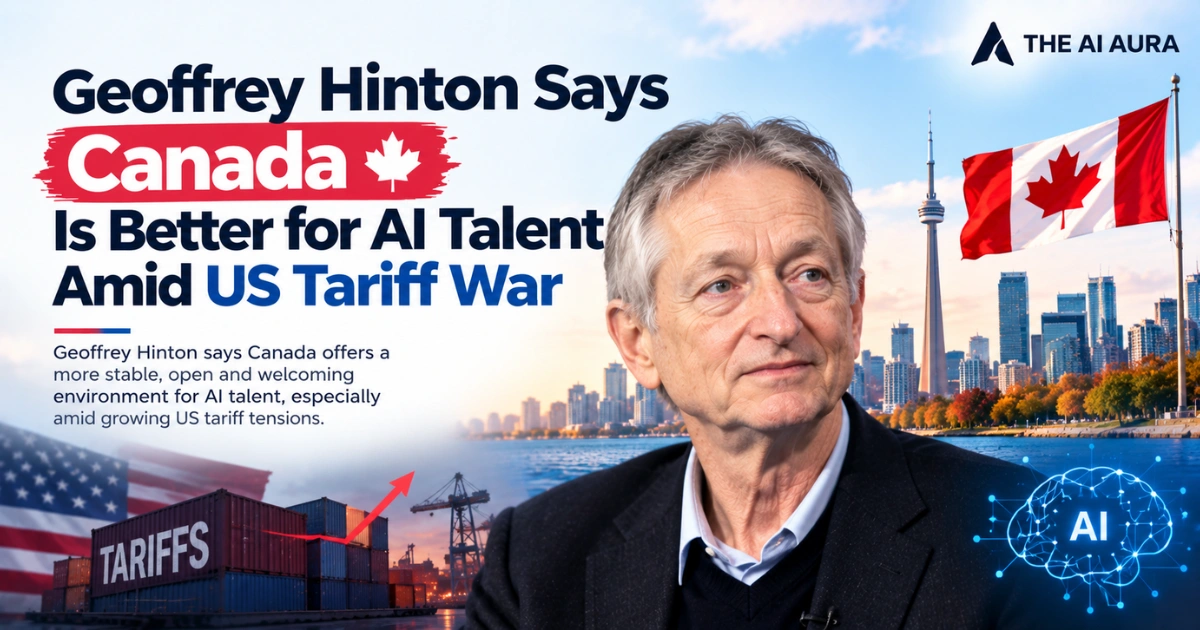

When Geoffrey Hinton walked away from a well-funded post at Carnegie Mellon in 1987 to teach at the University of Toronto, machine learning was an obscure academic backwater.
Nearly four decades later, that quiet migration has turned southern Ontario into a global nexus for artificial intelligence.
Now, with renewed US trade aggression, impending tariffs, and a volatile political climate south of the border, the Nobel laureate argues that Canada holds a critical strategic advantage over its neighbor: an open door for global talent.
Silicon Valley has dominated the tech landscape for generations, but Hinton points out that its dominance has always relied on foreign-born brainpower.
As Washington doubles down on protectionist trade measures and tightens its grip on cross-border labor, Canada’s predictable immigration framework offers global engineers and tech enterprises a far more stable harbor.
The Immigration Edge Over US Visa Gridlock
The real friction point in the race for artificial intelligence is not compute capacity it is access to elite researchers. American tech giants have long wrestled with the restrictive H-1B lottery, a system that routinely ejects highly skilled contributors due to bureaucratic bottlenecks.
Canada has capitalized directly on that vulnerability. While the US makes it difficult for foreign researchers to plan a long-term future, Canadian immigration avenues provide streamlined pathways to permanent residency and reliable work permits.
Gennady Pekhimenko, who founded CentML before selling it to Nvidia, built his core engineering team by hiring skilled workers squeezed out of the United States including an Amazon engineer who could not renew his American visa but secured a Canadian permit immediately.
Major tech firms have noticed the pattern. Instead of fighting US immigration machinery to bring talent to California or Washington, companies like Google, Nvidia, Meta, and Microsoft have expanded their footprints around the University of Toronto and the Vector Institute.
According to CBRE’s annual rankings, Toronto now holds the third-strongest tech talent market in North America, trailing only the Bay Area and Seattle while outpacing New York.
Retaining the Economic Spoils of the AI Boom
Beyond immigration, Canada’s appeal lies in an ecosystem that resists the all-consuming tech monoculture of Silicon Valley.
Hinton’s former student Nick Frosst chose to build Cohere now valued at $7 billion in Toronto rather than relocating to California, citing a balanced creative environment that allows technical talent to thrive without the insular echo chamber common in the Bay Area.
For Hinton, however, keeping talent north of the border is an economic survival tactic rather than a point of civic pride. If automated systems create widespread labor disruption, Hinton warns that Canada cannot afford to be an import-only market dependent entirely on US or Chinese intellectual property.
The capital and corporate tax windfalls generated by frontier models must remain inside the country to offset domestic workforce transitions and fund public safety nets.
As tariff threats disrupt supply chains and nationalist policies restrict movement across the US border, Toronto’s blend of academic heritage, livability, and open borders gives it a durable hedge.
For global engineers tired of administrative instability in the United States, the northern alternative is looking less like a fallback plan and more like the smarter long-term bet.
Source: The Times of India, "Father of AI Geoffrey Hinton Bets on Canada in Tariff War With US; Says, Unlike America, Canada Welcomes Immigration; Lead Engineer Lost H1-B Visa"