
Earth’s deep interior remains completely off-limits to physical exploration. The boundary layer between the rocky silicate mantle and the liquid iron core sits deep underground. It lies approximately 2,900 kilometers (1,800 miles) beneath our feet. We simply cannot drill there.
Instead, planetary scientists map this abyssal region indirectly. They use seismic waves from major earthquakes to scan the planet. Scientists treat the globe like a massive ultrasound subject.
For decades, interpreting these deep-earth echoes was an agonizingly slow manual process. Background interference heavily restricted this work. Now, geophysicists use advanced deep learning frameworks.
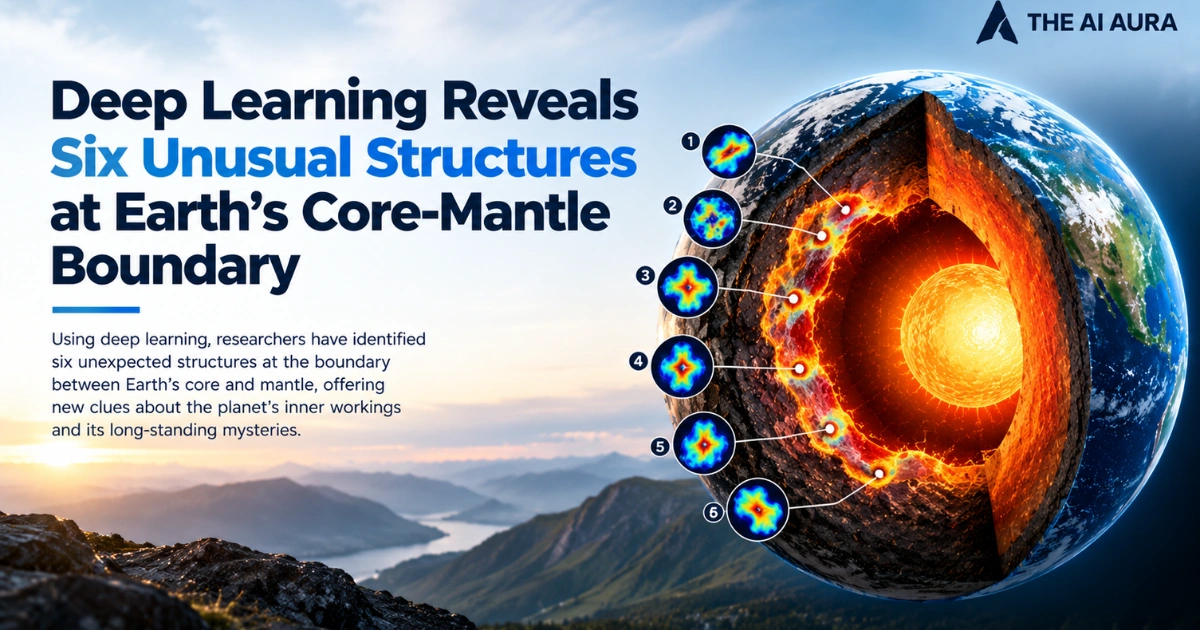
They analyze a massive archive of global seismic recordings. This fundamentally alters our map of the deep earth. The Journal of Geophysical Research: Solid Earth recently published the results. Researchers discovered six sprawling, continuous bands of unusual rock structures. These sit right at the core-mantle boundary.
Hunting Faint Seismic Echoes Through Neural Networks
An earthquake sends heavy shockwaves rippling through the planet. Standard primary waves are relatively easy to track. However, researchers mapping the core-mantle boundary rely on elusive PKP precursors. These are high-frequency seismic signals.
They scatter off irregular, dense structures near the core. The signals arrive at surface stations just seconds before the main wave.
These echoes are incredibly weak. Isolating PKP precursors from ambient noise once required painstaking manual analysis. Scientists also had to deploy highly dense, geographically limited sensor arrays.
To bypass this traditional data bottleneck, investigators constructed a machine learning pipeline and trained it on more than two million seismogram recordings cataloged between 1990 and 2024.
Instead of humans squinting at noisy waveforms on a screen, the neural network was optimized to automatically assess data quality, filter out unusable noise, and classify the presence of precursor signals.
Following extensive human validation through spot-checking to ensure algorithmic accuracy, the hybrid model successfully isolated 174,929 valid precursor events.
This represents an unprecedented order-of-magnitude increase over any previously compiled global seismic dataset. By feeding this massive influx of clean data into predictive models, researchers generated the highest-resolution probability maps of the core-mantle boundary to date.
The automated analysis pipeline demonstrates how scaling data processing through AI can completely clear long-standing bottlenecks in geophysics.
Mapping Continent-Sized Anomalies Deep Underground
The resulting high-resolution probability maps exposed something researchers had never seen with this level of continuity: six distinct, continent-scale belts of deep-mantle heterogeneity.
These massive structural anomalies are positioned directly beneath the North Atlantic, northern Eurasia, the South Atlantic, Southern Africa, the Pacific basin, and the Antarctic region. Far from being a smooth, predictable transition zone, the core-mantle boundary is heavily scarred and compositionally complex.
Geophysicists interpret these continuous scattering zones as the chaotic remnants of ancient geological processes.
Many of these newly mapped structural bands align perfectly with previously identified ultra-low-velocity zones regions where seismic waves suddenly drop in speed, indicating a severe shift in material density or temperature.
The observed belts are highly likely a mixture of ancient subducted tectonic plates that sank to the absolute bottom of the mantle over billions of years, mixed heavily with chemical differentiation and pockets of localized partial melting caused by extreme heat radiating off the outer core.
Prior to this deep learning deployment, sparse data made it impossible to tell if scattered anomalies were isolated patches or connected networks. The sheer scale of these six continuous structures proves that the lowermost mantle operates as an active geological graveyard, violently sculpted by thermal forces.
By leveraging machine learning to process decades of untapped wave data, researchers have established a robust new foundation for geodynamic modeling, bringing the deep earth into sharper focus without ever breaking ground.
Source: Phys.org, "Six Unusual Structures Identified at Earth's Core-Mantle Boundary With the Help of Deep Learning"