
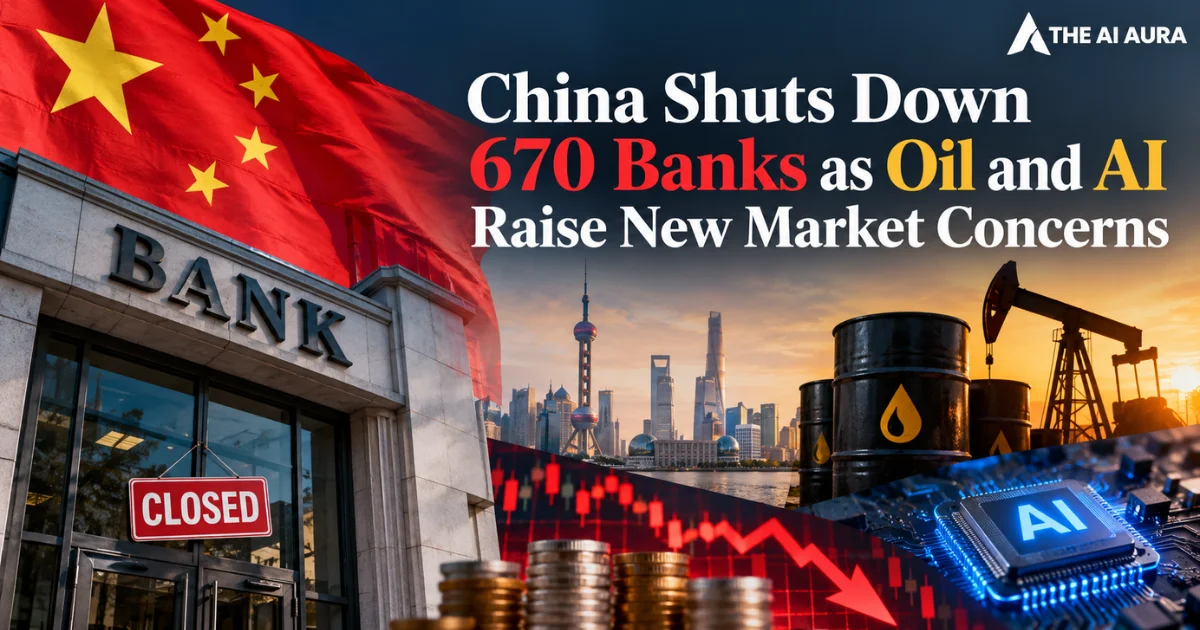

Global markets face major pressure across finance, energy, and technology. Beijing recently shut down a record 670 banks. This move highlights China’s urgency to stabilize a slowing economy.
At the same time, the energy sector warned of major oil supply shocks. Meanwhile, researchers raised new concerns over artificial intelligence development.
Banking Consolidation and Energy Market Anxiety
China closed roughly a quarter of its banking institutions to reduce systemic risk. Regulators want to build larger, better-capitalized lenders.
According to a recent market update published by CNBC, credit rating agency Fitch Ratings has explicitly identified small and rural commercial banks as the most fragile components of China’s financial architecture.
These regional institutions have long been plagued by poor asset quality, chronic undercapitalization, and severe governance shortcomings, making them highly vulnerable during periods of economic contraction.
Simultaneously, international energy markets are facing intense pressure stemming from geopolitical instability. The ongoing conflict involving Iran and the United States has introduced deep uncertainty into global oil supply chains.
Saudi Aramco Chief Executive Amin Nasser recently emphasized the severity of the situation, cautioning that it could take a full two years to rebuild global oil stockpiles.
As the conflict drags on, the squeeze on available supplies threatens to worsen, leaving traders highly sensitive to any further disruptions that could trigger severe price volatility.
Tech Sector Boom and Existential AI Warnings
While traditional financial and energy sectors grapple with physical and structural vulnerabilities, the technology industry continues to expand rapidly, though not without significant internal alarm.
Despite rising U.S. Treasury yields, investor enthusiasm for tech equities remains robust, recently driving the Nasdaq Composite to fresh all-time highs. However, this market exuberance is shadowed by profound warnings from leading artificial intelligence researchers.
Former Google DeepMind researcher Alex Turner recently testified before the New York City Council, delivering a sobering assessment of the risks associated with unchecked AI development.
Turner argued that misaligned artificial intelligence represents a universal adversary, one that could ultimately prove far more dangerous than aggressive foreign technological expansion.
Despite these existential warnings, the immediate integration of AI into corporate infrastructure is accelerating, fundamentally reshaping employment landscapes.
Wall Street is aggressively acquiring talent to capitalize on generative and algorithmic models. Recent data compiled by enterprise hiring firm Draup reveals that demand for AI-related roles at major financial institutions, including JPMorgan Chase, has surged by 49% this year alone compared to 2025.
This intense recruitment drive highlights a stark dichotomy: while leading scientists warn of profound long-term dangers, major corporations are racing to integrate the technology into their core operations as quickly as possible.
The day’s developments, rounded out by political friction over domestic campaign advertising controversies, paint a picture of a global economy caught between rapid technological adoption and the urgent need to manage deep-rooted geopolitical and financial instabilities.



