
The narrative around artificial intelligence has fractured into two distinct camps: those building practical tooling and those forecasting societal collapse. Bill Gates recently managed to straddle both lines during a deeply pragmatic conversation on the Decoder podcast.
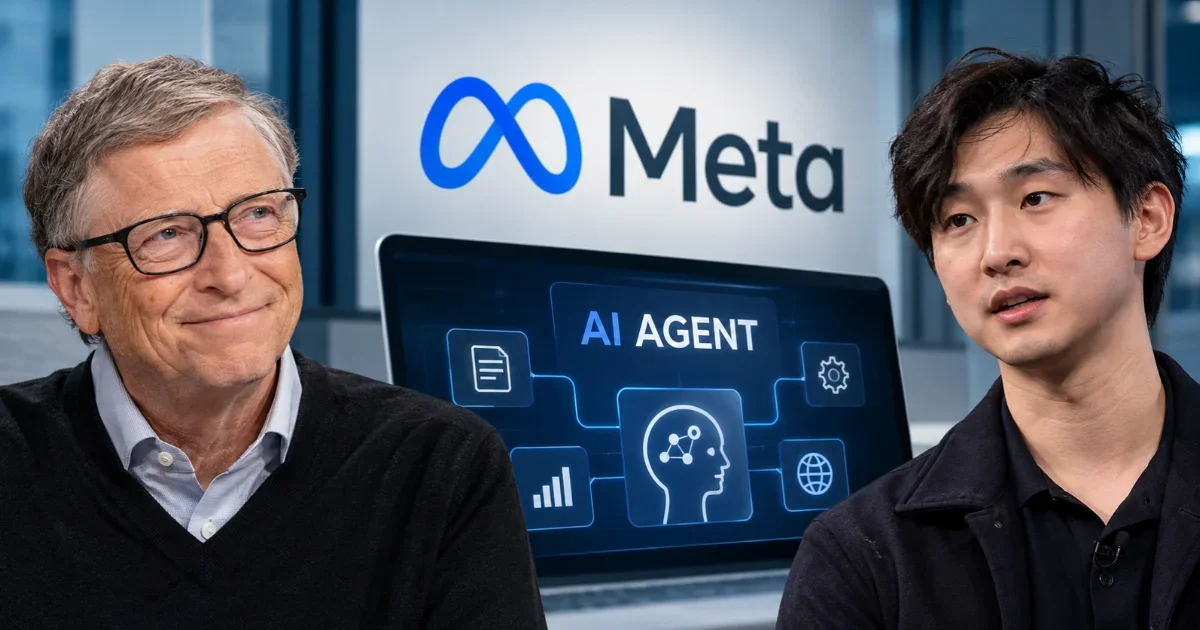
In an unusually glowing endorsement, Gates labeled Meta’s new personal AI agent, Muse, as the first truly great consumer AI product. The Microsoft co-founder went as far as personally congratulating Alexandr Wang, Meta’s chief AI officer and the former Scale AI CEO who took the reins of the AI lab alongside Nat Friedman in June 2025.
It is a striking moment of cross-industry validation, especially coming from a figure who simultaneously warned in the same interview that AI remains a dangerous weapon capable of driving two decades of severe economic disruption.
Moving Beyond Chatbots to True Agentic Execution
The core reason behind Gates’ enthusiasm comes down to deterministic utility. The tech industry has spent the last few years drowning users in cheap, hallucination-prone chatbots and messy search summaries, generating a massive wave of public distrust.
Muse works differently because it actually executes multi-step workflows. For businesses and consumers alike, this represents the transition from AI as a conversational novelty to AI as an asynchronous worker.
Running on Meta’s proprietary Muse Spark model, the agent handles travel bookings, completes complex forms, and manages inboxes directly within WhatsApp or its native app.
According to a recent Times of India report detailing how Bill Gates is a fan of Meta’s AI agent Muse, the billionaire believes these agents will fundamentally shift how people accomplish daily tasks, easily overcoming the friction of early developmental challenges.
Meta’s architectural approach here is highly deliberate and built for enterprise-grade safety. Instead of running a monolithic cloud instance, each user’s agent operates on a dedicated cloud computer. Every outbound action is monitored and gated by a separate Sentinel agent before it hits the open internet.
This dual-layer architecture provides a tangible security perimeter that prevents autonomous models from executing rogue web requests. The strategy is clearly resonating with users.
Mark Zuckerberg recently confirmed that over 10 million people are already using the platform, with a massive 25 percent daily return rate driven heavily by automated shopping tasks across North America.
The Tension Between Capability and Open Weights
The praise for Muse comes with a heavy caveat regarding the open-source movement. While Gates strongly supports closed-loop systems like the consumer-facing Muse, he draws a hard line at releasing deeply capable models without immutable guardrails.
Meta recently launched Muse Spark Open, a staggering 816-billion-parameter open-weight model designed for local execution.
Wang has aggressively positioned it as the most capable US-built model for coding and agentic work. However, Gates argues that allowing developers to strip safety protocols from models of this scale invites severe cyber and biological risks.
The debate over model weights is no longer academic; it is the defining regulatory battle of the decade. Gates maintains that top-tier models must be locked to platforms that mathematically guarantee safety compliance cannot be bypassed.
We are entering a phase where the definition of AI success is shifting from generating clever text to executing verifiable actions.
Personal agents will undoubtedly face friction, and Muse has already stumbled by leaking a user’s address to a Facebook Marketplace seller without authorization. Yet, for industry veterans like Gates, isolated architectural slip-ups do not negate the massive leap forward in utility.
The underlying token economics and latency improvements achieved by Wang’s team suggest that Meta is building for scale, not just for press releases. An agent that actually finishes the job it is assigned is the tipping point the industry has been waiting for, signaling a permanent shift from experimental tech to mandatory digital infrastructure.