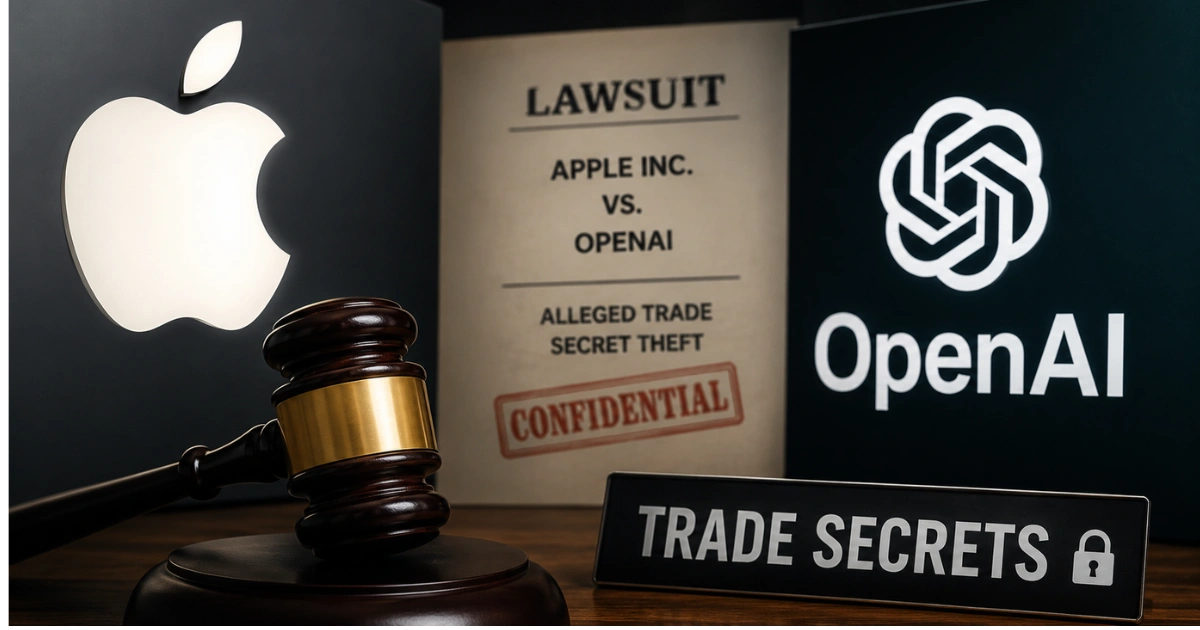

Two years after Sam Altman stood inside Apple’s headquarters to announce ChatGPT’s integration into the iPhone, Apple filed a federal lawsuit against OpenAI on Friday accusing it of stealing trade secrets to build rival hardware.
The complaint, filed in the US District Court for the Northern District of California, alleges the theft ran through the company’s ranks, describing a scheme operating, in Apple’s words, “at every level, from members of its Technical Staff to its Chief Hardware Officer.” OpenAI, io Products, and two named former Apple employees are defendants in the case.
What Apple’s complaint actually alleges
The suit centers on two individuals.
Tang Tan spent 24 years at Apple and became vice president of product design for the iPhone and Apple Watch. He left in 2024 to help launch io Products with Jony Ive. Apple alleges that, before leaving, Tan emailed confidential supplier information to himself.
The company also claims he used internal Apple codenames while interviewing OpenAI candidates who still worked at Apple. According to the complaint, he encouraged those candidates to bring physical Apple components to interviews.
Apple also alleges Tan circulated an internal security document to new OpenAI hires, coaching them on how to evade Apple’s exit-security checks.
The second defendant, Chang Liu, an eight-year Apple systems electrical engineer who left for OpenAI in January 2026, allegedly kept his company laptop, exploited an authentication bug to access Apple’s internal file storage after departing, and downloaded a compilation of confidential hardware files running over a thousand pages, reportedly joking to a former colleague that the access was “so funny.”
Apple further claims OpenAI approached one of Apple’s manufacturing partners and had it carry out a proprietary metal-finishing technique while leading the partner to believe Apple had authorized it.
Apple says it raised these concerns in a letter to OpenAI in February and received no response.
The complaint notes more than 400 former Apple employees now work at OpenAI, and Apple is seeking injunctive relief, damages, and an order forcing the return of any Apple materials.
Why this lands now, and what’s actually different this time
The relationship’s collapse tracks almost exactly with OpenAI’s move into hardware.
Tensions increased after OpenAI acquired Jony Ive’s io Products for about $6.5 billion last year. Reports also suggest the company is developing smartphone and smart-speaker prototypes. Together, those moves have intensified competition in AI hardware.
Apple, meanwhile, is launching a revamped Siri this fall built on Google’s Gemini models rather than OpenAI’s technology, even as ChatGPT remains integrated elsewhere in Apple Intelligence.
Reuters reported in May that OpenAI was considering legal action against Apple over the structure of its Siri partnership. However, Apple’s complaint says the current lawsuit is unrelated to that agreement.
The timing also lands awkwardly for OpenAI, arriving two months after it defeated Elon Musk in a high-profile nonprofit-governance trial and just weeks after confidentially filing IPO paperwork.
OpenAI’s public response has been brief: a company representative said it has “no interest in other companies’ trade secrets.”
Apple’s allegations have not been tested in court, and OpenAI denies wrongdoing. If the case moves into discovery, it could provide one of the clearest public views yet into how OpenAI built its early hardware roadmap.
Source: CNBC, "Apple Sues OpenAI Alleging Trade Secret Theft, Says Scheme Was 'at Every Level'"