
Recent student protests at New Delhi’s Jantar Mantar have brought a potent new variable into the spotlight: real-time algorithmic surveillance.
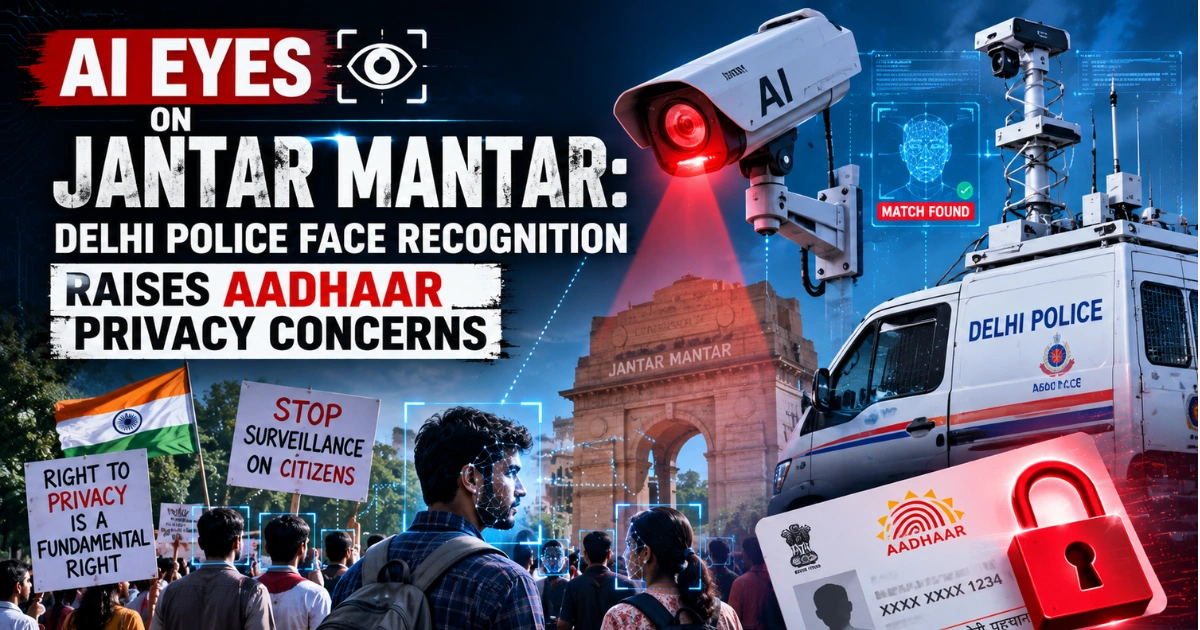
Viral footage circulating on social media reveals Delhi Police operating live CCTV vehicles equipped with 360-degree cameras.
Inside these mobile command centers, screens actively display names, photographs, and personal details of individuals passing through the lens.
Within hours, the rapid profiling sparked a wave of public concern. Citizens and privacy advocates questioned whether the system had been linked to the national Aadhaar database.
Delhi Police describe the technology as a preventive tool designed to identify known criminals. Even so, many people say its presence has created a noticeable sense of unease.
The use of artificial intelligence to monitor public demonstrations has sparked a wider debate. People are raising concerns about biometric data, state surveillance, and the potential chilling effect on democratic assembly.
How the Surveillance Tech Actually Works
At the center of the controversy are specialized facial recognition system (FRS) units, prominently featuring the Ikshana mobile surveillance vans.
First introduced during the 2023 G20 Summit, these vehicles act as rolling intelligence hubs. Authorities say four facial recognition units have been deployed at major entry and exit points around Jantar Mantar.
Specifically, the system relies on a sophisticated facial recognition process. High-resolution cameras capture faces from the crowd, converting facial features into unique digital templates.
The software compares each digital template with records stored in police databases within seconds.
According to police officials, the system is designed to identify wanted suspects, absconders, and people listed as “bad characters” or history-sheeters. It is not intended to target ordinary protesters.
From a law enforcement perspective, the objective is crowd security—preventing anti-social elements from hijacking a peaceful protest. When the software logs a positive match, nearby units receive an immediate alert, allowing officers to intervene swiftly.
The Core Privacy Debate and Data Fears
Despite official assurances, the rapid identification of faces on police screens has fueled concerns about where the data comes from.
As the software quickly retrieves detailed personal information, many people began to speculate that it was connected to the Aadhaar database.
Officials have categorically denied any link to Aadhaar, stating that cross-referencing is limited to internal criminal registries.
This technical clarification, however, has done little to ease the underlying privacy concerns. The fundamental issue is the absence of a dedicated legal framework governing the use of facial recognition by law enforcement in India.
There are currently no strict regulations on data retention limits, independent audits, or rules dictating how long protest footage can be stored.
Demonstrators are left in the dark about whether their presence at a protest could flag them in future background checks for public sector employment.
The immediate consequence of this technological ambiguity is visible on the ground. Many students are now wearing masks or covering their faces, prioritizing their anonymity over open expression.
When citizens feel compelled to hide their identities out of fear of state profiling, the technology inadvertently becomes a mechanism of intimidation.
Clear legal safeguards and greater transparency will be essential to balance public safety with the protection of individual privacy.
Source: India Today, "AI Eyes on Jantar Mantar: Police Using Face Recognition Vans to Connect CJP Protesters With Aadhaar?"