
Generative AI and intellectual property create major legal debates worldwide. India has now set clear boundaries. The Indian Copyright Office issued a landmark ruling on AI art.
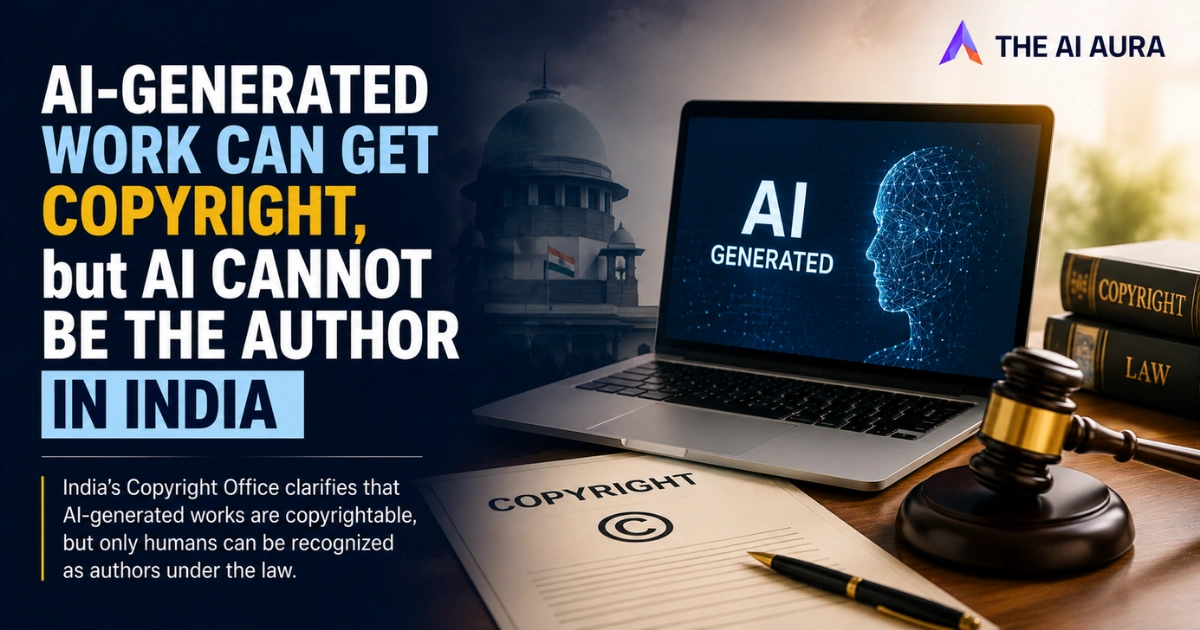
It confirmed that AI-assisted work can receive copyright protection. However, a machine cannot legally hold the title of “author.” This decision followed a rejected application for DABUS. Stephen Thaler created this AI system and listed it as the sole creator of visual art.
This ruling does not ban copyright for AI-assisted work. Instead, it distinguishes the artwork from the entity creating it. In India, technology does not block copyright protection. The real barrier is legal personhood, which statutory rights strictly require.
The Legal Mechanics Behind the DABUS Rejection
To understand this practice, examine the Copyright Act of 1957. This law relies entirely on human intellect, skill, and labor.
Under the Act, an “author” must be a legal person. This means a human or a recognized corporate entity that holds rights and liabilities.
When the Copyright Office reviewed the DABUS application, the AI system predictably failed the basic threshold of legal personhood.
An artificial intelligence cannot sign a contract, it cannot transfer rights, it cannot collect royalties, and crucially, it cannot be sued or held liable for infringement if its generated output inadvertently plagiarizes a human artist’s protected work.
The mechanics of copyright law demand a point of accountability. The Indian legal system operates on doctrines that require a “modicum of creativity” driven by human judgment. By naming DABUS as the author, the applicants attempted to grant legal agency to code.
The Copyright Office effectively ruled that AI, regardless of its autonomous capabilities or complex neural networks, remains a tool. Elevating an algorithm to the status of an author would break the chain of legal liability that copyright law is designed to manage.
Navigating the Loophole for Generative AI Creators
The DABUS decision does not strip protection from all AI content. It simply dictates how creators must file their applications.
Human users must step forward as legal authors. They must treat AI purely as a creative tool, similar to Photoshop or a digital camera.
Creators must show clear human intervention in the creative process. The user must provide creative direction and curate the output.
Simply typing a generic, one-line prompt into an AI image generator and claiming the raw output might struggle to meet the threshold of human authorship if heavily scrutinized in court.
However, if the human creator can demonstrate substantial creative control, precise selection, and iterative refinement, the Copyright Office is positioned to grant the copyright to that human.
This structural workaround ensures that the legal system maintains a human focal point for both ownership and accountability.
As generative AI becomes a permanent staple in commercial design, software development, and content creation, Indian businesses must adapt their IP strategies to ensure that all filings name the human operators not the underlying software as the definitive authors of the work.
Source: Bar & Bench, "AI-Generated Work Can Get Copyright but AI System Cannot Be Author: Indian Copyright Office"