
Silicon Valley loves a moonshot, and few sound better on a pitch deck than curing cancer. OpenAI’s Sam Altman frequently cites it to justify the push toward artificial general intelligence.
Google DeepMind’s Demis Hassabis previously suggested AI could cure all diseases within a decade. Even Anthropic’s Dario Amodei recently noted that the claim has crossed from credible to cliché.
Yet, despite the billions of dollars poured into AI drug discovery, the actual clinical results remain undeniably tepid.
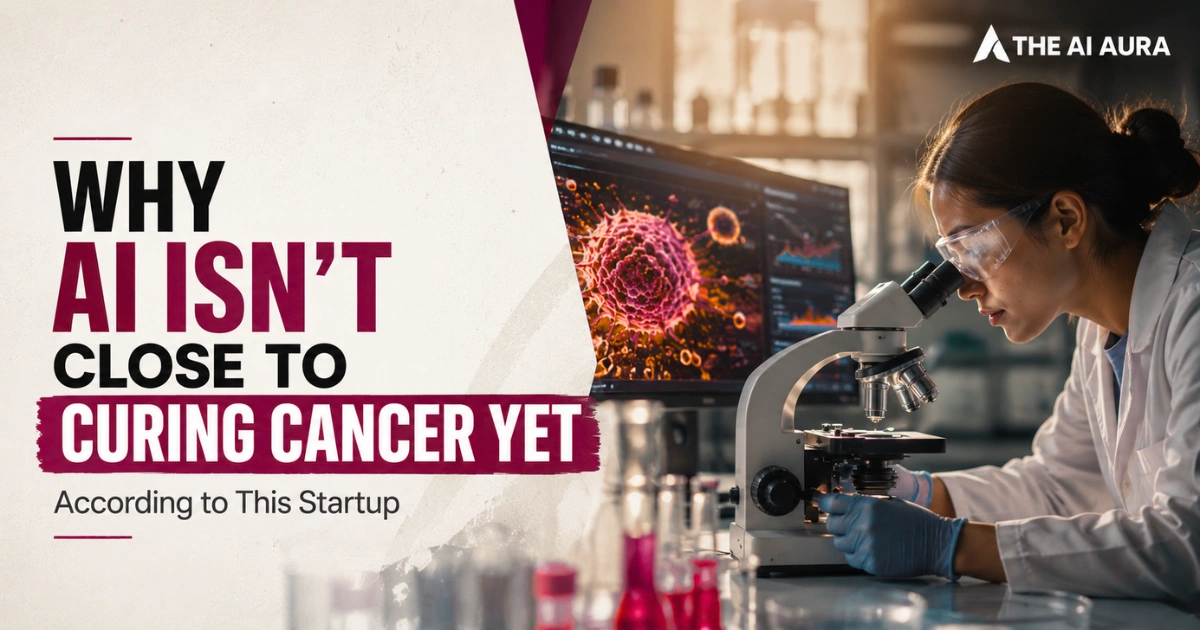
A rising biotech startup called Vivodyne points out exactly why: the artificial intelligence industry doesn’t have an intelligence problem.
It has a data problem. And until we fix the underlying information feeding these massive computational models, AI is just going to get incredibly good at curing cancer in mice.
The Problem With Training AI on Static Biology
Current AI models are starved of the right kind of biological context. While breakthroughs like the Nobel-winning AlphaFold revolutionized our understanding of protein structures, mapping the building blocks of life hasn’t translated directly into commercially viable drugs.
The roadblock isn’t a lack of computing power; it’s the flawed nature of the biological data being fed into the machines.
Right now, the pharmaceutical pipeline relies heavily on animal testing or isolated studies of single cells. This creates a massive blind spot. Historically, 90% of drugs that perform well enough in animal trials to reach human clinical phases end up failing to secure regulatory approval.
Vivodyne’s CEO and co-founder, Andrei Georgescu, believes the space is in desperate need of a sanity check. Generative AI models are currently trained on isolated, static snapshots of cellular data.
A model might learn what a specific cell looks like at state A and state B, but it completely misses the transition the actual biological process of how a cell becomes inflamed or diseased in the first place.
Without that causal relationship, models are essentially guessing in the dark when trying to predict how a living human body will react to a novel compound.
Building a “Human Data Center” to Uncover Causality
Spun out of the University of Pennsylvania in 2021, Vivodyne is taking a radically different, hardware-driven approach to drug discovery. The company has developed modular robotic labs called HIVE, which autonomously grow, dose, and monitor 20 different kinds of living human tissue.
Instead of relying on mice, Vivodyne generates its own causal biological data by tracking hundreds of thousands of active, ongoing experiments on actual human tissue. The results carry immense predictive weight.
The company reports that its engineered liver cells predict toxicity with 94% accuracy compared to human trials. Its airway tissue matches real human behavior 96% of the time, and its bone marrow has hit perfect concordance when tested against two dozen different chemotherapy drugs.
Backed by nearly $80 million from investors like Khosla Ventures, Vivodyne recently launched a massive “human data center” near San Francisco. The facility is already churning through experimental throughput at twice the rate of all U.S. animal trials combined.
Georgescu likens the pharmaceutical industry’s current approach to skipping safety tests in car manufacturing.
Automakers run countless simulated crash tests so they know a vehicle will pass regulatory standards before a physical prototype is built. Drugmakers, by contrast, frequently enter the massive expense of a clinical trial relying largely on hope and mouse data.
Vivodyne’s ultimate goal is to generate the continuous, dynamic reinforcement learning that AI actually needs to understand complex human biology.
Tomorrow’s most effective treatments won’t just target a single symptom; they will be complex combination therapies that require mapping out massive biological chain reactions.
We can’t search that vast biological space manually. But to let an AI do the heavy lifting, we have to teach it cause and effect first. Establishing that causality in actual human tissue is the only way we stop curing mice and start curing people.
Source: Official TechCrunch, "AI Isn’t Close to Curing Cancer. This Startup Says It Knows What It Will Take."