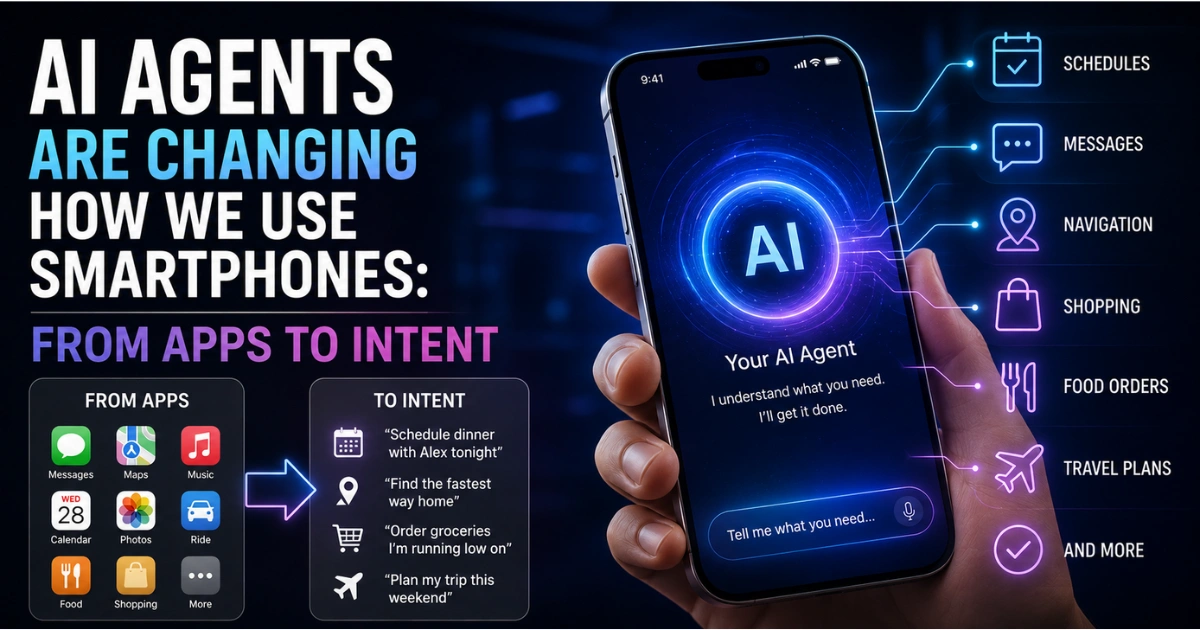

For nearly two decades, our relationship with mobile technology has been governed by a single, undisputed design: the app icon grid.
Ever since Apple launched the App Store in 2008, the burden of digital logistics has rested firmly on the user. Need a taxi? Open an app. Want to order dinner? Open another app. Pay a bill? Yet another.
Book a flight, check the news, edit a photo, send money, check your fitness, reserve a hotel, translate a menu, buy groceries there is an app for absolutely everything.
The modern smartphone is essentially a container filled with hundreds of miniature software silos. Each of these silos demands its own login, unique interface, privacy permissions, recurring subscriptions, and constant updates.
We’ve accepted this daily friction as the unavoidable cost of digital convenience. However, the underlying architecture of mobile computing is currently undergoing its most aggressive rewrite in history.
We are rapidly transitioning from an era of fragmented applications to an era of unified intent, driven entirely by sophisticated AI agents. The days of acting as a manual router for your own phone are coming to an end.
The Mechanics of Intent-Driven Computing
To understand how this shift operates on a technical level, we have to look past standard generative chatbots and focus on Large Action Models (LAMs) and agentic workflows.
Today, when you interact with a smartphone, you are the chief orchestrator. You manually bridge the gap between different, isolated walled gardens.
If you want to plan a Friday night out, you check your calendar app, open a restaurant platform to book a table, switch to a messaging client to send the invite, and finally launch a ride-hailing service to get there.
AI agents collapse this entire multi-app sequence into a single natural language command. Instead of clicking through software silos, you simply state your intent: “Book a table for two at an Italian place downtown at 8 PM, invite Sarah, and arrange a ride.”
The agent operates natively at the operating system level, bypassing individual app interfaces entirely.
It interprets your request, breaks it down into logical, sequential tasks, interfaces directly with third-party APIs securely in the background, and executes the actions. The AI acts as a highly capable digital proxy, dynamically reasoning through real-time obstacles.
If the first restaurant is fully booked, the agent automatically pivots to a comparable secondary option without requiring your micro-management. It transforms the smartphone from a passive grid of tools into an active, autonomous engine.
Dismantling the Software Silo
This agentic framework fundamentally breaks the traditional app economy that tech giants have relied on for over fifteen years.
Developers have spent vast resources optimizing for screen time, intrusive push notifications, and user retention within their specific walled gardens.
But when AI agents mediate the interaction between the user and the digital service, the graphical user interface (GUI) loses its dominance.
We are moving toward a reality where mobile applications become entirely “headless.” The visual design and branding of an app will matter far less than how efficiently its backend API can communicate with the phone’s central AI agent.
If your on-device agent is booking a cross-country flight, you no longer care what the airline’s user interface looks like. You only care that the transaction was completed accurately, at the right price, and securely.
For users, this represents the ultimate frictionless computing experience. The heavy cognitive load of navigating dozens of different software environments vanishes completely.
You will no longer hunt for the right icon on page three of your home screen or try to remember which specific app handles which micro-task. Instead, the smartphone’s operating system becomes an invisible, ambient layer that simply executes your will.
By shifting the computational burden from the human to the machine, AI agents are redefining what a phone actually is.
Source: The Times of India, "From Apps to 'Intent': How AI Agents Will Rewrite the Way We Use Next-Generation Smartphones"