
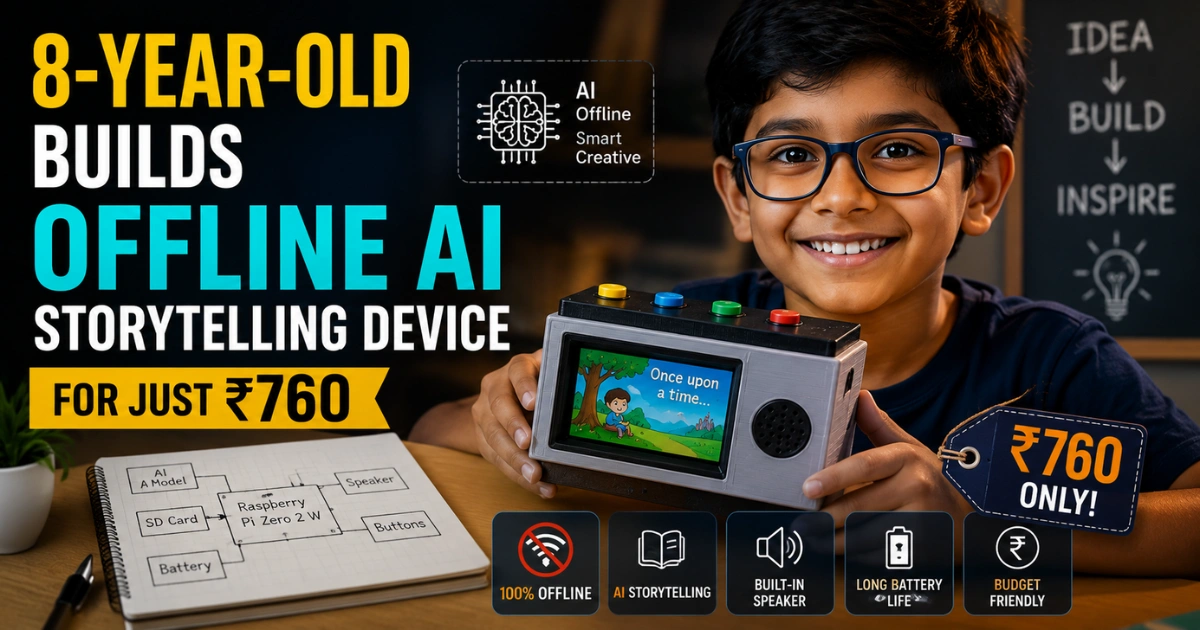

The tech industry is currently obsessed with massive server farms and billion-dollar cloud compute clusters. Yet, one of the most fascinating AI deployments this month didn’t originate from a massive tech conglomerate it came from an eight-year-old.
Laksh, the young hardware developer behind “Projects by Laksh,” has engineered a fully functional, voice-controlled AI storytelling device. The standout metric isn’t just his age; it’s the cost and the system architecture.
Built for merely ₹760 (around $8), this unit operates completely off the grid. It requires absolutely no Wi-Fi, zero API keys, and no monthly cloud subscriptions.
It is a striking demonstration of localized edge computing that challenges the prevailing assumption that interactive AI requires constant internet connectivity to function.
Breaking Down the ESP32 Hardware Stack
Looking under the hood, the ingenuity of this build lies in extreme resource constraint management. At the core of the device sits an ESP32-S3 microcontroller.
The ESP32 is widely used in IoT and embedded devices. However, its limited memory makes it difficult to run generative text and audio models locally.
Laksh paired the ESP32 with an INMP441 omnidirectional microphone to capture voice input. A MAX98357A amplifier powers a basic I2S speaker for audio playback.
The technical heavy lifting happens entirely locally. Most voice assistants send commands like “play,” “pause,” or “next story” to remote servers for processing. Laksh’s device handles those commands locally instead. Laksh’s system bypasses this completely.
It manages voice activation, localized intent recognition, and the actual story generation right on the silicon. Furthermore, the microcontroller simultaneously manages to drive a screen to display simple accompanying animations.
Running text generation, text-to-speech, and voice recognition within the ESP32’s limited SRAM is a significant engineering challenge.
It requires aggressive software optimization, severe quantization, and a deep understanding of how to strip a system down to its absolute bare metal without breaking its core functionality.
Why Localized Edge Computing is the Next Frontier
This ₹760 prototype highlights a massive, largely untapped opportunity in the consumer hardware market: latency-free, privacy-first AI.
Whenever an intelligent system operates without pinging an external server, it immediately eliminates data privacy risks, connectivity bottlenecks, and ongoing infrastructure costs.
For a storytelling gadget designed to be used in a child’s bedroom, the security benefit of keeping raw audio data strictly localized on the physical device is a massive selling point that many enterprise smart speakers still struggle to offer.
From a broader systems architecture perspective, what Laksh has prototyped is a miniature blueprint for the future of distributed AI. The hardware industry is actively pivoting toward a hybrid deployment model.
Massive, parameter-heavy models will remain in the cloud for complex reasoning, but lightweight, hyper-optimized models are rapidly moving to edge devices to handle immediate, localized tasks without latency.
The fact that an eight-year-old assembled a seamless, interactive AI loop using off-the-shelf, low-cost components proves that the barrier to hardware-level AI integration is collapsing fast.
If a complete voice-to-generation pipeline can run smoothly on an $8 chip today, the next wave of embedded smart devices will be remarkably powerful, highly affordable, and entirely decoupled from the cloud.
Source: India Today, "8-Year-Old Builds Offline AI Storytelling Device Using Rs 760 Microcontroller"