
Historically, discovering a new material required extreme patience. Thomas Edison famously tested thousands of physical filaments. He did this before finding the right one for his incandescent lightbulb. This set a precedent for a slow, iterative process.
That process defined industrial chemistry for a century. Today, our technological ambitions demand a much faster pipeline. We need solid-state batteries, biodegradable semiconductors, and carbon-capture frameworks quickly.
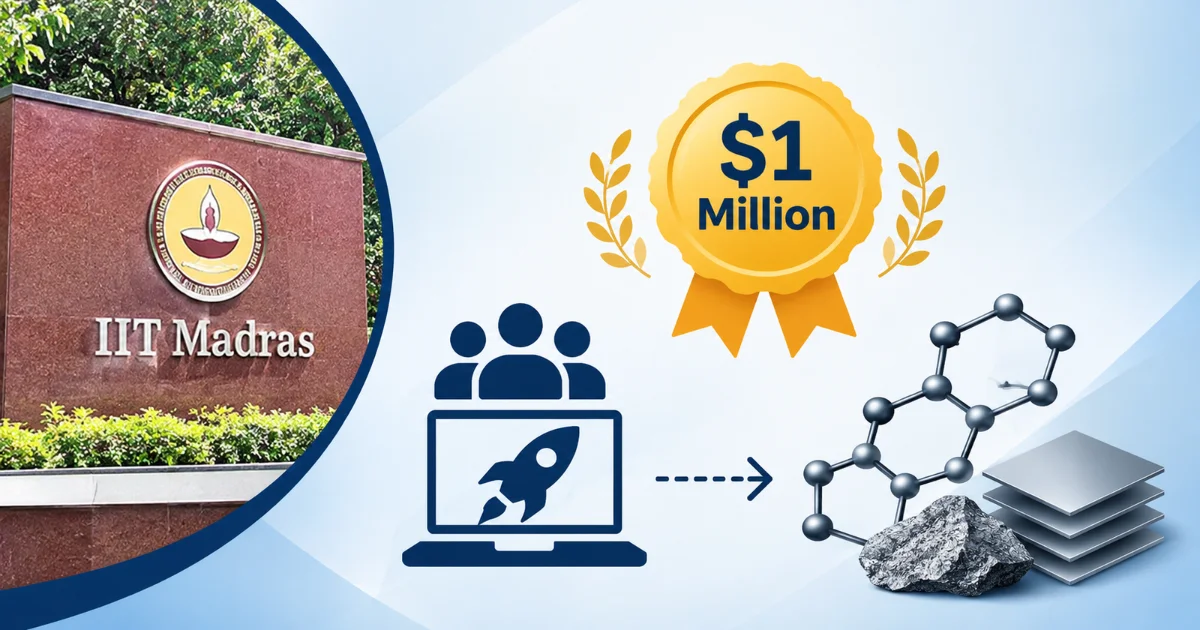
We simply cannot spare decades for incremental laboratory trial and error. This urgency drives massive funding into the intersection of AI and materials science. Recognizing this bottleneck, an AI startup founded by IIT Madras alumni took action.
They placed a massive financial bounty on the table. They offer up to one million dollars to anyone who can solve five notoriously difficult scientific challenges.
Accelerating Discovery Through Predictive Modeling
To understand why a deep tech company is offering such a massive reward for external research, we have to examine how machine learning fundamentally alters the laboratory workflow.
Traditional discovery relies on sequential physical synthesis and testing. Human working hours and physical laboratory resources severely limit this process. Modern AI shifts this entire workflow into a high-dimensional computational space.
Developers train sophisticated neural networks on massive datasets. These datasets include known chemical structures, atomic properties, and historical failure rates.
The algorithms then evaluate millions of molecular combinations in a fraction of a second. Scientists no longer physically mix volatile compounds and wait for results.
Instead, the AI predicts the exact quantum mechanical interactions. It also forecasts the thermal stability and structural integrity of a hypothetical material. The AI does all this long before researchers purchase a single chemical.
This computational leap is what makes the current million-dollar bounty so strategically important. The startup is leveraging advanced graph neural networks to map out complex atomic structures, but the founders intimately understand that theoretical models cannot solve industry-wide hardware bottlenecks without rigorous physical validation.
According to a detailed breakdown of the initiative published at Hindustan Times, the company is using this prize pool to crowdsource the critical step of translating AI-generated molecular candidates into physically viable substances.
They are essentially funding the missing link between a computer algorithm’s mathematically perfect prediction and the messy, unpredictable reality of physical laboratory synthesis.
Overcoming the Physical Synthesis Bottleneck
The core problem currently plaguing AI-driven materials science is not generating novel chemical compounds; it is figuring out how to actually manufacture them in the real world.
An algorithm might easily design a crystalline structure with flawless electrical conductivity, but if the required synthesis temperature causes the foundational elements to vaporize instantly, the material remains nothing more than a digital phantom.
The startup’s financial incentive is strategically designed to attack this exact friction point in the research pipeline. It challenges independent scientists to develop scalable, repeatable manufacturing pathways for these computationally verified materials.
By crowdsourcing the physical execution to global experts, the company bypasses the traditional, time-consuming bottleneck of building and staffing their own massive wet labs.
This decentralized approach to research and development signals a massive shift in how deep tech operates today. Companies are no longer confined by the physical limitations of their own testing facilities; instead, they function as algorithmic architects who leverage their capital to incentivize the broader scientific community to physically build their most complex digital blueprints.