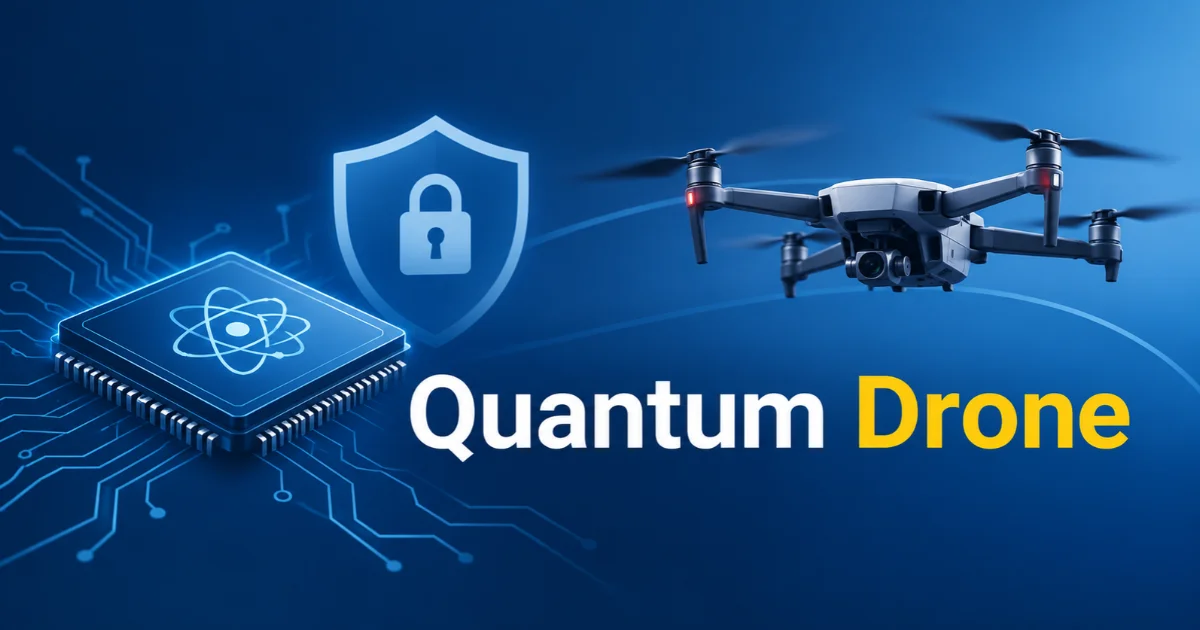

The rapid proliferation of unmanned aerial vehicles in critical sectors has brought an underlying vulnerability to the surface: the communication links connecting these drones to their operators. As quantum computing advances from theoretical physics to a tangible reality, the legacy encryption safeguarding our skies is inching closer to obsolescence.
To preempt this looming cybersecurity crisis a threat landscape heavily influenced by how hackers and defenders are using AI in 2026 the Odisha-based deep-tech start-up Quanshium AI Core Private Limited has successfully engineered an indigenous quantum-secure communication link.
Recently, the Odisha-based startup tested this technology on a 4G/5G drone. They successfully transmitted data over 10 kilometers. Therefore, this breakthrough significantly protects aerial telemetry. By moving this security into live platforms, the company actively future-proofs drone networks.
The Mechanics of Quantum-Resistant Encryption
The new secure link integrates two advanced cryptographic components. Together, they eliminate interception risks. First, the system uses a Quantum Random Number Generator (QRNG).
Traditional encryption uses software algorithms to create keys. Because mathematical formulas generate these keys, they are only pseudo-random.
As a result, powerful machines could easily predict them. In contrast, a QRNG derives randomness from physical quantum states. Thus, it generates fundamentally unpredictable numbers. Ultimately, this creates a randomized foundation for security keys.
The second crucial layer is Post-Quantum Cryptography (PQC). While the QRNG handles the generation of the keys, the PQC provides the actual encryption framework designed specifically to withstand brute-force decryption attempts from both conventional supercomputers and future quantum processors.
According to a comprehensive industry report detailing the successful flight test at Business Standard, Shaswat Kumar Lenka, founder and CEO of Quanshium AI Core, explained that securing telemetry, live video feeds, and command signals is absolutely crucial as these platforms transition into active defence roles.
The QRNG fortifies the cryptographic keys, while the PQC algorithms actively protect the data stream in real-time. This dual-layered approach ensures that sensitive information flowing between the ground control station and the drone remains completely inaccessible to unauthorized manipulation, even if the transmission is intercepted.
Strategic Independence in Aerial Surveillance
Integrating this level of cryptographic resilience into a live aerial platform addresses a critical gap in modern defence and infrastructure monitoring. Drones are now heavily deployed for military reconnaissance, border surveillance, logistics, and the protection of critical power grids.
As these vehicles beam back sensitive intelligence and execute remote commands, their communication channels inherently become high-value targets for hostile actors seeking to exploit data leaks and bypass security protocols.
Up until now, much of the underlying security infrastructure relied heavily on imported technologies, creating a strategic vulnerability for domestic defence initiatives.
Developing this technology natively shifts that dynamic. Specifically, it ensures our encryption standards remain completely self-reliant.
Additionally, they become immune to foreign supply chain disruptions. Moving beyond theory, the 10-kilometer field test proved highly successful. It showed developers can streamline complex quantum protocols.
Therefore, they operate effectively on standard cellular networks without latency. Indeed, this operational viability makes the innovation highly disruptive. It proves forces can deploy military-grade security on mobile platforms today. Ultimately, this secures the airspace before the global quantum threat materializes.