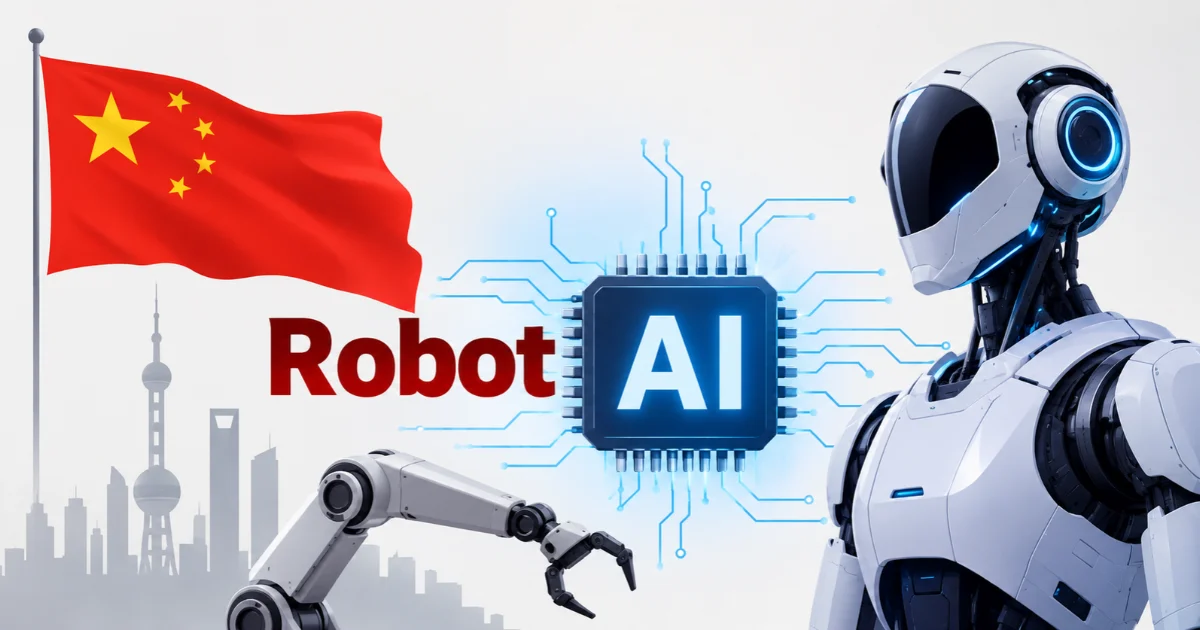

The spectacle of humanoid robots performing synchronized backflips, dancing, and executing flawless parkour routines has largely lost its novelty. For years, the global robotics industry obsessed over mechanical agility. Companies drove down hardware costs and continually pushed physical limits.
Now, the sector is undergoing a massive pivot. The realization across major manufacturing hubs is that physical capability means very little without cognitive adaptability.
Chinese robotics companies are heavily redirecting their capital. They are pouring billions of dollars into a specific software frontier known as embodied AI. Hardware costs are falling fast. Manufacturers now know a robot’s true commercial value comes from its brain, not its body.
How Embodied AI Changes the Game
To understand how this shift works in practice, we have to look at how robots have traditionally been operated. Historically, industrial machines were driven by rigid, millions-of-lines codebases designed for highly specific, repetitive motions. If a part on an assembly line was shifted by half an inch, the robot would fail.
Embodied AI fundamentally breaks this mold by allowing a machine to perceive its environment, intuitively understand physics, and adapt to unfamiliar tasks without requiring manual reprogramming for every single variable.
According to a detailed industry breakdown at Reuters, developers are now racing to build models where robots can acquire handling skills by simply watching a short video of a human performing a task.
This requires a massive shift in how artificial intelligence is trained. Unlike conversational language models that simply scrape the internet for text, robots require high-fidelity physical data.
Startups are tackling this immense challenge head-on. They employ hundreds of human workers wearing advanced sensors. These workers meticulously record grip forces, tactile feedback, and spatial movements. Others take a digital approach by building hyper-realistic virtual environments.
Here, robots run millions of trial-and-error simulations in just hours. The ultimate goal is to move beyond hard-coded scripts. Researchers want machines to operate with basic common sense. A smart robot should inherently know how to adjust its grip if a wire bends unexpectedly.
The Hardware Bottleneck and Real-World Testing
While the software architecture is rapidly advancing, training these sophisticated models requires immense computing power. The algorithms dictating physical interactions must process spatial awareness, weight distribution, and object recognition simultaneously with near-zero latency.
Chinese developers face specific hurdles in this arena, largely due to international export controls limiting access to top-tier AI processing chips. To bypass these compute bottlenecks, engineers are refining their training data to prioritize absolute quality over sheer volume, while simultaneously testing lighter, more efficient models on active factory floors.
Because China possesses an expansive manufacturing ecosystem, developers have the unique advantage of plugging their experimental AI directly into live production lines.
Companies are already deploying these intelligent systems to execute delicate maneuvers, such as plugging flexible wires into battery packs on active assembly lines or sorting complex pharmaceutical orders in live retail environments alongside human staff.
When a robot encounters an object just out of its grasp, the AI allows it to improvise like pushing a nearby crate to use as a stepping stool rather than shutting down and triggering an error code.
As researchers anticipate a looming threshold where machines can complete a vast majority of physical tasks in completely unfamiliar environments based purely on spoken instructions, the race is no longer about building a stronger robot, but a smarter one that can actually think on its feet.