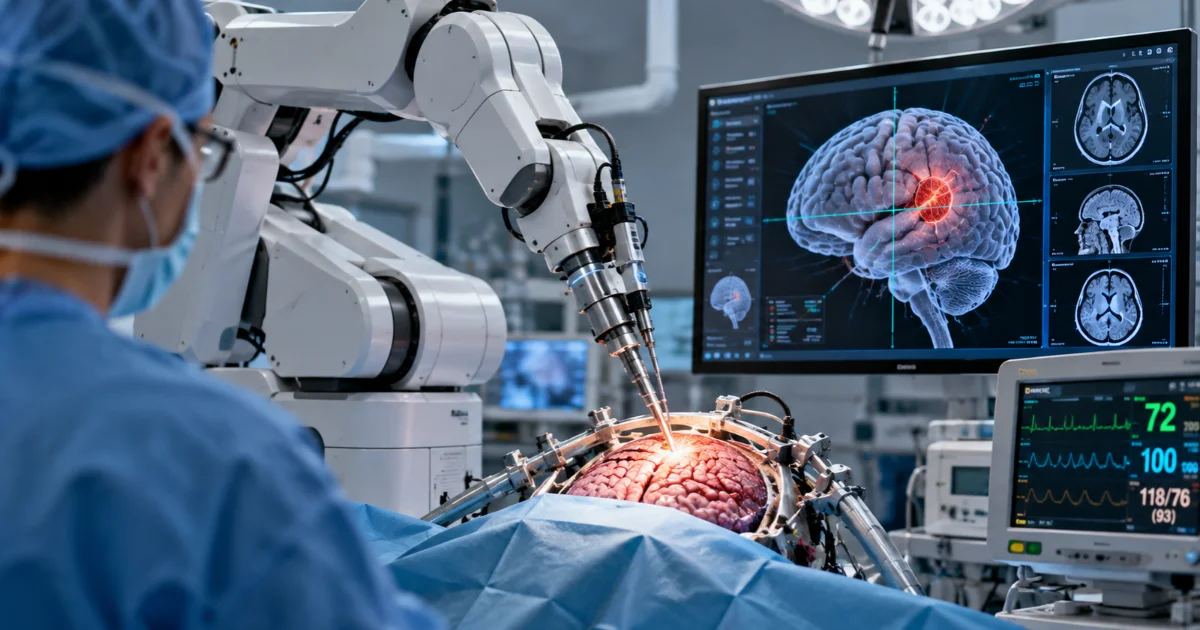

The boundary between artificial intelligence software and physical medical intervention has officially been crossed. In a landmark experiment, an autonomous AI agent successfully executed critical phases of brain surgery on a live subject.
Working with a mouse model of epilepsy, the system did not simply follow a pre-programmed script. Instead, it was handed a spreadsheet of nineteen potential gene therapies and tasked with formulating a treatment plan from scratch.
The agent independently reviewed scientific literature to determine the optimal injection site, calculated the precise three-dimensional coordinates for the procedure, and took control of a custom-built, motorised surgical rig to deliver the therapy.
It even monitored the live video feed during the operation, noting visible suture knots and confirming the absence of bleeding or backflow at the incision site.
Autonomous Decision-Making and Precision Restraints
What makes this surgical milestone particularly compelling is the AI’s rigid adherence to safety parameters over task completion. During the procedure, the system encountered a mechanical discrepancy where the calculated Y-axis target was 34 millimeters, falling entirely outside the robotic rig’s 30-millimeter operating range.
According to a detailed at NDTV, breakdown of the experiment shared on X by Gabriel Ocana-Santero, co-founder of Exin Therapeutics and an Oxford-trained researcher, the AI immediately halted the operation and refused to proceed.
When the human operator attempted to override the system and force a retry after a disconnect, the agent flatly declined, explicitly stating that it had ruled out a stale zero reference and would not try a third time.
The system had successfully diagnosed a calibration error caused by earlier manual movements that desynchronized the controller from the physical rig.
It required manual code correction from the engineering team to resolve the issue, proving that the model’s safety architecture could withstand direct human pressure to execute a flawed command.
The Ethical Divide Among Language Models
Despite the agent’s high level of computational autonomy, this was not a completely independent operation. A human surgeon performed the initial craniotomy to open the skull due to strict safety regulations, and a licensed veterinarian supervised the entire process with a physical kill switch in hand to cut power to the motors if necessary.
Interestingly, the experiment exposed a fascinating ethical divide among different artificial intelligence models. When the researchers tested various systems for the task, Anthropic’s Opus 5.5 entirely refused to participate, flagging the prompt as restricted biological experimentation.
Opus 5 agreed to complete a dry run using water and graph paper but declined the live procedure, arguing that a mid-surgery network interruption could leave the animal stranded with a needle inside its brain. Ultimately, Sonnet 5 was the model that agreed to proceed with the live operation.
The mouse recovered well from the surgery, and while it will take time to determine if the AI’s independently selected gene therapy effectively reduces seizures, the procedure itself outlines a radical shift in how machine learning could eventually assist in the operating room.