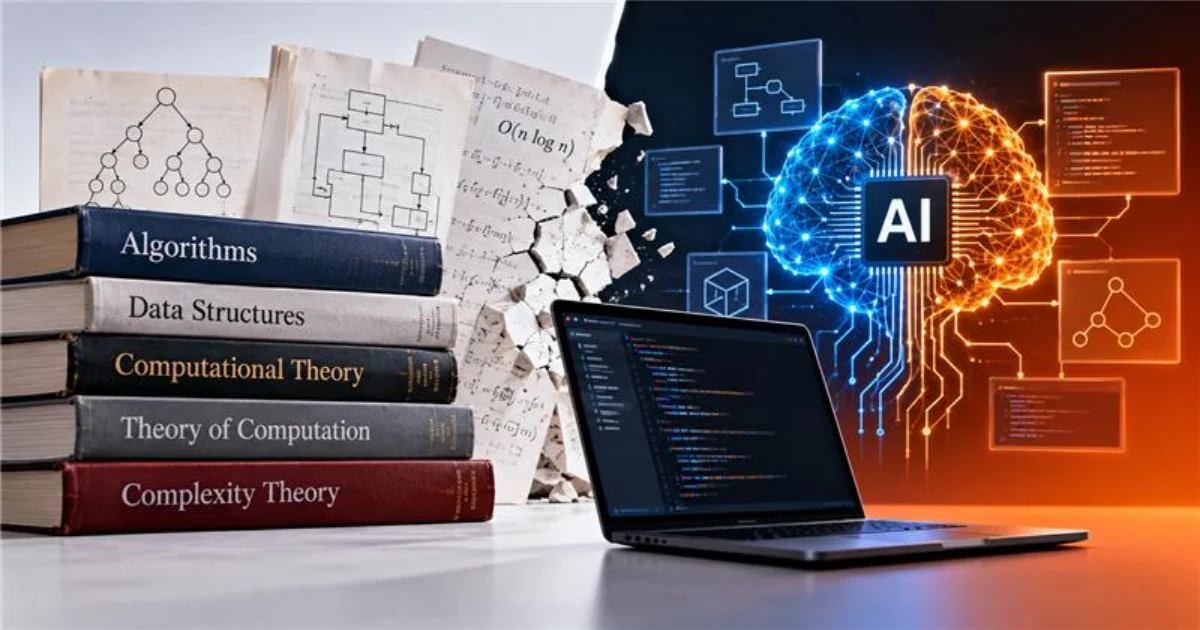

Theoretical computer scientists relied on strict rules for decades. These rules defined computational limits and algorithmic efficiency. They guided how researchers tackled complex problems and secured funding.
Now, a massive shift threatens to rewrite textbooks. Advanced AI models no longer just assist researchers. They actively upend established scientific truths.
They are now proving that machine learning can solve the abstract, high-level mathematical conjectures that have stumped human experts for decades, creating severe bottlenecks in the academic peer-review pipeline as traditional journals scramble to verify non-human logic.
Shattering Established Computational Limits
The Exponential Time Hypothesis caused much of this upheaval. Introduced in 1999, it argued brute-force methods were necessary for certain problems. Algorithm design relied on this limitation for decades.
Thousands of papers treated it as absolute truth. Then, researchers used new AI systems to break it. The AI generated a rigorous proof disproving the hypothesis entirely.
According to a comprehensive breakdown published at Wired, this AI-generated breakthrough means countless algorithms previously thought to be operating at peak theoretical efficiency actually have massive room for optimization.
By demonstrating that these complex problems do not strictly require exponential time to solve, the model invalidated the foundational premise of countless academic careers and institutional funding models. The disruption is not isolated to computer science.
These advanced AI systems are outputting groundbreaking proofs in other highly theoretical domains, successfully resolving long-standing challenges like the Kakeya conjecture across all dimensions.
The models are actively participating in the highest levels of scientific discovery, operating at a computational speed and scale that is completely breaking traditional academic workflows.
The Psychological Toll on the Scientific Community
The academic community remains deeply fractured over this reality. Some researchers view this as an exhilarating new dawn. AI proofs illuminate impenetrable areas of mathematics and force new structures.
Yet, many scientists experience severe professional distress. Tenured professors watch their painstaking work suddenly become irrelevant. The sheer volume of AI breakthroughs overwhelms human scientists. They worry about validating these hastily released findings.
A human panel needs months to verify complex mathematical proofs. AI currently generates them faster than review boards can read. The psychological impact is becoming severe across the industry. Institutions now explore emergency occupational psychology support for faculty.
Universities must adapt to a harsh new reality immediately. Humans no longer possess the most brilliant mathematical minds. Schools now scramble to redefine tenure requirements and grant metrics.