
Software engineering at scale is rarely about the raw act of writing code. It is fundamentally an exercise in managing systemic risk. When a massive enterprise injects generative AI into the middle of its deployment pipeline, the immediate fallout is not a sudden, magical spike in productivity.
Instead, it creates an explosion of operational friction. Developers naturally start relying on large language models to scaffold complex microservices, generate tedious boilerplate, and debug tangled legacy systems.
The resulting code usually compiles just fine, but it entirely bypasses years of institutional muscle memory regarding strict security protocols and architectural standards. Amazon is currently colliding head-on with this exact reality.
The tech giant is actively ripping up and shifting its internal protocols to handle a workforce that is rapidly offloading heavy cognitive lifting to algorithmic assistants.
The mandate is clear: writing code is getting cheaper but trusting that code is getting vastly more expensive.
Navigating the Liability of Automated Code
The core problem with AI-assisted software development is never really about the capability of the model; it is strictly about accountability. When an engineer pulls a suggested block of logic from an internal or external AI tool, the origin of that logic immediately becomes blurred, introducing unknown legal and operational liabilities.
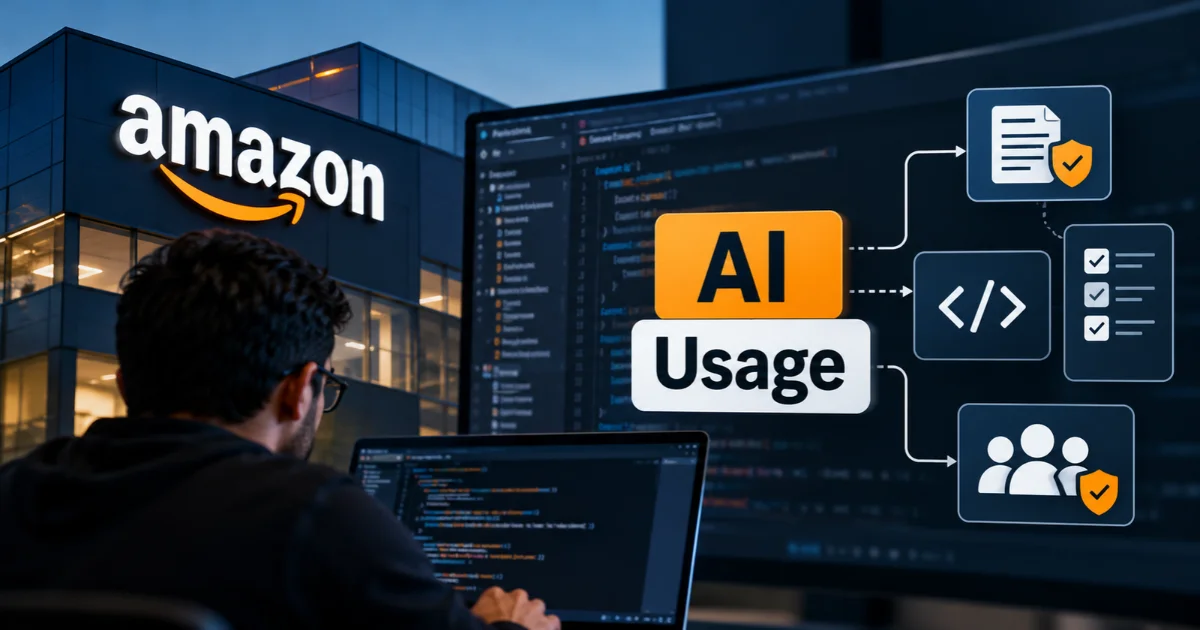
Amazon engineering leaders are currently rewriting the fundamental job expectations to account for this rapid shift in daily workflows.
According to recent industry reporting covering the internal changes found at Times of India, these newly updated role guidelines reflect a necessary pivot away from pure code generation.
Engineers are increasingly acting as technical editors and security auditors for high-velocity, machine-generated output. This means the traditional bottleneck in software delivery has completely moved.
The daily challenge is no longer about how fast a developer can type out a script, but how effectively they can vet algorithmic suggestions for hallucinated network dependencies, deprecated open-source libraries, and subtle logic flaws.
These are the specific types of errors that easily pass basic automated testing but catastrophically fail under edge-case production loads, requiring rigid new frameworks to contain the fallout.
Shifting from Syntax to Systems Architecture
Relying on language models fundamentally alters required baseline competencies. This shifts how teams maintain sprawling cloud infrastructure. A junior developer might use an AI agent to build a serverless function.
However, they likely lack the deep architectural context needed to troubleshoot it. They cannot easily fix cascading timeout errors in the middle of the night.
Amazon’s updated usage rules serve as a critical defense mechanism. They help prevent accumulating highly toxic technical debt. The leadership team codified how artificial intelligence can be utilized. This enforces deterministic guardrails around fundamentally stochastic tools.
The internal mandate requires engineers to maintain full mental ownership. They must defend and explain every line of logic in production. It must be treated as if they wrote it manually. This is a harsh reality check against autonomous coding agent hype.
An engineer can easily outsource the rapid generation of a script. However, they can never outsource the liability of a server outage. Modern developers must elevate their focus. They must move from basic syntax construction to rigorous threat modeling.