
Generative artificial intelligence is no longer confined to enterprise tech stacks or developer environments. It has trickled down to everyday consumer applications, drastically altering how information is consumed, manipulated, and shared.
Recognizing the urgent need for digital literacy in this domain, the National Council of Educational Research and Training has officially rolled out a specialized curriculum.
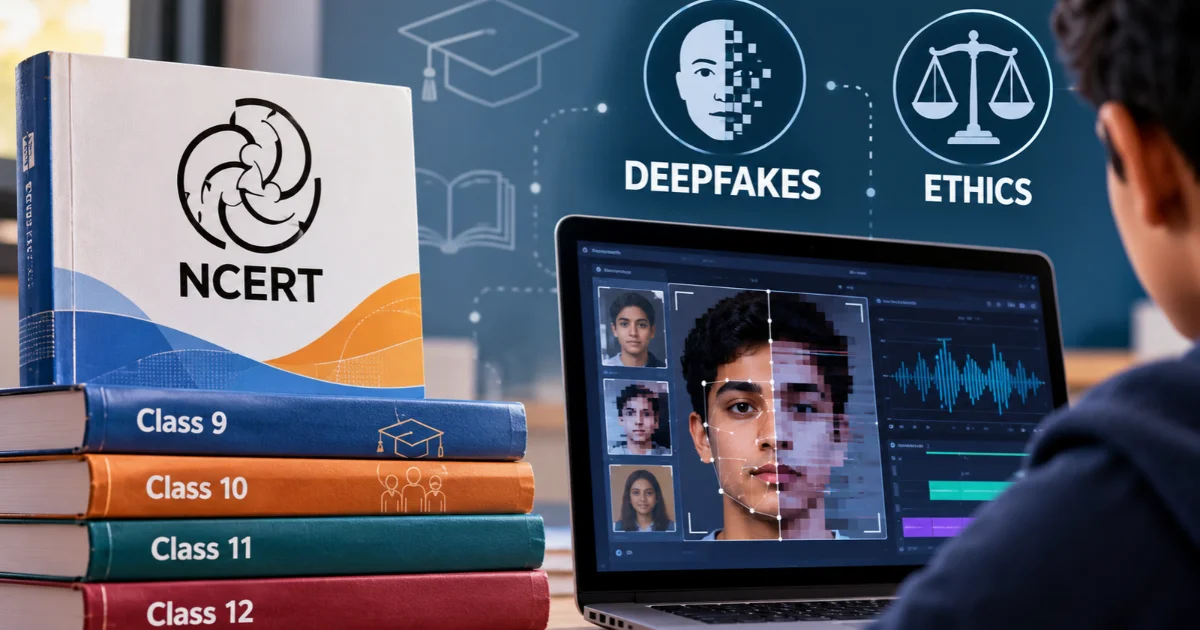
This NCERT 20-hour AI module for classes 9 to 12 aims to ground students in the realities of machine learning, moving them away from blind reliance on algorithmic outputs. Rather than treating artificial intelligence as an infallible magic box, the curriculum forces young learners to peek under the hood.
They are taught to question how these models generate responses, where the training data originates, and what inherent limitations exist within the architecture. This represents a significant pivot in secondary education, treating AI literacy with the same foundational importance as basic computer science.
Decoding the Mechanics of Computational Thinking
Introducing complex algorithmic concepts to students with absolutely no prior background in artificial intelligence requires a structural teardown of how machines actually process information.
To achieve this, the educational body collaborated closely with technical experts from IIT Madras and IIT Jodhpur. The resulting framework heavily emphasizes computational thinking, framing it as a highly systematic approach to problem-solving rather than just an abstract coding exercise.
According to a recent report on the release published by The Hindu, the curriculum adopts an experiential learning model built around practical experimentation, discussions, and reflection rather than traditional rote memorization.
By stripping away the intimidating jargon usually associated with neural networks and large language models, the course focuses on fundamental mechanics.
Students learn exactly how machines recognize patterns from vast datasets and why those patterns might occasionally be flawed or biased. This foundational knowledge is critical for modern digital interaction.
If a student understands the underlying mechanism of predictive algorithms or image generation, they are far less likely to accept AI hallucinations as factual truth. They shift from being passive consumers of technology to informed operators who know how to rigorously test and evaluate the systems they interact with daily.
Navigating Deepfakes and the Ethics of Data Privacy
Understanding the core technology is only half the battle. Navigating massive ethical landmines forms the other half. Synthetic media grows increasingly sophisticated every day. Discerning reality from AI-generated fabrication is now an essential survival skill.
The newly introduced curriculum dedicates significant time to the mechanics and dangers of deepfakes. Teenagers face unique vulnerabilities regarding digital misinformation and manipulated media. This early intervention remains crucial for their digital safety.
The module strips away deepfake sensationalism to explain actual synthetic media mechanics. Students learn visual cues to spot manipulated content. Furthermore, the curriculum tackles the often-ignored concept of data privacy. Educators highlight strict ethical boundaries around personal information.
They explore the consequences of feeding sensitive data into public models. Through guided discussions and hands-on exercises, learners map out their digital footprints.
The overarching goal is cultivating a deep sense of digital responsibility. Students will approach every AI interaction with analytical skepticism. They will actively verify outputs and respect ethical technology boundaries.