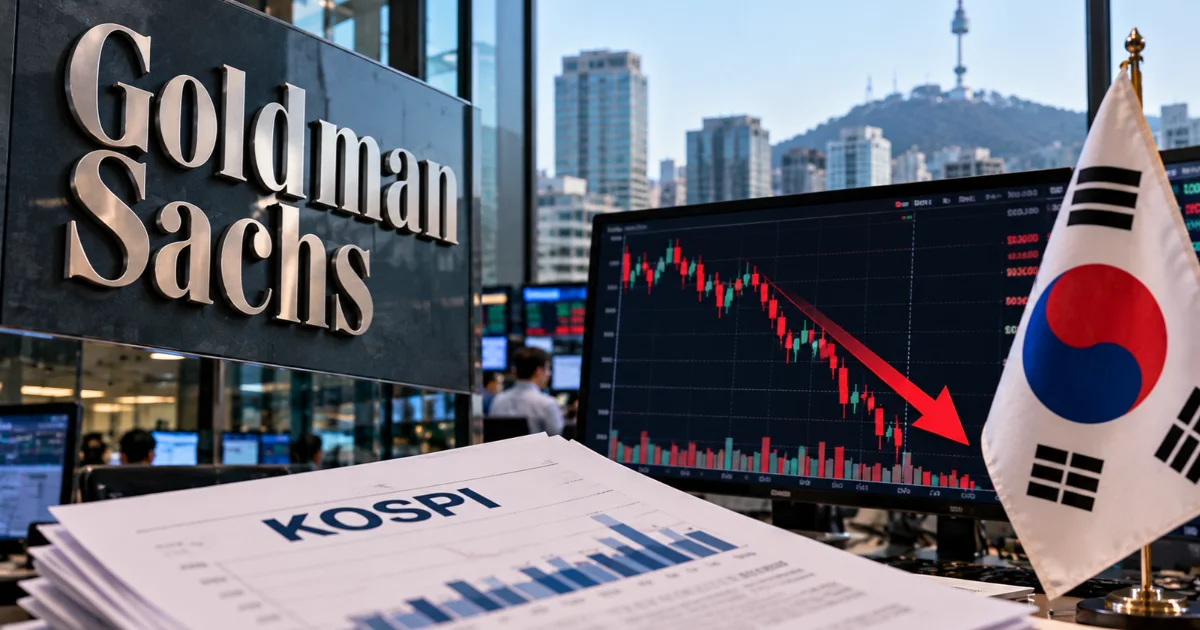

The AI supercycle faced an inevitable collision with financial pragmatism. We are now watching this reality unfold across East Asian equity markets. Goldman Sachs officially slashed its twelve-month KOSPI index target by a stark 25 percent.
The firm stepped back from an aggressively bullish stance. Institutional investors now heavily scrutinize massive AI infrastructure spending and semiconductor valuations.
For a year, capital poured blindly into memory chipmakers and the AI supply chain. Investors assumed infinite, price-agnostic demand. But the narrative is rapidly shifting. High financing costs and delayed returns on multibillion-dollar AI investments force a market-wide recalibration.
The benchmark index shed over 35 percent from its June peak. Major financial institutions must now revise their quantitative models. They are rethinking their exposure to hardware-heavy equities.
Timothy Moe and his team of strategists at Goldman Sachs adjusted their projection down to 9,000 from the previous 12,000 mark. While this appears to be a severe retreat on paper, according to a recent market breakdown by NDTV Profit , the investment bank actually maintains that the market still offers significant upside following this aggressive selloff.
The revised forecast is less of an abandonment of the South Korean tech sector and more of a sobering adjustment to how markets value corporate fundamentals in a constrained macroeconomic environment. In fact, even with the target reduction, their underlying math still implies a potential upside of more than 60 percent from current trading levels.
The Semiconductor Earnings Reality Check
Korean equities have violently swung from being the absolute darlings of the global market to trading at multi-decade discounts. Right now, the twelve-month forward price-to-earnings ratio for the index has collapsed to roughly four times. This is a basement-level valuation that the financial world has not witnessed since 2006.
The underlying anxiety driving this multiple compression is that the massive capital expenditure required by hyperscalers to build out AI data centers will not translate into sustained software revenue.
If the enterprise adoption of generative tools slows down, chipmakers could be left holding the bag on massive overcapacity.
Goldman’s models suggest that current semiconductor equity prices are baking in a catastrophic 65 percent collapse in sector earnings by 2027. That level of extreme pessimism borders on irrationality.
The market is essentially pricing in a complete failure of the artificial intelligence monetization cycle, which directly contradicts the enterprise integration rates we are currently seeing in the field.
Finding Value Beyond the Hype
If you look past the dominant memory hardware segment, which makes up about half the index, the rest of the South Korean market is trading at an entirely reasonable 7.6 times forward earnings.
Goldman has made it clear that while they are lowering their headline target, they are not fleeing the region entirely. The smartest capital is simply rotating to safer ground.
There is a distinct strategic pivot toward sectors that are insulated from the AI hardware bottleneck. The bank is currently favoring power infrastructure, which is ironically required to run those same high-compute data centers, alongside traditional industrial manufacturing.
We are also seeing a renewed appetite for corporate governance-related plays that aim to fix historical valuation gaps, as well as businesses positioned to leverage domestic reflation and the continued global export of Korean culture.
Ultimately, this target cut is a symptom of AI fatigue rather than a terminal diagnosis. Institutional capital is demanding hard proof of return on investment rather than just a compelling narrative about the future of computing.
The recent selloff represents an overly pessimistic repricing, and while markets will likely stabilize, the era of blank-check valuations for anything tangentially related to artificial intelligence is over.