
Enterprise adoption of generative models has rapidly outpaced the talent market. Today, companies try to deploy complex agentic workflows. However, they lack engineers who understand practical deployment mechanics.
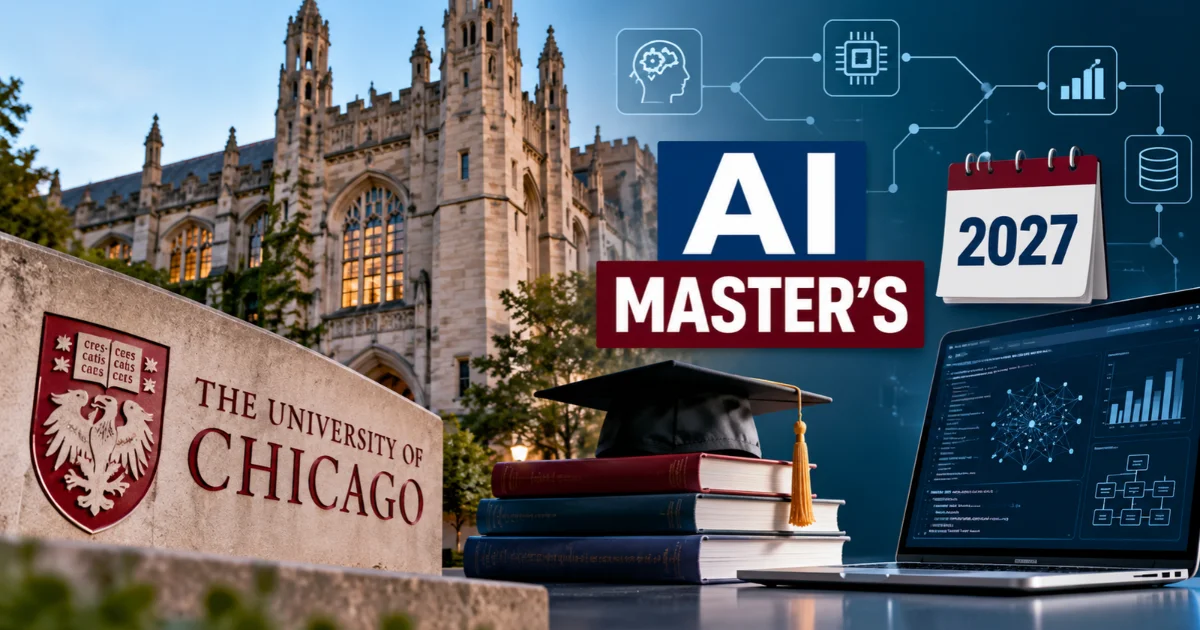
The University of Chicago aims to fill this void. The institution has launched a new Master of Science in Applied Artificial Intelligence. It will welcome its first cohort in autumn 2027. The program shifts focus away from purely theoretical machine learning. Instead, it prioritizes rigorous, production-grade engineering.
The degree runs as a nine-month, full-time intensive. It targets candidates who already possess technical proficiency. The Physical Sciences Division and the Data Science Institute jointly run the curriculum. Together, they address a persistent industry frustration
Operating as a nine-month, full-time intensive, the degree heavily targets individuals who already possess a baseline technical proficiency. The physical sciences division and the data science institute at the university are jointly orchestrating the curriculum to address a persistent industry frustration.
The broader goal is fairly straightforward. The tech sector needs fewer graduates who solely know how to train models in sterile, vacuum-sealed academic environments, and desperately requires practitioners who understand system architecture, deployment latency, and real-world integration.
This upcoming program intends to solve the common bottlenecks that explain why AI projects fail before they ever reach production, bridging the gap between abstract academic theory and the messy reality of enterprise software development.
Structuring the Applied Curriculum
The curriculum design differs from legacy computer science degrees. It does not simply add an AI module to an old syllabus. Instead, students follow a focused pathway built around four core modules.
These foundational courses tackle critical challenges in modern AI deployment. Students explore advanced architectures, AI security risks, and enterprise compliance frameworks.
According to a recent NDTV report detailing the university’s 2027 program launch, students will supplement this mandatory core by carefully selecting five electives divided across practical application, frontier models, and performance metrics.
Because they are required to pull at least one class from each of those three elective buckets, candidates cannot hide in their intellectual comfort zones. This deliberate structural choice prevents the kind of isolated hyper-specialisation that frequently leaves developers blind to broader system architectures.
Whether a student is diving into quantum computation, biomedicine, or asset management, the coursework remains strictly tethered to applied engineering rather than speculative research. Value creation is treated as a core technical competency, framing the technology as a business lever rather than just a novel software experiment.
Executing on Frontier AI Mechanics
The fundamental differentiator of this degree lies in exactly how the university handles the transition from theory to execution. Faculty director Arnab Bose has architected the nine-month experience around an immediate immersion into applied problem-solving.
The academic model intentionally discards the traditional, sluggish approach of front-loading theoretical concepts for entire semesters before ever allowing hands-on experimentation. Instead, the curriculum requires students to begin untangling actual industry challenges from their very first day on campus.
This execution strategy matters immensely considering the current trajectory of multimodal agents and production AI systems. Every concept learned is immediately tested against practical constraints, equipping students with the exact skills needed on how to build scalable AI systems that don’t fail in production.
Students continuously build a comprehensive professional portfolio throughout the duration of the course, providing tangible proof of their engineering capabilities.
By fusing conceptual rigour directly with active project builds, the objective is to graduate professionals capable of stepping directly into a corporate infrastructure, auditing a model, optimising an agentic pipeline, and delivering immediate value without requiring months of expensive onboarding.