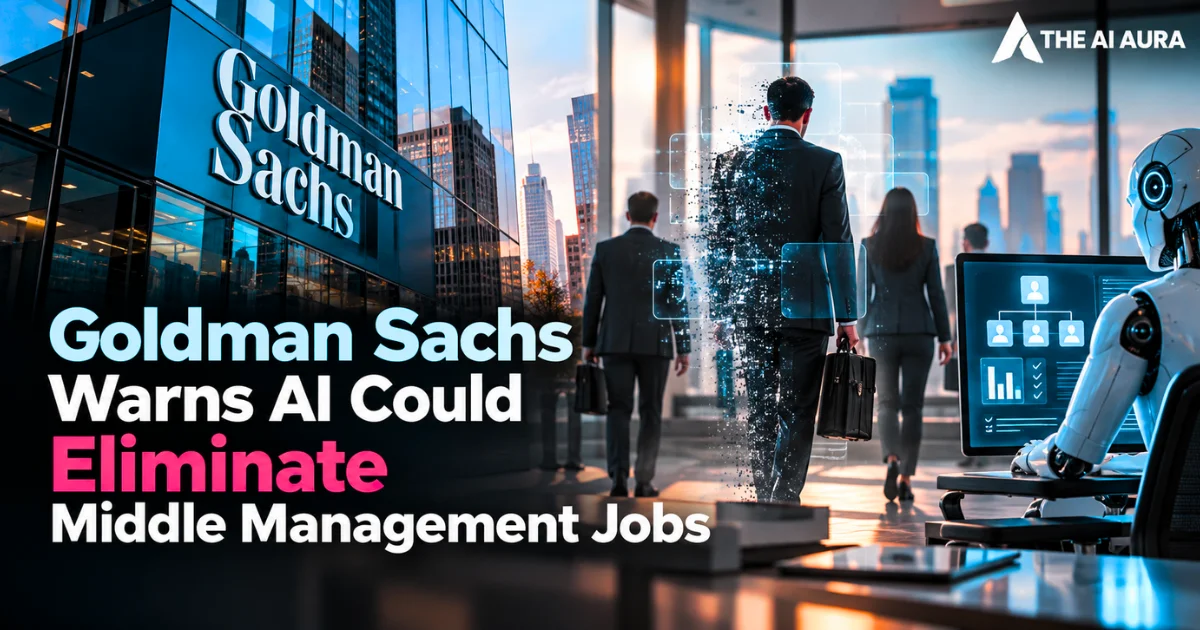

For decades, the financial industry followed a predictable path. Graduates joined firms as junior analysts. They endured years of grueling work before managing teams.
Today, companies are tearing down that traditional corporate ladder. Fresh graduates now skip the waiting period entirely. They step directly into managerial roles on day one. However, they do not supervise human juniors.
They are commanding autonomous software.
This abrupt shift in the labor dynamic has triggered a serious alarm across Wall Street, raising an urgent question about the structural integrity of modern enterprises and the impending obsolescence of a massive professional demographic.
The Collapse of the Corporate Pyramid
Traditional firms once relied on a pyramid model. A wide base of junior staff ground through repetitive data analysis. Meanwhile, layers of middle managers supervised work and reported to executives.
That structure is rapidly breaking down. Kevin Sneader, head of Goldman Sachs’ Asia Pacific operations outside Japan, highlighted this friction. New hires now maximize the output of artificial intelligence agents immediately. Supervisory responsibilities have shifted directly to the front line.
According to a recent market analysis published by NDTV, this transition creates a severe generational challenge regarding how to redeploy existing middle managers.
If the heavy lifting is handled by algorithms and overseen directly by junior staff utilizing prompt engineering and agentic workflows, the traditional middle layer loses its primary operational function.
Goldman Sachs president John Waldron described legacy operations as a human assembly line ripe for automation. Investment partners agree that the old survival ladder is disappearing. The managerial middle ground is shrinking fast.
Redefining the Entry-Level Experience
This technological pivot fundamentally alters what it means to be an entry-level employee in a high-stakes corporate environment. Industry leaders are already calculating that firms will simply need fewer fresh graduates to handle initial analysis, basic modeling, and preparatory document drafting.
The monetary and temporal resources previously spent on training junior staff to perform rudimentary tasks are instead being reallocated into training them as sophisticated AI supervisors.
Regulators and banking officials are already adapting to this reality, recognizing that legacy operations staff must rapidly pivot to become directors of machine output rather than human coordinators.
The traditional rites of passage are vanishing, which leaves a massive workforce gap for those caught in the middle of their careers without highly specialized domain expertise. Yet this systemic disruption is not entirely a narrative of corporate loss.
As the barrier to executing complex operational tasks plummets, the necessity for massive capital to build and scale a business drops alongside it. Individuals entering the workforce now possess the operational leverage of an entire enterprise right at their fingertips.
The corporate middle manager may be facing a severe existential crisis, but the environment for lean, hyper-efficient entrepreneurship has never been more fertile.