
Monthly subscription tiers remain the lifeblood of consumer and small-business AI adoption, functioning as loss-leader gateways that convert casual tinkerers into long-term enterprise customers.
Beneath the deceptively simple $20 to $200 price tags, however, sits an invisible infrastructure of aggressive compute subsidies. Both OpenAI and Anthropic bleed tens of millions of dollars in potential revenue per megawatt to keep these flat-rate tiers alive.
Yet despite operating under similar unit-economic pressures, the actual return on investment delivered to power users has dramatically diverged.
While OpenAI has quietly pulled back on user allowances to protect its operational margins, Anthropic has taken the opposite route, transforming its subscription tiers into an absolute bargain that delivers roughly five times the API-equivalent value of its chief competitor.
Unpacking the Mechanics of Token Limits and API Equivalence
Evaluating the true worth of a subscription plan requires looking past marketing buzzwords and examining the underlying token mechanics.
When you subscribe to a platform, you are essentially purchasing an unstated pool of dynamic credits. Different models, context window thresholds, and token categories such as fresh inputs, cache writes, cache reads, and high-cost output generation deplete that balance at radically different velocities.
Because internal credit deduction rates rarely match public API pricing cards, a subscription’s dollar-for-dollar efficiency fluctuates wildly depending on the specific workload running through it.
According to a detailed reverse-engineering study published by Semi Analysis, measuring real-world limit meters across isolated token workflows reveals that Anthropic plans vastly outpace OpenAI in usable compute.
By tracking how individual prompts for cached reads and lengthy outputs tick the usage meters, researchers demonstrated that Anthropic grants substantially more headroom where it counts.
When running real-world agentic workflows that heavily depend on large context caching and iterative reasoning loops, Claude subscriptions deliver far more output before hitting administrative walls than equivalent ChatGPT tiers.
Diverging Playbooks: Margin Defense vs. Developer Goodwill
The stark value gap becomes undeniable when comparing the daily-driver models that power programmatic development and sustained technical work. While top-bracket reasoning models show comparable exhaustion thresholds on both sides, the mid-tier engines tell a very different story.
Mid-range workhorses like Opus 5.5 on Claude plans consistently deliver roughly five times the API-equivalent dollar value compared to OpenAI’s GPT-6.1 Sol tiers.
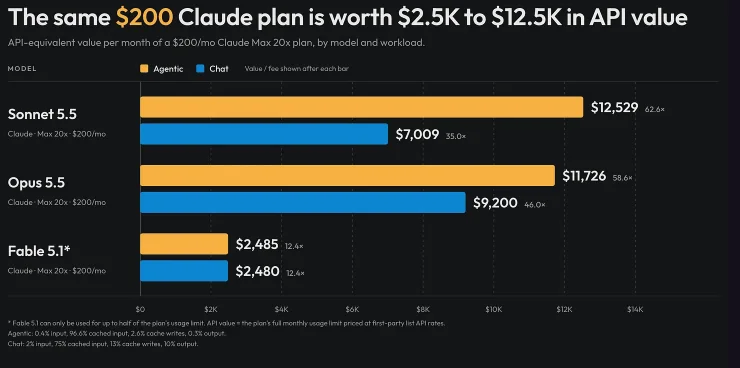
Img source: Semi Analysis
Even if you strip away pricing discrepancies and calculate raw token volumes, Anthropic still maintains an overwhelming volumetric advantage for engineers running heavy, daily multi-turn prompts.
This discrepancy stems from fundamentally conflicting business strategies regarding margin preservation. Subscriptions consume an outsized share of inference compute while contributing a modest slice of total corporate revenue, forcing both labs to engineer ways to reduce subscriber subsidies.
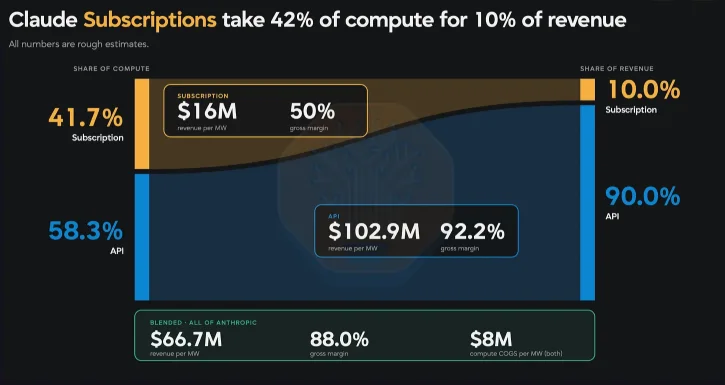
Img source: Semi Analysis
OpenAI recently opted for an abrupt correction, halving the token allowances on its $200 tier, normalizing tokens-per-dollar across its premium brackets, and introducing an expensive $500 tier to capture heavy enterprise usage.
Anthropic, by contrast, has protected its core developer goodwill. Rather than cutting daily driver limits across the board, Anthropic subtly tapers the equivalent value only on its highest-end flagship models while keeping baseline workflows deeply discounted.
For power users and builders deciding where to allocate their monthly budget, Anthropic currently offers an unmatched economic advantage that OpenAI’s revised pricing tiers simply fail to rival.