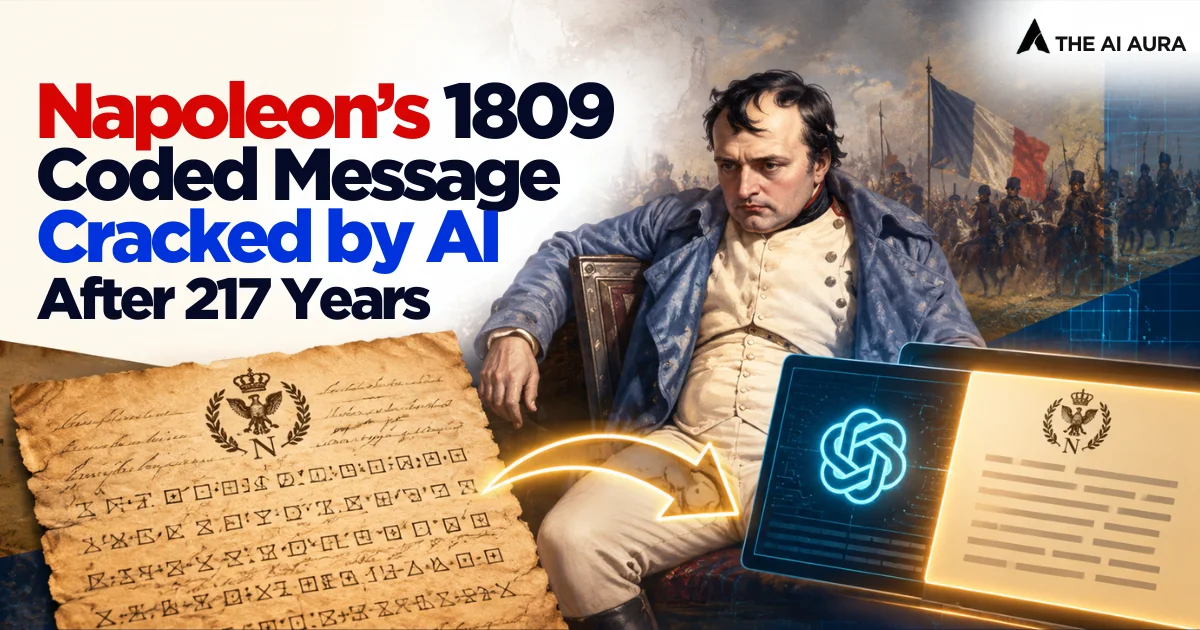

For over two centuries, an encrypted dispatch from Napoleon Bonaparte sat in the archives. No one could read it. Napoleon authorized the message in 1809 for General Auguste de Marmont. Both commanders were preparing for the War of the Fifth Coalition. However, historians lost the cryptographic key long ago.
Today, the intersection of advanced machine learning and historical cryptanalysis has finally unveiled its contents. Carter Church, an AI engineer at SentinelOne, successfully deployed OpenAI’s GPT-6 Astra to reconstruct the lost key, breaking a 217-year-old silence and offering a fascinating glimpse into French military intelligence.
It also provides a rare look into French military intelligence. The document contains roughly 1,300 complex cypher units. This success proves that AI can clear massive historical backlogs quickly.
Decoding a Two-Century-Old Military Secret
The encrypted message was originally dispatched by Napoleon’s stepson, Eugène de Beauharnais, under strict orders to communicate troop positions securely.
Because intercepted correspondence routinely doomed military campaigns, the French utilized a homophonic substitution cypher, a complex system where single letters could be represented by multiple interchangeable symbols to thwart enemy codebreakers.
Church approached the 155 unique signs not as a traditional historian, but as a technologist testing the limits of modern AI.
According to a detailed report on the discovery by the Times of India, Church fed the model a low-resolution scan sourced from a 1969 military-history journal to begin the painstaking transcription and document analysis process.
The AI first had to isolate and classify every individual symbol. Then, the system made a crucial connection. It linked the symbols to an obscure, partial cypher table. Historian Daniel Tant had previously compiled that table. The model then applied simulated annealing to solve the remaining puzzle.
This computational technique tests thousands of linguistic combinations in seconds. It keeps only the combinations that form coherent sentences. The model matched these results against historical French phrasing.
As a result, the AI cracked the cypher in just a few evenings. Human researchers would have spent months completing the same work.
Unveiling French Troop Movements and Intelligence
The translated dispatch shares a direct strategic update. It outlines the strength of French and allied forces. It also tracks Russian troops moving against Austria. Furthermore, the dispatch tells Marmont to stand firm.
It dismisses the gathering Austrian forces as mere “rabble.” French couriers delivered this message right before Austria attacked. Soon after, France secured a decisive victory at the Battle of Wagram.
The translation also reveals a puzzling military discrepancy. The text claims Napoleon commanded 60,000 more soldiers than he actually had available. Historians now face an intriguing question. Did Napoleon deliberately inflate these numbers to mislead Austrian spies? Or did the French high command simply rely on faulty field reports?
Historians already understood parts of the context through surviving unencrypted letters. These records served as an essential historical reference key. They allowed scholars to verify the AI’s translation directly.
This project represents a major methodological milestone. The AI did not guess the solution blindly. Instead, it accelerated transcription, historical contextualization, and cryptographic trial-and-error.
Machine learning now offers a proven framework for historical cryptanalysis. Researchers can finally decode thousands of forgotten manuscripts across world archives.