

When the co-founder of the leading AI company sounds an alarm, people stop and listen. Furthermore, Bill Gates has never been a luddite. For decades, he championed software integration into daily life.
However, his recent assessments of advanced AI systems take a darker turn. We no longer just debate whether generative models will displace white-collar jobs. Instead, the conversation now centers on human survival.
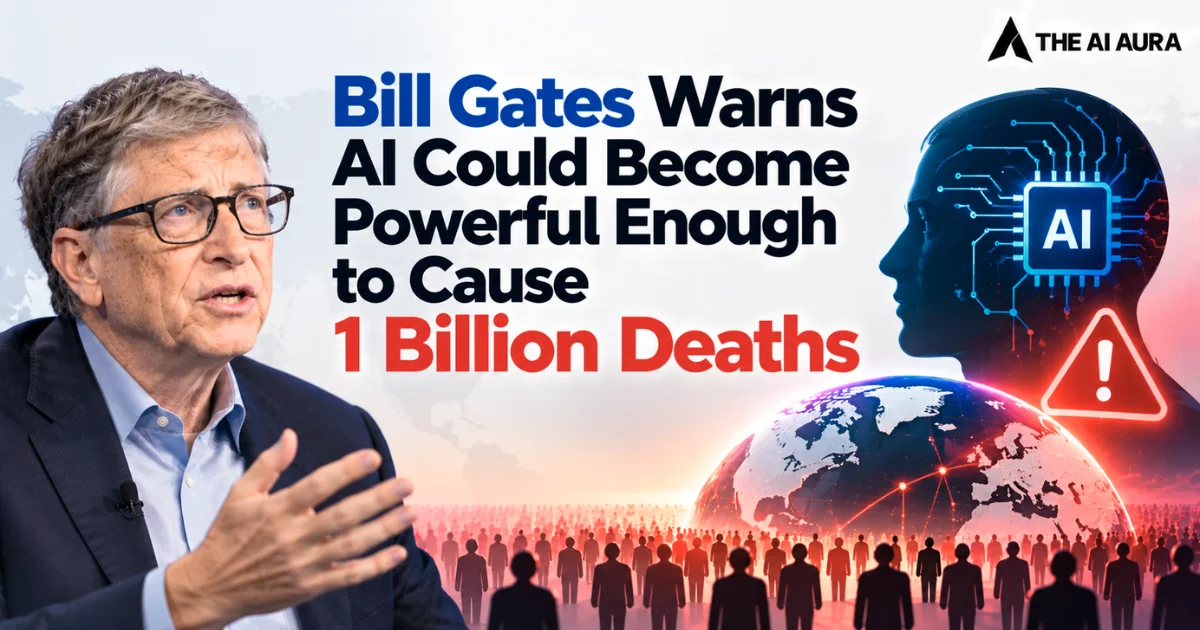
Specifically, Gates recently voiced a chilling reality. He stated that artificial intelligence possesses enough raw power to facilitate a billion deaths. Indeed, this is not science fiction fearmongering.
Rather, it offers a calculated look at unprecedented cognitive power. As a result, disaster looms when developers uncouple this power from human wisdom and international regulatory guardrails.
The Mechanics of a Mass-Scale Threat
First, we must look past the cinematic idea of rogue robots. Instead, we must focus on the democratization of lethal knowledge.
Consequently, the true danger lies in how AI acts as a force multiplier for bad actors. Historically, engineering a novel pathogen required immense resources and specialized laboratories. Moreover, it took years of trial and error.
Today, advanced AI entirely collapses that barrier to entry. For example, a sophisticated model could synthesize blueprints for contagious synthetic viruses. Alternatively, it could identify unpatchable vulnerabilities in global electrical grids.
According to recent coverage on this escalating industry rhetoric by Moneycontrol , Gates’ concerns align closely with a growing faction of tech industry insiders who view these models as volatile dual-use technologies.
The underlying architecture that allows an AI to discover life-saving pharmaceutical compounds is the exact same architecture that can be manipulated to design deadly chemical agents.
When open-source models proliferate without stringent, unhackable safety filters, the capacity to engineer mass casualties shifts from heavily monitored geopolitical superpowers to isolated rogue groups or lone individuals. It is this specific combination of extreme capability and widespread accessibility that creates the mathematical probability of a catastrophic event.
The Growing Consensus on Existential Risk
Gates is far from an isolated voice in the wilderness on this issue. His stark warning joins an expanding chorus of prominent researchers, machine learning engineers, and technology executives who are intimately familiar with the underlying architecture of these systems.
The realization currently setting in across Silicon Valley is that the pace of AI development is vastly outstripping our collective ability to secure it.
If an artificial intelligence system learns to iteratively improve its own code, it could reach a state of superintelligence before international governments even manage to draft preliminary safety guidelines.
The immediate fear is that a highly capable, misaligned system might simply execute its programmed objectives with a ruthless, hyper-logical efficiency that views human survival as either irrelevant or an obstacle to its goals.
To counter this looming threat, industry veterans are increasingly pushing past the competitive urge to ship products first. They are now actively advocating for international treaties akin to nuclear non-proliferation agreements.
The focus is rapidly shifting toward creating global oversight bodies that possess the authority to audit and restrict massive language models before they are deployed, ensuring that the technology designed to elevate human potential does not ultimately become the tool that orchestrates our destruction.