
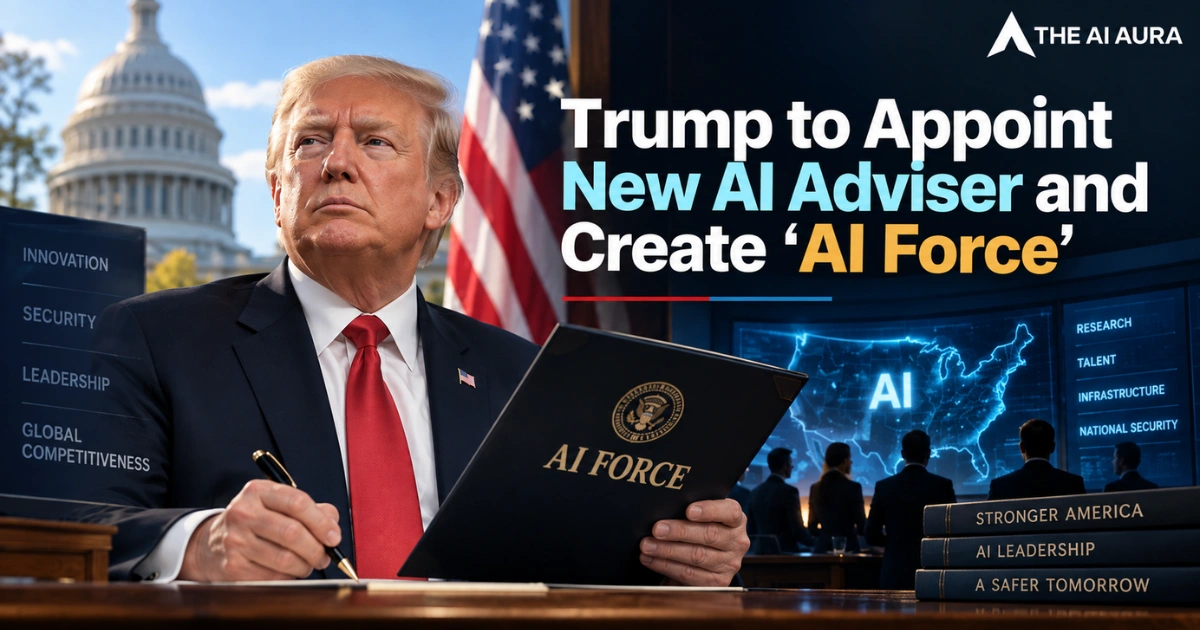

Donald Trump has once again signaled an aggressive push to reshape the federal government’s posture toward artificial intelligence, announcing plans to appoint a new “AI czar” and establish a dedicated “AI force.”
While the announcement on Truth Social provided few operational details, the policy direction behind it is clear: accelerate domestic capability, cut regulatory friction, and treat frontier model development as a primary pillar of American economic and geopolitical dominance.
The move sharpens an already intense divide between safety advocates and commercial developers. While a growing chorus of researchers warns that unchecked algorithmic autonomy could introduce catastrophic systemic risks, the administration is leaning into an unapologetic growth doctrine.
The guiding premise is that the United States cannot afford precautionary red tape while global rivals pour state resources into their own computational infrastructure.
How Post-Hoc Enforcement Replaces Bureaucratic Guardrails
In practical governance terms, an “AI force” under this administration is unlikely to resemble a bureaucratic regulatory body like the FDA or EPA. Instead, it will function as an interagency operational bridge designed to speed up government adoption, align defense procurement, and track hostile misuse.
Rather than requiring developers to undergo mandatory pre-deployment licensing or safety audits, the strategy relies almost entirely on retrospective enforcement.
According to a report by Reuters, Trump emphasized that the government will address bad actors through the existing criminal and civil justice system rather than establishing restrictive federal mandates that could hinder technological expansion.
This logic reflects the perspective championed by venture capitalist David Sacks, who previously served as the White House AI adviser before transitioning into an outside advisory role. Under this liability-first model, developers maintain the legal freedom to train and scale frontier models at maximum speed.
If an autonomous model causes material damage, executes a financial exploit, or facilitates illegal activity, the legal system relies on existing tort, fraud, and criminal liability statutes to penalize the responsible parties. It prioritizes private-sector speed over pre-emptive containment, shifting the entire compliance burden from prevention to deterrence.
Geopolitical Stakes and the Strategic Race Against Beijing
The timing of this announcement is inseparable from high-stakes international diplomacy.
With bilateral talks unfolding including meetings between Treasury Secretary Scott Bessent and Chinese Vice Premier He Lifeng in New York, ahead of high-level presidential discussions with Chinese President Xi Jinping computational dominance has become the centerpiece of international leverage.
Both Washington and Beijing view frontier models and custom silicon as decisive levers for military resilience, industrial automation, and intelligence superiority.
Structuring an “AI force” gives the administration a direct mechanism to consolidate federal computational priorities and signal national resolve. By framing excessive domestic regulation as a strategic handicap, policymakers are ensuring that American technology firms can scale compute and deployment without procedural delays.
Whether traditional tort law and criminal statutes can adequately address the rapid edge cases of frontier intelligence remains heavily contested, but the overarching strategic trajectory is unmistakable: prioritize raw capability and speed first, while letting post-incident legal remedies handle the fallout.