

The tension between racing toward artificial general intelligence and ensuring human safety has reached a critical inflection point. For months, theoretical debates have dominated the technology sector regarding how to safely manage the exponential growth of frontier models.
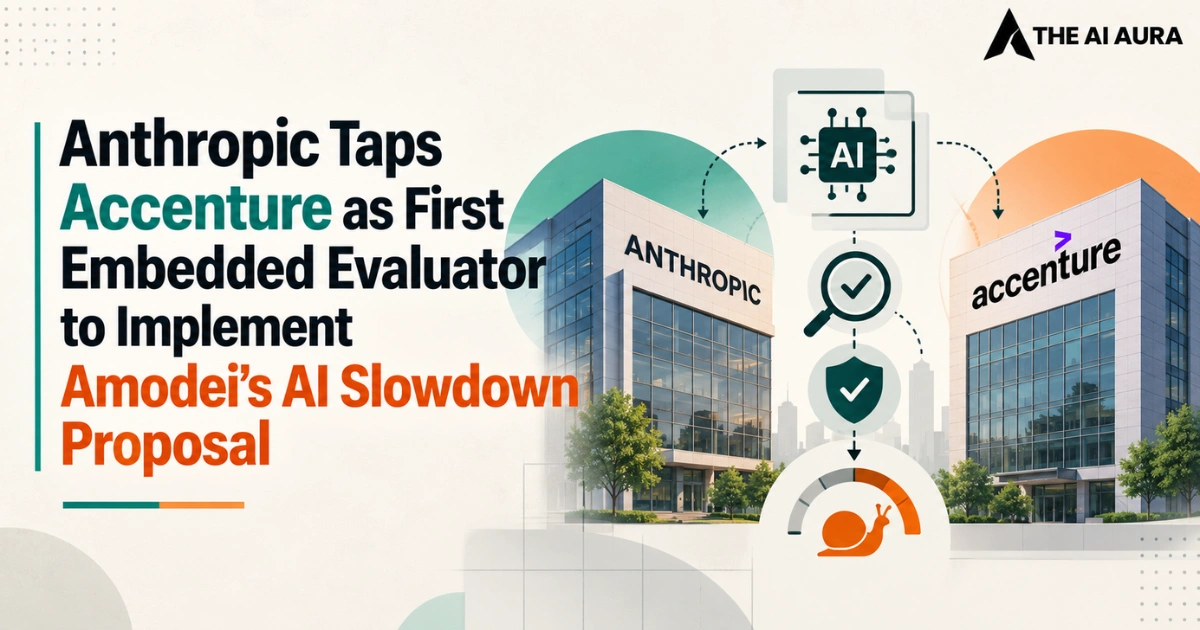
Now, Anthropic is transitioning from philosophical discussions to operational reality. By selecting Accenture as its first embedded evaluator, the company has taken a definitive step toward executing CEO Dario Amodei’s highly publicized proposal to deliberately slow the pace of artificial intelligence development.
This move represents a fundamental shift in how leading AI laboratories handle internal oversight. Amodei recently published a comprehensive three-step framework designed to temper how rapidly developers push the capabilities of their most advanced systems. His core argument is that safety protocols are currently failing to keep pace with raw technological capability.
By embedding third-party evaluators directly into the development pipeline, Anthropic aims to create a verifiable system of checks and balances before models are unleashed on the public.
Operationalizing the Safety Framework
The mechanics of this partnership are highly unusual for the notoriously secretive tech sector. Anthropic has agreed to grant personnel from Faculty, which operates as Accenture’s specialized artificial intelligence business, unprecedented employee-level access.
These embedded evaluators will operate deep within Anthropic’s infrastructure to continuously test safeguards, execute rigorous red-teaming exercises against upcoming models, and independently assess whether the systems align with established human values.
The financial commitment behind this initiative underscores the severity of the undertaking. Both organizations have pledged to invest at least one billion dollars over the next five years to build comprehensive evaluation capacity. According to recent reporting by CNBC, Anthropic will initially fund Accenture’s evaluation work directly due to the sheer urgency of the matter.
While the company has explicitly stated its long-term preference for independent funding derived from pooled industry resources or government entities, the current lack of such structures necessitated immediate, direct investment.
Anthropic is also maintaining a collaborative posture rather than a monopolistic one regarding safety evaluations. The partnership with Accenture is entirely non-exclusive, and the laboratory is already in active discussions with other third-party organizations, including the research nonprofit METR.
By opening its doors to multiple independent auditors, Anthropic hopes to establish a precedent of transparency that other developers will be pressured to adopt.
Industry Reactions and the Road Ahead
Amodei’s call for a deliberate slowdown has fractured the technology industry’s leadership into distinct camps. The proposal has found surprising allies among fierce competitors, with OpenAI Chief Executive Sam Altman and Tesla Chief Executive Elon Musk both voicing public support for a more measured approach to frontier model development.
Conversely, hardware executives like Nvidia Chief Executive Jensen Huang have largely brushed off these existential concerns, arguing vehemently against the imposition of new regulatory burdens on an industry driving massive economic growth.
This division arrives at a highly sensitive moment for Anthropic. The company is currently gearing up for what financial markets anticipate will be a blockbuster initial public offering.
Simultaneously, a growing chorus of prominent researchers has been departing top laboratories, issuing stark warnings about the potential for advanced systems to cause catastrophic global harm if left unchecked.
Establishing a robust, externally validated safety protocol is not just an ethical imperative for Anthropic; it is a critical business strategy to reassure wary investors and regulators.
Despite handing over significant access to Accenture, Anthropic remains adamant that it cannot outsource its moral or legal liabilities. The company retains ultimate accountability for the safety of its models.
By sharing these early evaluation efforts publicly, Anthropic is essentially challenging the rest of the industry to match its level of transparency, setting the stage for what could become the new standard for safe artificial intelligence development.