
Financial markets love a strategic pivot. That is especially true when legacy infrastructure companies join the AI boom. We are seeing that dynamic play out with Nokia right now.
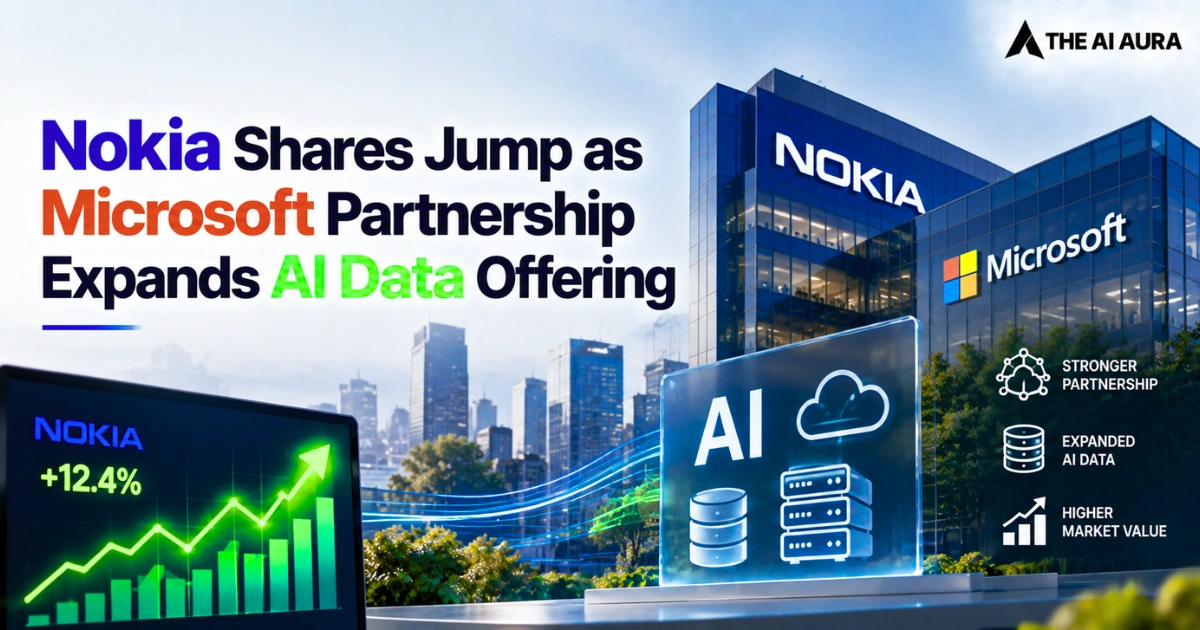
The Finnish telecommunications maker saw its stock jump 6.3 percent to 9.39 euros in European trading. This rally is no fluke. It pushes Nokia’s year-to-date gains to an impressive 70 percent.
The primary catalyst driving investor enthusiasm is a newly expanded partnership with Microsoft, which is designed to radically upgrade the AI data offerings available to global telecommunications providers.
To understand why the market is reacting so bullishly, we have to look under the hood at how modern telecom networks and cloud-based artificial intelligence actually interact.
The Mechanics Behind the Network Integration
For decades, telecom operators have been sitting on an absolute goldmine of network telemetry, latency metrics, and bandwidth utilization data. The enduring problem has always been extraction and processing.
Telecommunications infrastructure is inherently fragmented, making it notoriously difficult to pull raw, unstructured data from cell towers and edge networks and feed it into advanced artificial intelligence models. This is precisely where the expanded synergy between these two tech heavyweights comes into play.
According to a recent market breakdown by The Wall Street Journal, this collaboration focuses heavily on bridging that operational gap by expanding Nokia’s underlying data capabilities and tying them directly to Microsoft’s massive cloud architecture an increasingly critical component in the modern enterprise AI stack and infrastructure.
In practical terms, Nokia is building the intelligent digital pipelines. Their network equipment and software layers are being deliberately optimized to pre-process network data directly at the edge of the network.
Instead of forcing carriers to send massive, expensive dumps of raw information back to centralized servers, the Nokia infrastructure cleans, categorizes, and formats this telemetry on the fly.
Microsoft then takes the baton, utilizing its Azure AI and machine learning environments to ingest this highly structured data stream.
Telecom providers can then deploy Microsoft-powered AI tools to predict network outages before they happen, dynamically reroute bandwidth during peak traffic hours, and automate complex network maintenance protocols.
It effectively transforms passive telecommunications hardware into an active, predictive nervous system.
Shifting the Telecom Revenue Model
The reason institutional investors are pricing Nokia so much higher right now is because this technology fundamentally alters the company’s long-term business trajectory. Selling base stations, radio antennas, and physical 5G hardware is a highly competitive, capital-intensive business with notoriously tight hardware margins.
By partnering with Microsoft to deliver advanced AI data services, Nokia is embracing the shift from traditional software to AI-as-a-Service, successfully transitioning a crucial portion of its operations into high-margin enterprise software and recurring data management services.
The company is proving it is no longer just manufacturing the digital pipes; it is actively managing and monetizing the highly valuable artificial intelligence data flowing through them.
Global telecom operators are currently desperate to reduce their staggering operational expenditures, and AI-driven network automation is the clearest path to achieving those cost reductions.
However, most regional operators completely lack the in-house software engineering talent required to build these sophisticated AI data pipelines from scratch.
By offering a bundled, deeply integrated solution where Nokia handles the complex network data extraction and Microsoft provides the heavy generative AI processing power, the two companies are creating an indispensable telecom product.
Network providers gain immediate access to predictive traffic shaping without having to build bespoke data centers.
For Nokia, this translates to locking major global carriers into their software ecosystem for years, securing the kind of highly predictable, recurring revenue streams that traditional hardware sales alone simply cannot guarantee.