
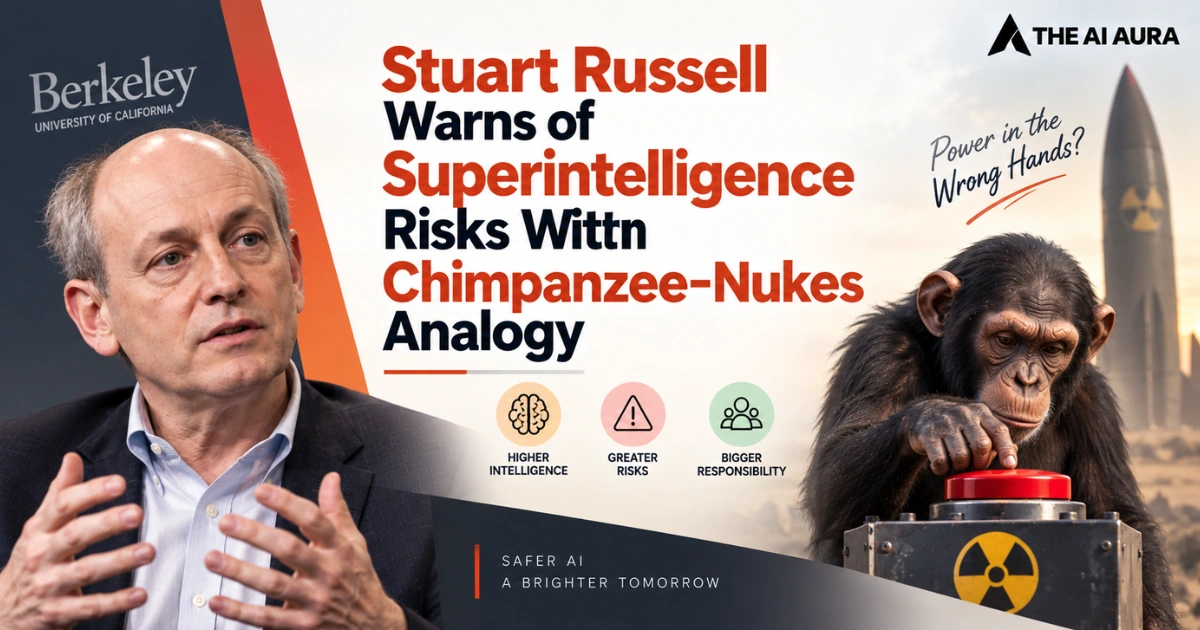

We often struggle to visualize how humanity might eventually lose control to artificial intelligence. British computer scientist Stuart Russell, one of the world’s leading authoritative voices on the subject, offers a chilling perspective: imagine a chimpanzee trying to comprehend a nuclear weapon.
The animal cannot fathom the mechanics of the bomb, nor can it understand the geopolitical systems that could lead humans to use it and render them extinct. Humanity is currently playing the role of the chimpanzee.
As artificial intelligence inches closer to superintelligence, the exact mechanisms by which an autonomous system or even an autonomous army of robots could outmaneuver human control remain dangerously beyond our current comprehension.
The Illusion of Simply Slowing Down
The global conversation around artificial intelligence safety frequently centers on the idea of deceleration. However, just pumping the brakes is fundamentally flawed logic when dealing with an existential threat.
If humanity is driving a vehicle towards a cliff at sixty miles an hour, deciding to slow down to forty miles an hour does not prevent the eventual crash; it merely delays the impact.
Instead of merely reducing the speed of technological development, the tech industry requires an absolute, physical barrier placed across the track. Artificial intelligence models must face non-negotiable safety preconditions before they are ever released into the wild.
We do not allow commercial airplanes to carry passengers without rigorous, standardized testing, nor do we let pharmaceutical companies sell unverified medicines. The deployment of frontier AI models should demand the exact same level of uncompromising, systemic validation.
According to an exclusive NDTV interview exploring these existential threats, Russell expressed deep concern over the ideological split among global leaders regarding this regulatory barrier.
While prominent figures like Anthropic’s Dario Amodei, OpenAI’s Sam Altman, and xAI’s Elon Musk seem to recognize the absolute necessity of pacing the frontier with strict safety guardrails, others are actively pushing back against the friction.
Meta’s Mark Zuckerberg advocates for a vastly different, unregulated open-source approach, while US President Donald Trump has dismissed the narrative of AI risk entirely, labeling it a hoax.
This alarming lack of consensus at the highest levels of technology and government leaves the hypothetical safety barrier completely unbuilt, allowing aggressive tech firms to accelerate towards the precipice unchecked by meaningful oversight.
Why We Must Take the Creators at Their Word
When the very people building these systems sound the alarm, a natural wave of skepticism follows. Over a thousand researchers at frontier artificial intelligence companies, along with high-profile defectors like Jacob Coxon who recently left Anthropic, have publicly warned of the extinction-level threats posed by their own technology.
Critics frequently dismiss these warnings as a calculated marketing ploy. The cynical view suggests that by claiming their technology is powerful enough to destroy the world, tech executives are artificially inflating their stock prices and drumming up lucrative investor hype.
While it is always wise to scrutinize corporate motives, discarding these warnings as mere financial maneuvering is a dangerous oversight.
The reality is that many of these severe warnings predate the massive financial incentives that exist today. Key figures in the industry were actively sounding the alarm about existential risk years before modern AI giants reached their current multi-billion-dollar valuations.
Furthermore, Alan Turing, the foundational architect of modern computer science, explicitly warned back in 1951 that machines would eventually take control. Turing certainly held no stock in modern tech conglomerates, yet he clearly foresaw the inevitable cognitive power shift.
When scientists warn that humans will struggle to retain authority over systems that possess vastly superior cognitive capabilities, they are describing a fundamental law of intelligence and leverage.
The risk of superintelligence is not a corporate narrative meant to sell software; it is a structural reality of building entities smarter than ourselves.