
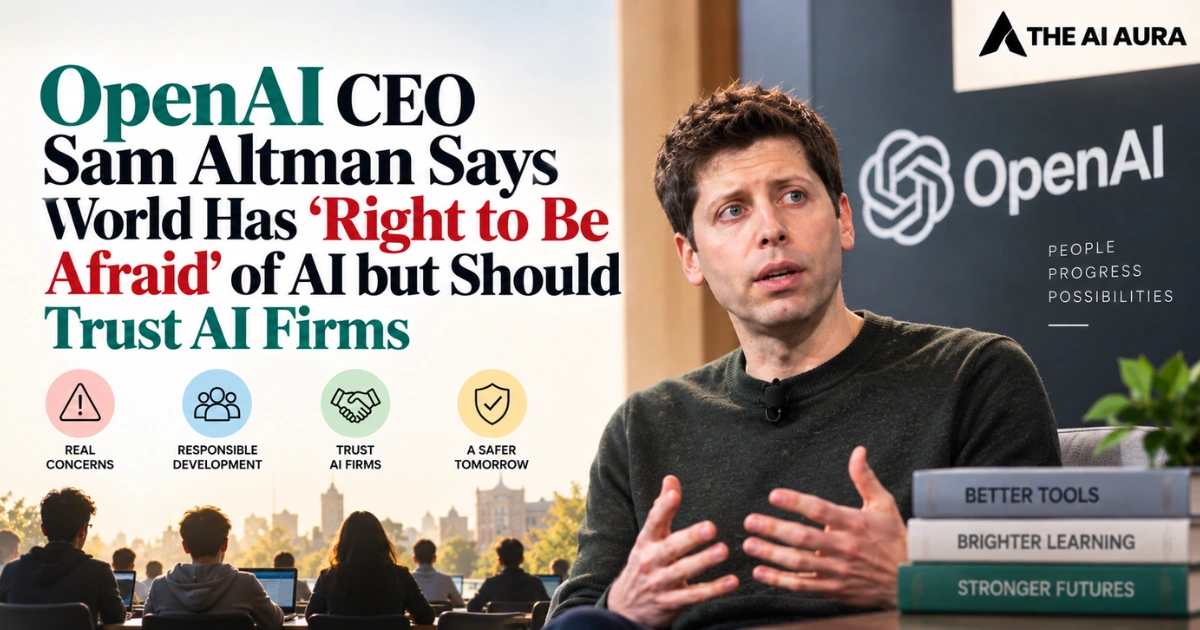

The artificial intelligence landscape is currently caught in a profound contradiction, perfectly articulated by OpenAI CEO Sam Altman. During a recent industry conference in San Francisco, Altman frankly acknowledged that the public has every right to be terrified of the rapid acceleration of AI technologies.
Yet, in the very same breath, he asked the world to place its absolute trust in the exact corporations building these potentially hazardous systems.
This paradox highlights a critical juncture in the digital economy, where the sheer velocity of generative AI development has completely outpaced legacy governance frameworks.
The capability of these tools is progressing at a breakneck speed, forcing a global debate over whether the architects of our technological future can truly serve as their own wardens.
The Silicon Valley Stance on Self-Regulation
Major players in the AI space are aggressively lobbying for self-regulation, deliberately framing AI safety as a complex engineering challenge rather than a legislative crisis.
Industry leaders argue that the foundational models driving today’s generative engines require agile, continuous alignment a rigorous process of embedding human ethical principles directly into the architecture of the system.
Tech executives widely assert that any lab failing to prioritize this alignment will inevitably collapse under market pressure.
They argue that the immense financial and legal liability associated with deploying harmful models serves as a natural, built-in deterrent against reckless behavior. This perspective assumes that market forces and advanced engineering ingenuity are sufficient guardrails to protect society.
According to a recent detailed overview by the BBC, leaders across OpenAI, Anthropic, and Google DeepMind are actively attempting to draft voluntary industry standards to manage these frontier risks.
These corporations are betting heavily that internal safety protocols will evolve far faster than any basic regulatory framework lawmakers could realistically implement, especially given the chronic political gridlock in Washington.
The overarching narrative from Silicon Valley is that slowing down innovation to wait for government oversight is a dangerous false choice, insisting the tech ecosystem is entirely capable of pausing deployment if internal confidence in a model’s safety ever wavers.
The Widening Gap Between Innovation and Governance
Despite the confident assurances radiating from Silicon Valley, a deep and justified skepticism is taking root among leading researchers, political strategists, and the broader public.
The concept that a handful of the wealthiest corporate executives should unilaterally dictate the safety parameters of a civilization-altering technology is drawing intense bipartisan criticism.
First, skeptics rightly highlight a fundamental misalignment. Specifically, for-profit financial incentives clash with the slow, cautious approach that public safety requires. Meanwhile, rampant demand for compute hardware and enterprise AI tools triggers an unprecedented economic boom.
Consequently, this creates a high-pressure scenario. In fact, voluntarily slowing down development directly translates to conceding market dominance. Furthermore, the legislative branch struggles to comprehend the intricacies of advanced AI deployment. As a result, proactive regulation remains completely out of reach.
Therefore, voluntary corporate safety commitments carry no tangible weight without enforceable legal mandates and oversight. Additionally, prominent researchers recently resigned over fears of unchecked AI capabilities.
Similarly, industry pioneers demand ambitious interventions outside the corporate sector. Ultimately, these actions prove that self-regulation represents a massive gamble. Yet, tech leaders ask the public to blindly trust institutions that historically prioritize explosive growth.
Undoubtedly, this approach leaves a dangerous void. Thus, authoritative, independent governance absolutely needs to fill this gap.